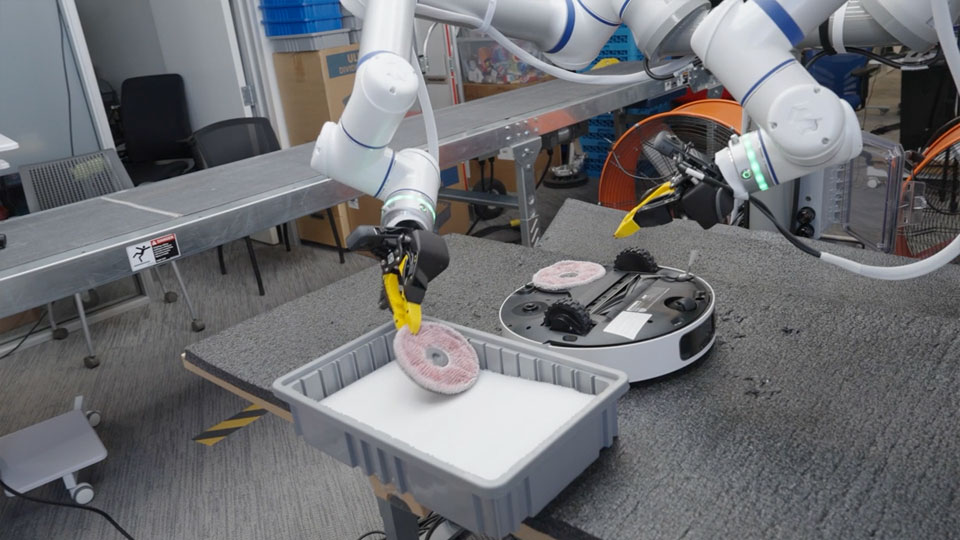
Redefining Industrial Robotics with Learned Physical Intelligence
The evolution of artificial intelligence in manufacturing and metrology has long been defined by advances in perception, computation, and automation. Today, a new milestone is emerging—one that shifts the conversation from programmed automation to learned physical intelligence. The introduction of GEN-1, a general-purpose multimodal AI model for robotics, signals a potential inflection point for industrial applications.
GEN-1 is being positioned as the first system to cross a critical performance threshold – mastery of simple physical tasks. With reported success rates approaching 99%, execution speeds up to three times faster than prior state-of-the-art systems, and minimal task-specific data requirements, the implications for metrology-driven manufacturing environments are significant.
From Automation to Generalist Physical Intelligence
Traditional industrial robotics has relied on deterministic programming—precise, repeatable, but inherently rigid. These systems excel in controlled environments but struggle with variability, limiting their flexibility in modern production ecosystems where customization and rapid change are the norm.
GEN-1 represents a departure from this paradigm. Built as a large multimodal model capable of real-time action generation, it integrates perception, reasoning, and motion into a unified system. Rather than executing predefined instructions, it learns tasks and adapts dynamically to new environments.
This shift mirrors the trajectory seen in large language models, where scaling data and compute unlocked emergent capabilities. In robotics, this transition marks the move into a pretraining era, where generalized knowledge can be transferred across tasks and domains.
Scaling Laws Come to Robotics
A defining feature of GEN-1 is its foundation in scaling laws – principles that have underpinned the success of modern AI systems. Earlier work with GEN-0 demonstrated that increasing data and computational resources leads to consistent improvements across multiple robotic tasks.
GEN-1 builds on this foundation through expanded datasets exceeding 500,000 hours of real-world interaction, combined with advances in multimodal architectures, reinforcement learning from experience, and improved inference-time optimisation. A particularly notable aspect is its efficiency: the system achieves high performance using approximately one hour of robot-specific data per task. This represents a significant reduction in the data burden typically associated with robotic training and is highly relevant for industrial environments where data acquisition is both costly and time-intensive.
Redefining ‘Mastery’ in Robotics
A key contribution of GEN-1 is its reframing of how performance is evaluated. Rather than focusing solely on accuracy, the model introduces a broader definition of mastery that combines reliability, speed, and improvisation.
Reliability refers to the ability to consistently and repeatedly execute tasks over extended periods. GEN-1 demonstrates this through sustained performance across activities such as kitting components, packaging items, and executing assembly-like operations with success rates exceeding 99%.
Speed is considered not just in terms of motion, but in overall task completion time. This distinction is important in industrial settings, where throughput is critical. GEN-1 reportedly completes tasks up to three times faster than previous systems, addressing one of the longstanding barriers to deploying general-purpose robotics.
Improvisation introduces a new dimension to robotic capability. It reflects the system’s ability to respond to unexpected changes and recover from errors without predefined instructions. This capacity for adaptation has historically been a major limitation in robotics, particularly outside tightly controlled environments. For metrology applications, where variability is inherent, such flexibility is especially valuable.
Implications for Metrology and Quality Control
The emergence of GEN-1 has direct implications for metrology-driven manufacturing processes, particularly those requiring both precision and adaptability.
In inline inspection, robots equipped with generalist intelligence could dynamically modify measurement strategies in response to part variation or environmental conditions. This would reduce reliance on rigid programming and enable more responsive quality control systems.
As production environments shift toward high-mix, low-volume manufacturing, the ability to generalise across tasks becomes increasingly important. GEN-1’s learning-based approach allows it to handle a broader range of components without extensive reconfiguration, making it well suited to flexible production lines.
The reduced dependency on task-specific data also has significant practical benefits. Faster deployment cycles mean new inspection or assembly processes can be implemented more quickly, improving overall operational agility.
Another notable aspect is the model’s reliance on human-derived data collected through wearable devices rather than traditional teleoperation. This approach provides a scalable method for capturing human expertise and translating it into robotic capability. For metrology, where skilled operators play a critical role, this could facilitate the transfer of tacit knowledge into automated systems.
A New Data Paradigm
One of the more disruptive elements of GEN-1 lies in its training methodology. Instead of relying heavily on robot-generated data, the system is pretrained using large volumes of human activity data. This reduces the need for expensive and complex data collection processes typically associated with robotics.
By leveraging wearable technology to capture real-world human interactions, the model gains exposure to a diverse range of scenarios. This diversity enhances its ability to generalise and adapt, which is essential for real-world deployment.
For the metrology sector, this opens up new possibilities for encoding complex inspection techniques and workflows that have traditionally been difficult to automate.
System-Level Innovation
GEN-1 should not be viewed solely as a standalone model, but rather as a comprehensive system. Its performance improvements are the result of coordinated advances across multiple layers, including pretraining, post-training optimisation, reinforcement learning, multimodal guidance, and inference strategies.
This system-level approach reflects a broader trend in industrial AI, where overall performance is increasingly determined by how effectively different components are integrated and deployed, rather than by model architecture alone.
Commercial Viability: Crossing the Threshold
A central claim surrounding GEN-1 is its transition into commercial viability. Earlier generations of generalist robotics models demonstrated promise but lacked the consistency and efficiency required for real-world use.
GEN-1 appears to bridge this gap by combining high reliability, competitive speed, and low data requirements. While it does not yet address all possible tasks, it establishes a clear pathway toward broader industrial adoption.
The Road Ahead: Toward Physical AGI
Despite its advances, GEN-1 is not a complete solution. Many complex and multi-step tasks remain beyond its current capabilities. However, it provides a strong indication that continued scaling of data, compute, and learning techniques will yield further progress.
The concept of physical artificial general intelligence – systems capable of performing a wide range of real-world tasks with human-like adaptability – remains an ambitious goal. Nevertheless, GEN-1 demonstrates that meaningful steps are being taken in that direction.
Shift in How Physical Processes can be Automated and Optimised
For the metrology community, GEN-1 represents more than just another technological development. It signals a broader shift in how physical processes can be automated and optimised.
By combining reliability, speed, and improvisation within a highly data-efficient framework, it challenges traditional assumptions about the limitations of robotics. As these capabilities continue to evolve, their integration into inspection, quality control, and manufacturing workflows has the potential to significantly reshape precision engineering.
The transition from programmed automation to learned physical intelligence is now underway, and its implications for metrology are likely to be far-reaching.
For more information: www.generalistai.com