Metrology’s Role in Optimising Takt Time
Inspection belongs at the point of manufacture. By moving measurement closer to the machining process and by using rapid, robust systems, manufacturers can meet tough takt time targets, reduce scrap and improve process capability — without inflating costs.
 In high-value manufacturing, the specification for new parts is defined long before the first billet is clamped, complete with tolerances for every critical feature. The challenge is to achieve those tolerances repeatedly while shortening the overall cycle time and lowering the cost per part. Traditional inspection can become a bottleneck, sometimes taking longer than the machining that creates the features themselves. Aligning metrology with production, and designing for a consistent, universal takt time across operations, enables a steadier flow through the factory and earlier decisions based on real-time data.
Balancing Flow, Cost and Capability
Bottlenecks accumulate parts, starve downstream stations, and inflate lead times. Adding resources at a choke point often shifts the constraint elsewhere and increases overheads. A better approach is to plan every operation, including loading and unloading, to meet a universal takt time. Where predicted cycle times exceed that ceiling, processes can be split or duplicated; however, each added station increases capital expenditure and maintenance. The priority, therefore, is more efficient operations that preserve capability while cutting wasted time.
Metrology’s Role in Optimising Takt Time
 Inspection serves three purposes: proving out a new batch, checking parts mid-route, and verifying dimensions for conformance records. Each touchpoint is an opportunity to save time.
Established production may adopt sampling strategies, provided nothing changes that could degrade accuracy, such as tool changes, fixture changes, or operator hand-overs. On complex components, it may be sufficient to verify the first and last features cut with a common tool, assuming a stable process between those points. For mixed or lower volumes, rapid shop floor systems provide fast, consistent results without long transfers or thermal stabilisation delays.
Why the Shop Floor is the Right Place to Measure
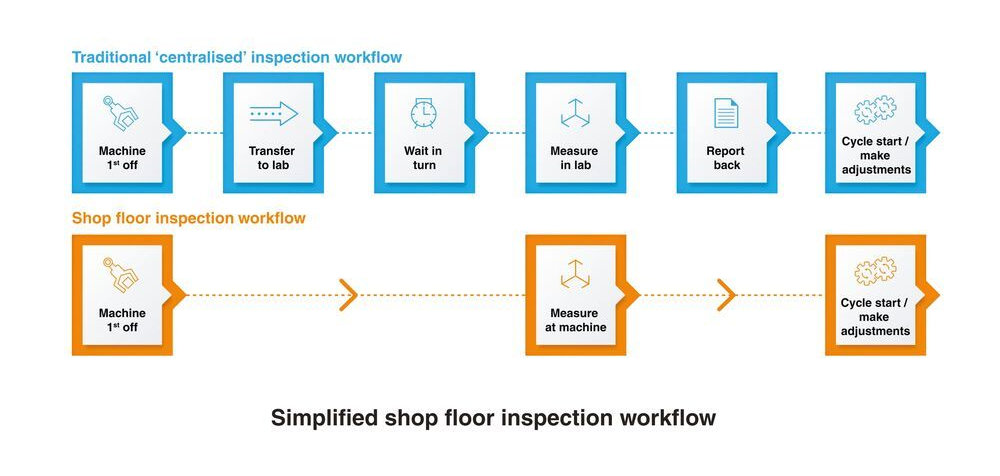
Near-machine inspection eliminates travel to a central laboratory, avoids queues, and delivers results while the part is still at the source operation. Modern inspection equipment is engineered for thermal variation and air-borne contaminants, ensuring traceable, repeatable data in real conditions. This brings inspection into the same takt time framework as machining, supporting faster feedback, and earlier corrections.
This article focuses on off-machine measurement solutions positioned at, or near, the point of manufacture. On-machine probing and in-cycle verification offer further upstream opportunities for process improvement and are beyond the scope of this discussion.
Renishaw Shop Floor Inspection Solutions for Faster Cycles
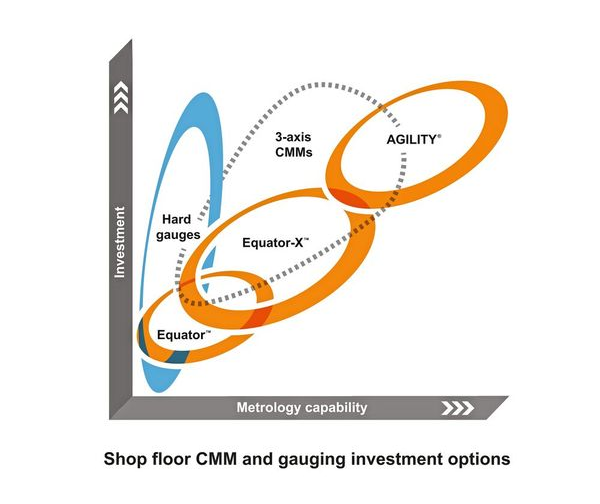
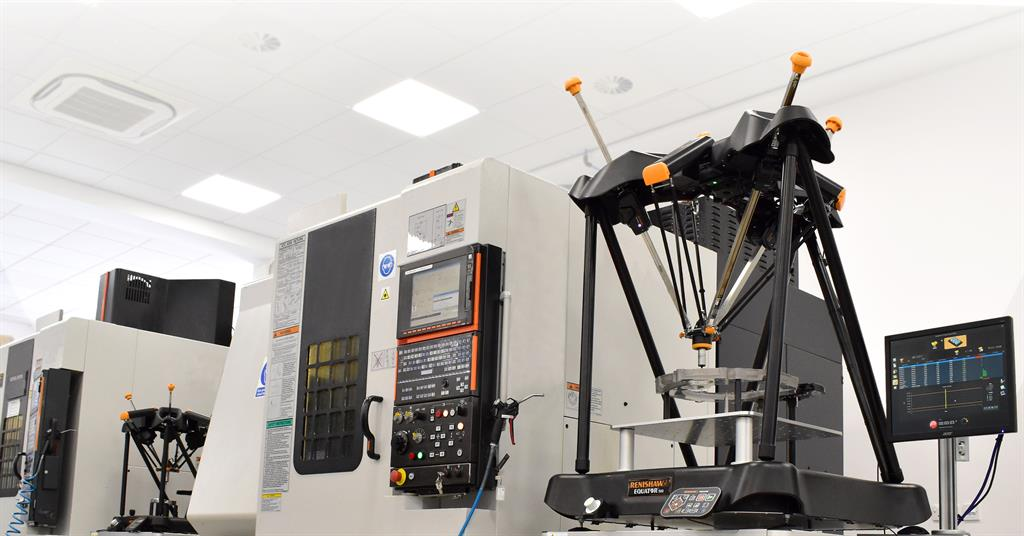 For high volumes of similar parts, the Equator gauge functions as a reprogrammable comparator that rapidly verifies critical features. Once calibrated against a master part measured on a CMM, the Equator system delivers fast results at scanning speeds up to 250 mm/s, with automatic prompts to remaster when ambient temperature shifts exceed 2 °C. The platform is well suited to long runs, robot loading and single-feature checks, and can be top-mounted to minimise footprint and integrate with automated handling cells.
Equator-X Dual-Method Gauge
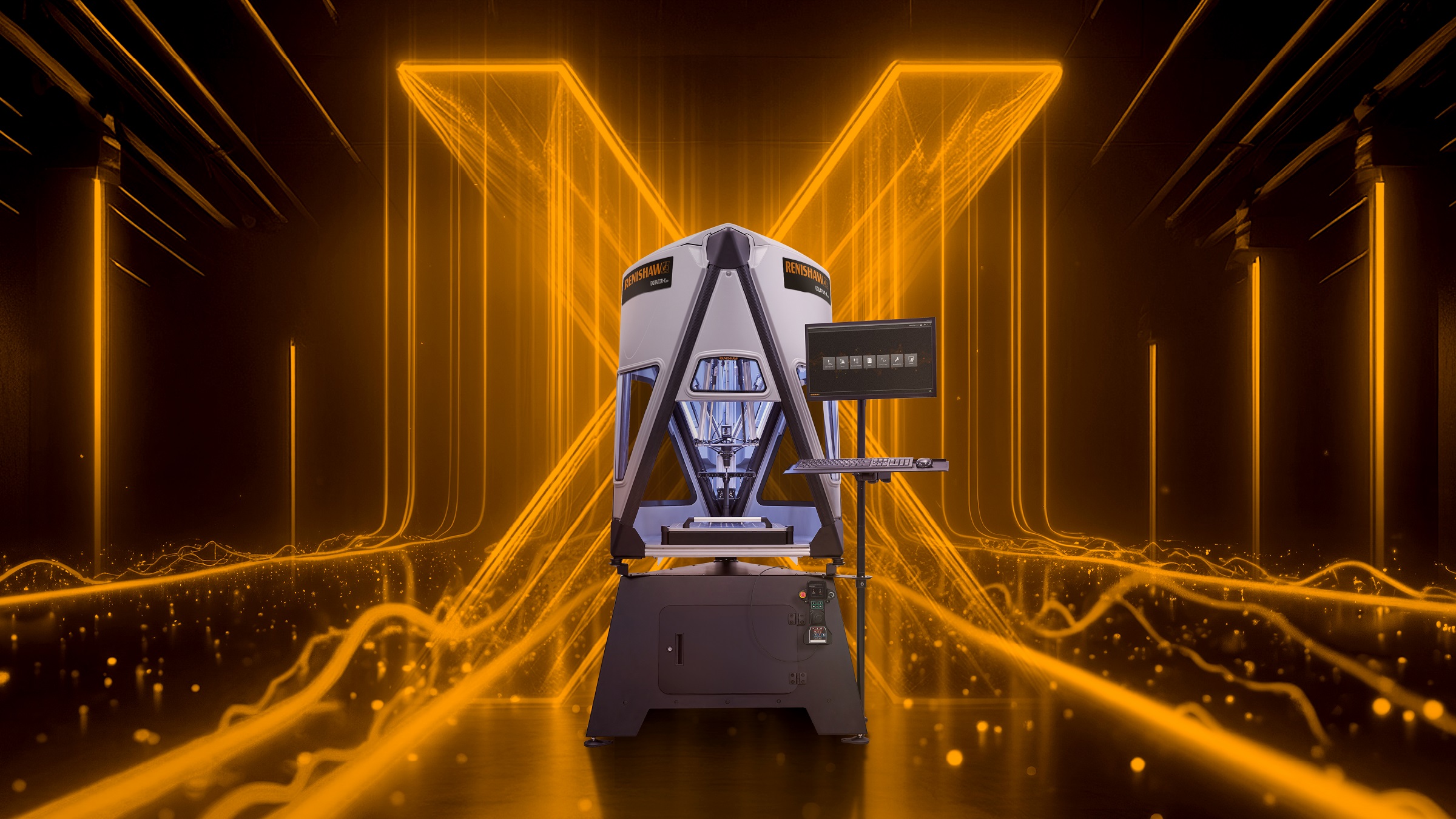
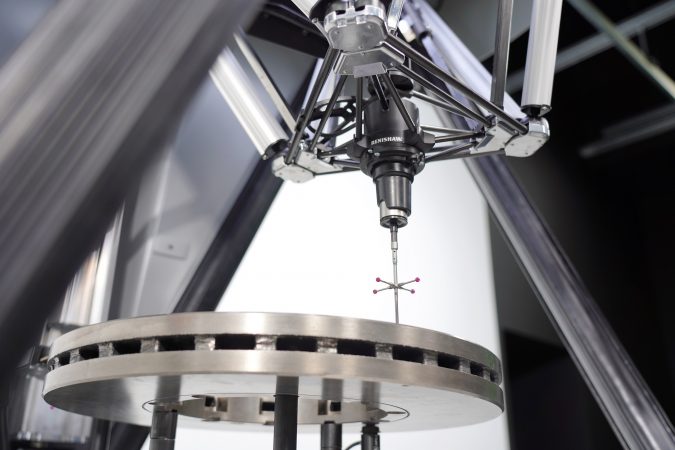
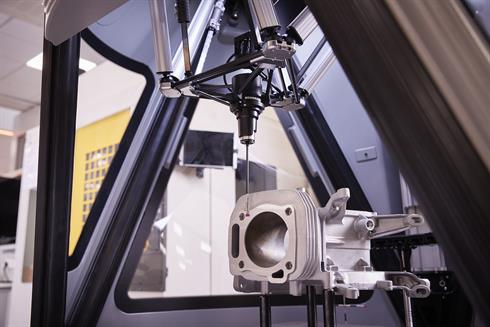 The new Equator-X gauge extends the Equator gauging concept by offering two operating modes. In Compare mode, it delivers comparator-style speed and repeatability with an even stiffer structure for higher acceleration. In Absolute mode, it measures like a CMM without the master-compare stage, enabling rapid inspection for one-offs or high-mix production. An innovative carbon-fibre hexapod drive and measurement architecture provides exceptional rigidity under high g-forces, maintaining accuracy while achieving remarkable inspection speeds — up to 250 mm/s and as much as 50 times the surface-scan rate of traditional 3-axis CMMs.
AGILITY S Shop Floor CMMs with REVO 5-axis Measurement
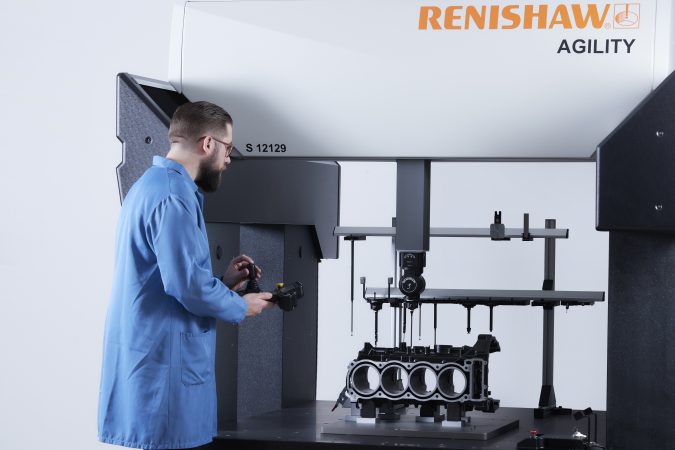 When flexibility and breadth of capability are paramount, the AGILITY S range of co-ordinate measuring machines combines a robust shop floor CMM platform with REVO 5-axis technology. The system is designed for high-performance scanning and automatic switching between contact and non-contact sensors, including surface finish measurement. Available machine sizes span from X 700 mm, Y 900 mm, Z 600 mm to X 2,000 mm, Y 4,000 mm, Z 1,600 mm, supporting a wide spectrum of part envelopes.
The REVO system enables infinite positioning with synchronised 5-axis motion, dramatically reducing repositioning overheads and enabling continuous surface data acquisition. Multi-sensor and stylus change capability provide the right tool for each feature with reach up to 800 mm for deep-cavity or large-form parts. In production environments, the combination of 5-axis motion and linear motors has demonstrated low maintenance requirements and high uptime, supporting sustained throughput with immediate feedback to up-stream CNC operations.
From Centralised Inspection to Near-Machine Measurement
Migrating from a centralised inspection room to shop floor systems removes non-productive time: there is no transfer queue, no waiting for parts to stabilise to 20 °C and no backlog at a single metrology resource. Results are available sooner, enabling faster offset decisions and preventing the accumulation of rework at downstream stages.
Closing the Loop: Intelligent Process Control
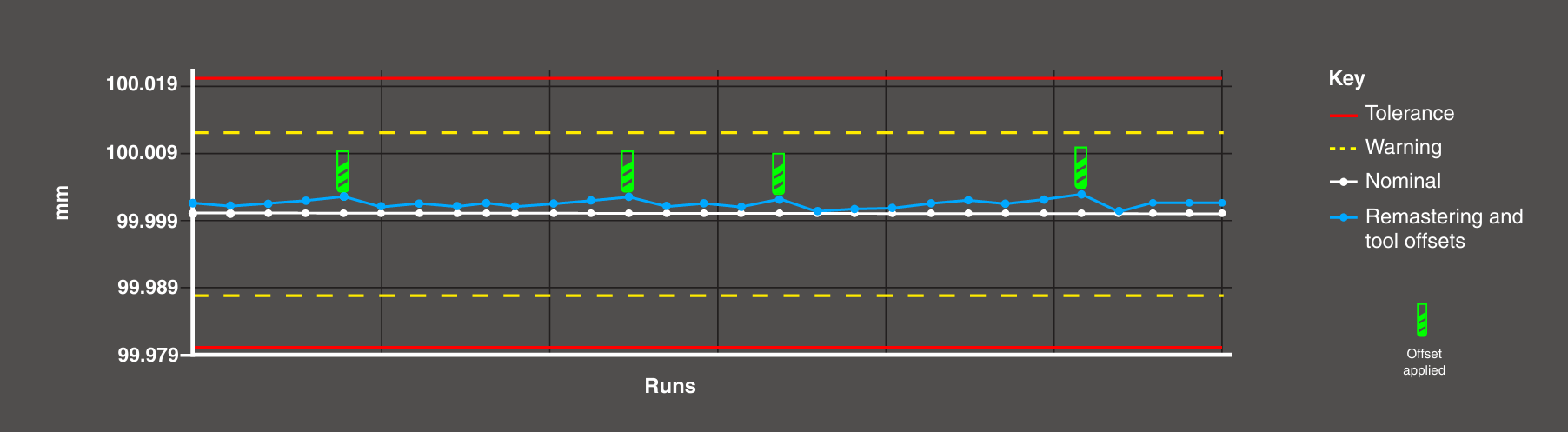
Inspection adds cost when treated as a standalone activity. Its true value emerges when measurement feeds the process. By comparing empirical part data to nominal tolerances, systems compute tool offset corrections and convey them to the CNC controller in real time. Subsequent parts move closer to target, and periodic updates counter gradual drift from tool wear and thermal cycling. This closed-loop approach, often referred to as intelligent process control, supports tighter capability, improves statistical stability, and prevents out-of-tolerance conditions before they occur.
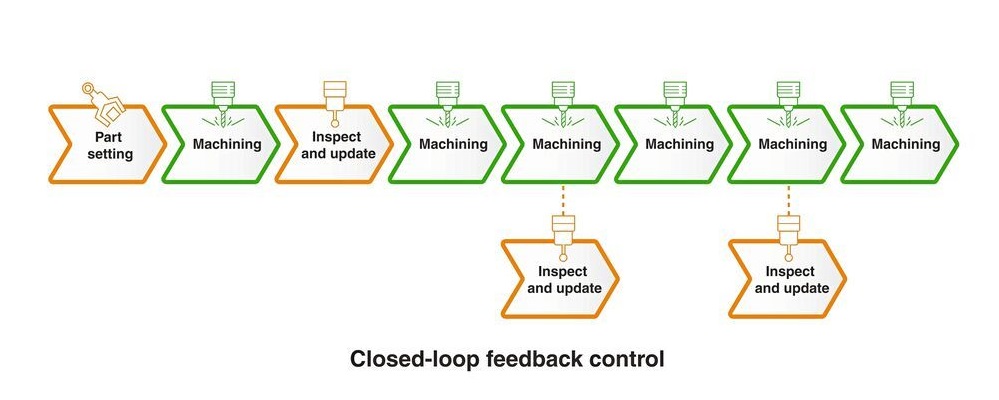
In mature lines with proven capability, near-machine measurement may primarily confirm tool integrity and monitor daily thermal effects, maintaining compliance without measuring every feature on every part.
Achieving a Sub-10-Second Takt Time in an EV Stator Line
An automotive manufacturer producing electric motor stators required 100% inspection to ensure that out-of-tolerance components would not be paired with compliant parts in final assemblies. With takt time below ten seconds, a Renishaw Equator system was integrated directly into the production line with automated loading and measurement. The system acts as an effective gatekeeper, preventing non-conforming parts from advancing and protecting downstream assembly yield.
By delivering immediate pass/fail results at the point of manufacture, the solution eliminates transfer delays, reduces scrap, and supports continuous flow.
In plants adopting automation strategies, Renishaw’s Equator systems with top-mount configurations can be combined with robot handling to save floor space, and automated guided vehicles to position parts and fixtures at the machine, further aligning inspection with the line’s takt time.
Connected Metrology for Smart Factories
To sustain high productivity, inspection platforms must deliver predictable up-time and robust performance in real-time shop floor conditions. Systems should cover tactile and non-contact measurement, and surface finish analysis within a single framework, and be readily reprogrammable to support a variety of parts and frequent changeovers. When integrated with manufacturing execution and CNC controls, metrology can provide closed-loop feedback and analytics that stabilise processes and enable lights-out operation.
Aligning Metrology with Production Flow Turns Inspection Into a Source of Value
Aligning metrology with production flow turns inspection into a source of value. By deploying shop floor measurement systems that are fast, reliable, and tightly integrated with CNC controllers, manufacturers can meet takt time commitments while improving capability and reducing scrap.
Renishaw’s Equator gauging systems, and AGILITY CMM solutions are proven in near-machine metrology across aerospace, automotive, consumer electronics and precision engineering. Their ability to couple rapid inspections with process control supports tough takt time targets and reduces total manufacturing cost.
For more information: www.renishaw.com