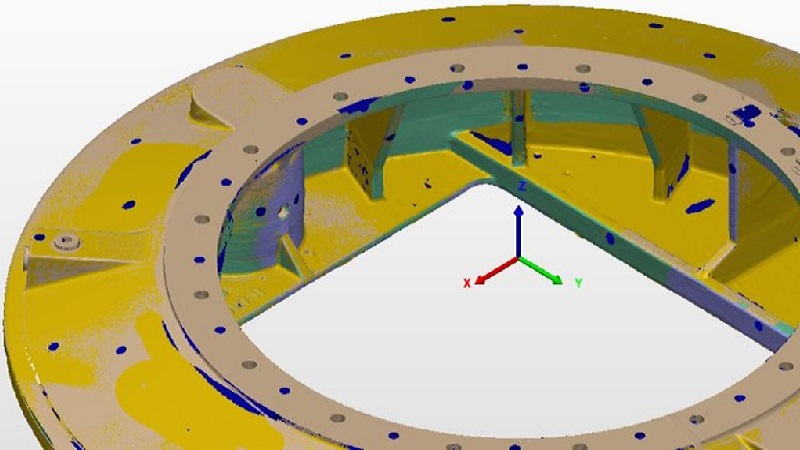
Large-Scale 3D Metrology Enables Reconstruction of Critical Agitation Component
Buffalo Metrology was recently tasked with reverse engineering an 8-foot outside diameter clarifier cover used in a mixing and agitation application. The project centered on evaluating a fracture along the tapered face of the component and capturing the dimensional data required to support a potential new fabrication.
Clarifier agitators play a critical role in groundwater and wastewater treatment processes. Installed within tanks and basins, these systems facilitate separation by enabling solids such as sludge and scum to settle or float for removal. The clarifier cover serves as a key structural and alignment component within the agitation assembly, ensuring proper bearing positioning and weld integrity under load.
Assessing the Damage
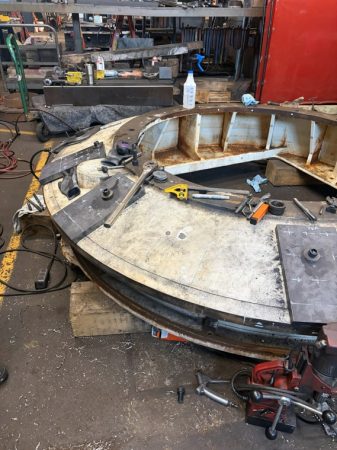 Inspection revealed a fracture along the top tapered surface of the clarifier cover. While a metal locking repair service is currently being performed to restore short-term functionality, the extent of the damage prompted consideration of a fully fabricated replacement.
The customer required detailed inspection data to recreate the original bearing alignment and weld placements. Because legacy drawings were unavailable, reverse engineering through 3D scanning and digital inspection became essential.
High-Resolution 3D Scanning in a Single Day
The on-site scanning phase was completed in a single day, capturing comprehensive geometry of the 8-foot structure. Weeks of engineering analysis followed, as Buffalo Metrology’s team processed and evaluated the scan data.
All data acquisition was performed using the Shining 3D FreeScan Trak Nova, a portable optical 3D scanning system well-suited for large-scale industrial components. Multiple overlapping scans were collected and merged to create a unified, high-resolution digital model of the clarifier cover.
Inspection and Data Analysis with PolyWorks
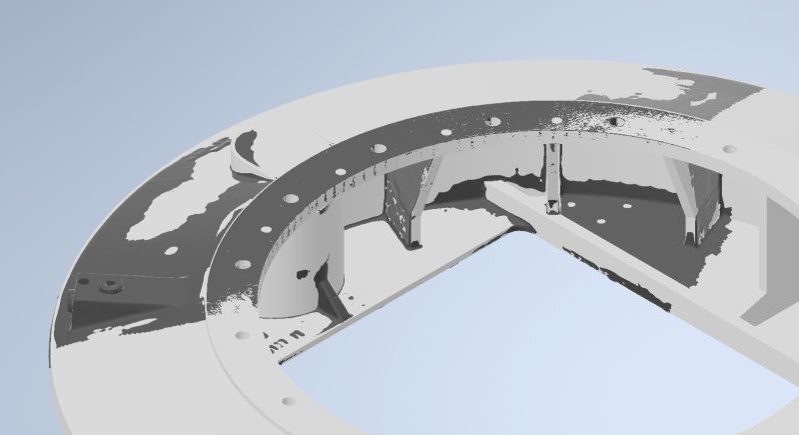
Using multiple scan datasets, engineers overlaid large mesh files to extract critical measurements, including:
-
Bearing alignment geometry
-
Weld seam locations
-
Tapered surface profiles
-
Structural support placements
The digital inspection process enabled Buffalo Metrology to identify deviations, confirm dimensional relationships, and capture all features required for reconstruction. This workflow ensured traceable measurement data to support fabrication decisions.
From Scan to Nominal CAD Model
With a validated scan model established, Buffalo Metrology’s engineering team developed a fully parametric 3D CAD model. Every inspected dimension from the scan dataset informed the creation of a nominal model — effectively reconstructing the original design intent of the clarifier cover.
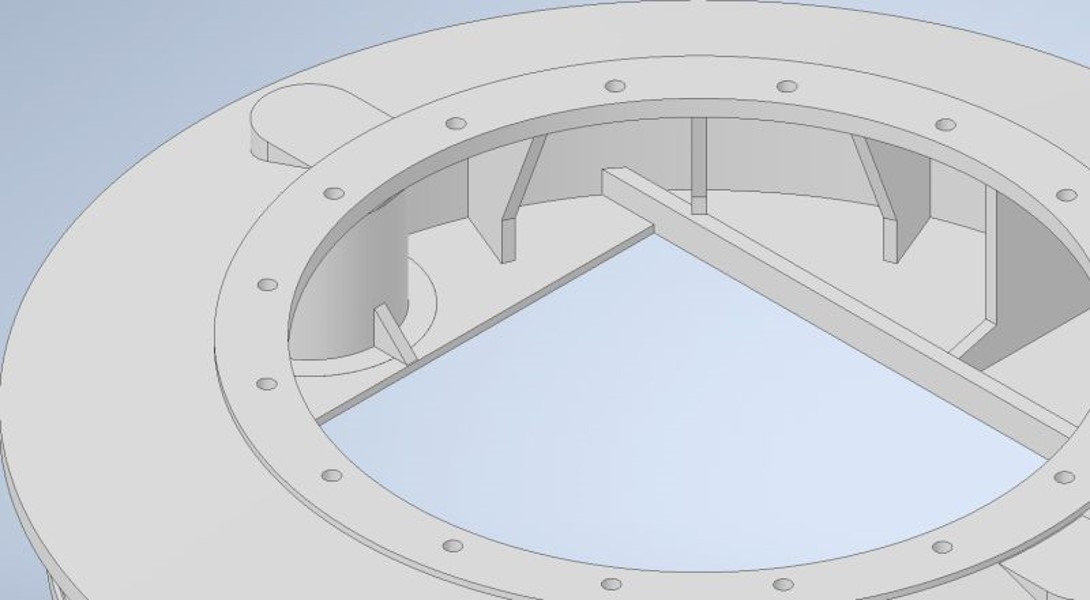
This step is critical in reverse engineering large industrial assemblies. Rather than replicating wear or distortion, the engineering team establishes optimized nominal geometry that reflects both functional requirements and manufacturability.
Material Selection and New Fabrication Strategy
The next phase involves material selection and fabrication planning. For this 8-foot outer diameter clarifier cover, an industry-standard grade of carbon steel will be specified to meet structural and environmental demands of the agitation application.
The new assembly will incorporate reinforcement enhancements based on Buffalo Metrology’s engineering evaluation. Center supports will be welded into the overall frame, increasing load-bearing capacity during mixing operations and improving long-term durability.
Delivering Digital Thread Value in Heavy Industry
This project highlights the growing importance of digital metrology tools in heavy industrial maintenance and retrofit applications. In the absence of original design documentation, high-accuracy 3D scanning combined with advanced inspection software enables manufacturers to:
-
Recreate legacy components
-
Improve structural integrity
-
Reduce downtime
-
Transition from repair to optimized replacement
By integrating portable 3D scanning technology with robust inspection workflows and CAD reconstruction, Buffalo Metrology delivered a comprehensive reverse engineering solution – transforming a fractured clarifier cover into a fully engineered pathway toward new fabrication.
For more information: www.buffalometrology.com