High-Precision Robotics Gains Ground in Aero-Structure Manufacturing
Composite aero-structures, primarily based on carbon fibre and epoxy resins, are essential in today’s aerospace to reduce weight, increase strength, and improve fuel efficiency. Their use in fuselages, wings, and stabilizers provides longer service life and greater corrosion resistance compared to conventional metals.
The production and machining of these large components require extremely tight tolerances. Although standard industrial robots offer flexibility, they typically lack the rigidity and precision needed to meet such demanding requirements.
IDEKO, a technology centre with extensive experience in developing advanced manufacturing solutions, has overcome these limitations by bringing the performance of industrial robots closer to that of precision machine tools.
At the upcoming edition of the International Machine Tool Biennial (BIEMH) – at the Bilbao Exhibition Centre, Spain from March 2 to 6, 2026, the centre will present the results of the work carried out in an intelligent robotic cell integrating drilling, deburring and inspection operations on a composite aero-structure representative of an aircraft wing.
The demonstrator will highlight the full set of technologies, methodologies, and tools specifically developed by the centre for manufacturing these components, significantly reducing robot positioning errors during machining tasks.
Combining Advanced Capabilities
In the design and development of these high-precision robotic cells, IDEKO combines several advanced technological capabilities, positioning itself as a leading player in applied R&D&I for the aerospace industry.
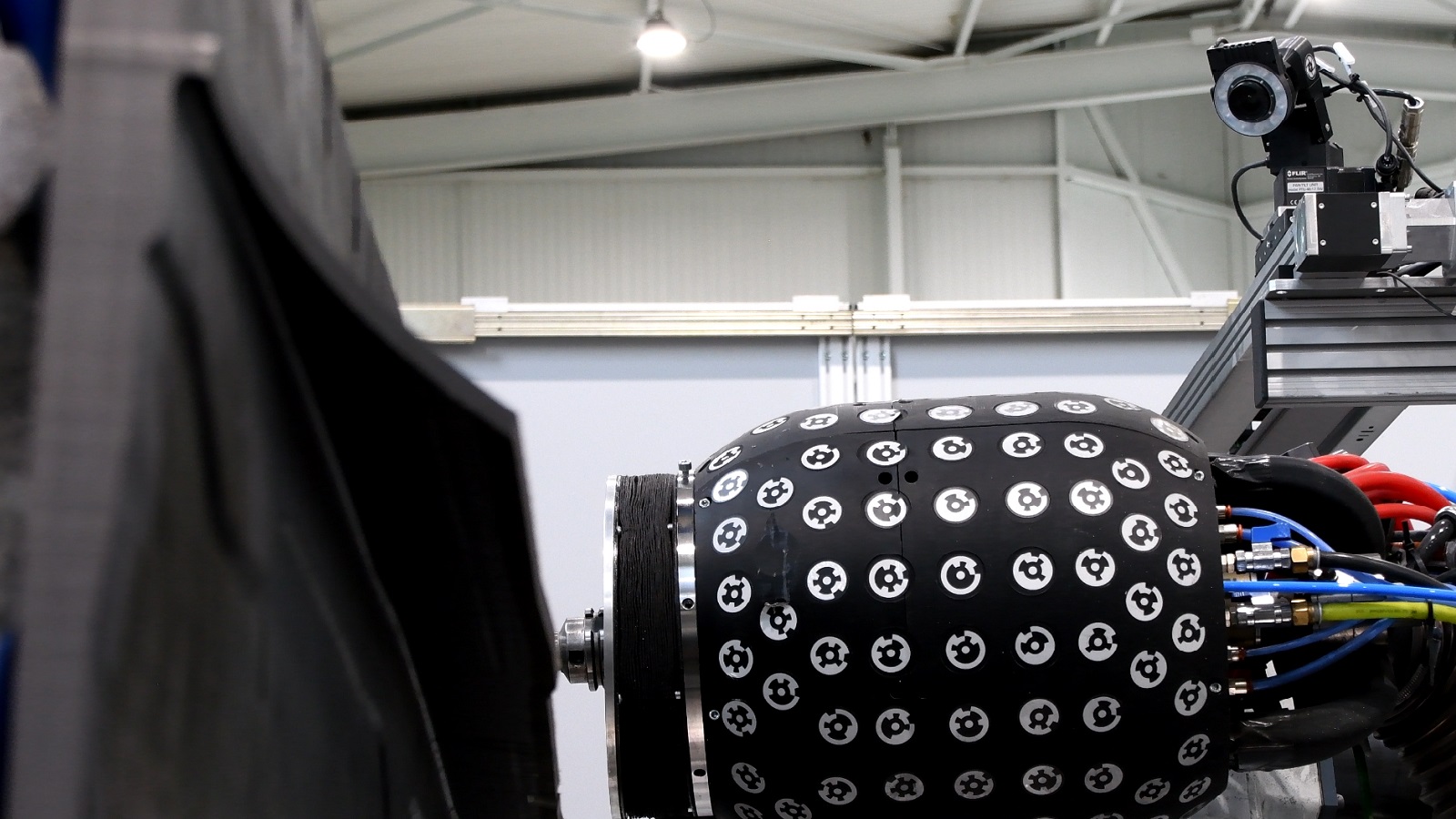
On the one hand, the centre’s strong expertise in photogrammetric measurement technologies has led to the development of an innovative computer vision system capable of continuously tracking the robot end-effector across large working volumes and correcting its position in real time. The solution integrates predictive models to optimize metrological performance and enables automatic camera repositioning based on the machining trajectory.
On the other hand, IDEKO has enabled the robot to perform automatic component referencing, generate and adapt movements to real parts once clamped in fixtures, and automatically adjust machining operations to the measured geometry. These advances drastically reduce the need for manual adjustments and improve process repeatability.
In parallel, IDEKO has integrated technologies aimed at achieving more efficient, intelligent, safe, and sustainable machining. These solutions help prevent common defects in composite materials, such as delamination. Additionally, in the case of carbon fibre—widely used in aero-structures—the centre has developed and validated systems to contain and extract the toxic dust generated during machining operations.
The incorporation of advanced sensing technologies allows potential issues, such as vibrations, to be identified in real time, enabling timely intervention in the process.
These digitalization and advanced analytics capabilities contribute to improving surface quality, extending tool life, and enhancing workplace safety.
To address the structural limitations typically associated with commercial robots, the centre has also developed extensive expertise in defining and validating robotic cell architecture design. This know-how is complemented by strong capabilities in the conceptual design and commissioning of advanced fixtures for clamping and referencing large components, specifically tailored to composite aero-structures.
In this work, IDEKO considers critical aspects such as robot and machining head accessibility to all functional areas of the component; control of deformations induced by gravity and the clamping system; compatibility with automatic referencing and digitalization systems; and positioning repeatability in machining operations.
For more information: www.ideko.es