GiantEye Project Aims to Transform Large-Scale Industrial CT Inspection
The ability to look inside complex components without cutting them open or dismantling them lies at the heart of nondestructive testing (NDT). However, traditional industrial computed tomography (CT) systems are constrained by the size of the objects they can accommodate. Components must fit inside the scanner, limiting the application of CT for large assemblies such as full vehicles, aircraft structures, or large energy systems.
To overcome these limitations, the Fraunhofer Institute for Integrated Circuits IIS is developing an advanced high-energy CT system as part of the GiantEye project at its Development Center X-Ray Technology in Fürth, Germany. The new system is designed to enable non-destructive inspection and digitalization of large and complex industrial objects with a level of detail previously difficult to achieve.
Expanding the Limits of Industrial CT
Industrial CT systems face significant challenges when dealing with large volumes and dense materials. Although Fraunhofer IIS already operates one of the most capable facilities of its kind, its existing XXL CT system, installed in 2013, requires complex handling of test objects. While the facility is considered the world’s only publicly accessible CT system capable of scanning entire vehicles or freight containers, positioning and manipulating these large items during inspection remains a demanding process.
The GiantEye project aims to address these operational challenges while further expanding CT capabilities for large-scale industrial inspection.
Gantry Design Inspired by Medical CT
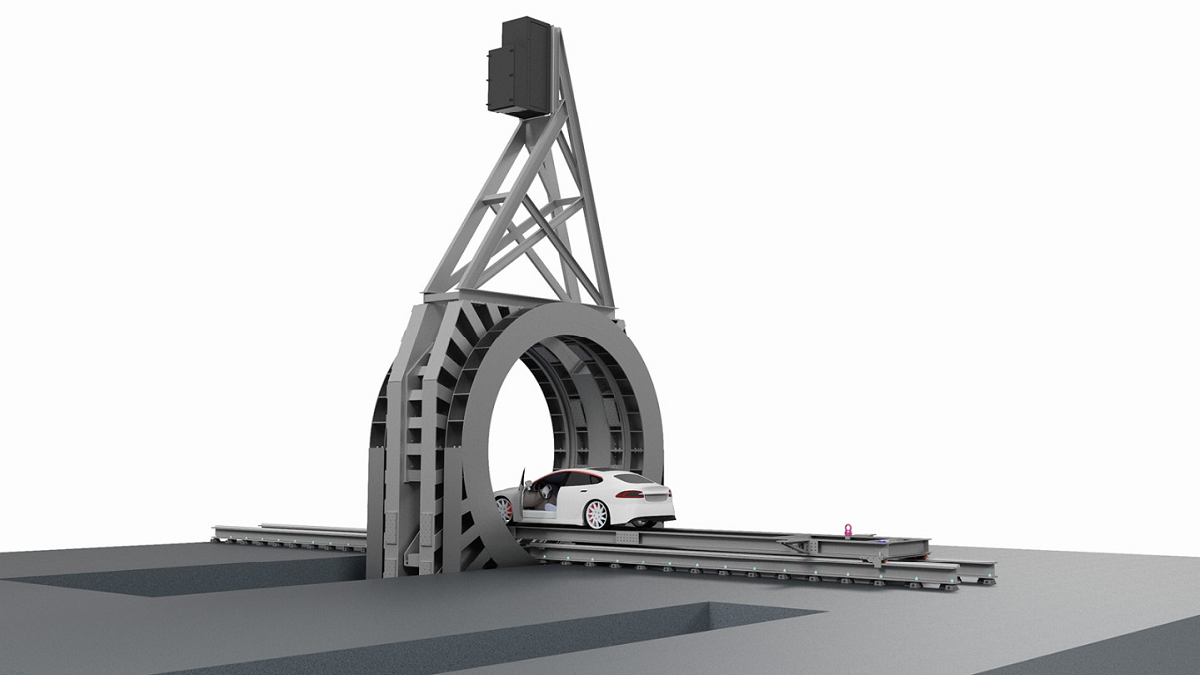
A key innovation in the new system is its gantry-based architecture. Unlike the earlier setup, where large objects must be manipulated extensively during scanning, the GiantEye system supports both the radiation source and detector in a rotating gantry. This configuration allows the imaging components to rotate around the test object in a vertical plane, similar to the operation of a medical CT scanner—albeit on a much larger scale.
This approach enables large objects to be inspected in their natural horizontal orientation without requiring them to be repositioned on their sides. The configuration not only simplifies handling but also ensures more stable measurement conditions in highly absorbent regions, such as the battery packs of electric vehicles.
By eliminating the need for extensive mechanical manipulation, the system reduces the risk of introducing stresses that could distort measurements or damage sensitive components.
“The technology can thus be used for the first time in a production environment, such as in initial production of complex high-voltage battery systems,” explains Alexander Ennen, Head of the Application-Specific Methods and Systems department at Fraunhofer Institute for Integrated Circuits IIS.
Fraunhofer expects the system to become available for industrial partners in early 2027.
High-Energy Imaging for Dense Structures
At the core of the GiantEye platform is a linear accelerator capable of producing X-ray energies of up to nine megaelectron volts. Combined with a high-precision manipulation system and advanced detector technology, the system can deliver 3D measurement resolutions down to approximately 100 micrometers.
This combination of high-energy radiation and robust detectors enables the inspection of thick components and dense materials commonly found in large assemblies, including complete vehicles, high-voltage battery packs, and aerospace structures. The precision motion system ensures accurate data acquisition while minimizing image artifacts that can compromise CT reconstruction quality.
Industrial Scanning Architecture
Beyond its imaging hardware, GiantEye introduces an industrial scanning architecture designed to balance measurement precision with operational efficiency. The system architecture supports routine CT inspection of large components without lengthy preparation or complicated handling procedures.
The horizontal gantry design contributes to shorter scan times and improved image quality while reducing risk to sensitive test objects. These benefits are particularly relevant in safety-critical applications such as high-voltage battery analysis.
Broadening Application Possibilities
The system also opens new possibilities across multiple industries. Potential applications include:
- Inspection of crash-test vehicles
- Final inspection of large additively manufactured components
- Material diagnostics for large engine assemblies
Research efforts in large-scale CT are already progressing in other institutions. At the Technical University of Kaiserslautern, for example, the Gulliver CT system has been used since 2024 to examine concrete beams under load in three dimensions, demonstrating the potential of modular CT portal architectures for structural testing.
According to Norman Uhlmann, Head of the Development Center X-Ray Technology at Fraunhofer IIS, the technology could also support public safety applications. “A system like this, enabling more detailed insight into the contents of closed transport units without having to open them at great expense, represents a significant technological advance,” he explains.
From Measurement System to Data Ecosystem
As the GiantEye system moves toward industrial deployment, researchers are focusing not only on imaging hardware but also on data processing and automation. High-energy CT scans of large objects generate enormous volumes of data, creating new challenges for rapid reconstruction and analysis of 3D images.
“We are standing at the threshold of a new technical era and want to make our innovation available worldwide for industrial applications,” says Giovanni Del Galdo, Director of Fraunhofer IIS.
The modular system architecture is intended to support customized solutions for a wide range of inspection tasks across industries including automotive, aerospace, and energy.
At the same time, researchers are developing new algorithms and workflows to handle the massive datasets produced by high-energy CT imaging. “Our goal is not just to build a measuring instrument, but to provide an entire ecosystem for efficient use of the data,” Ennen adds.
Once routine operation becomes possible, the GiantEye platform could significantly reshape quality assurance and product development for large and complex industrial systems – bringing the power of high-resolution CT inspection to objects previously considered too large or dense to scan.
For more information: www.iis.fraunhofer.de