
Weaving the Digital Thread – The Interoperability Standards Powering Smart Manufacturing
As manufacturing continues its shift toward digital transformation, the concept of the digital thread has become central to initiatives around smart manufacturing, Industry 4.0, and data-driven quality. The digital thread represents the seamless flow of information across the product lifecycle — from design and engineering through manufacturing, inspection, and ongoing improvement.
Realizing this vision, however, depends less on any single platform and more on the interoperability standards that allow data to move reliably between systems. In metrology and manufacturing, these standards define how product definition, manufacturing intent, machine execution, and quality results are represented, exchanged, and linked. Together, they form the foundation of a connected manufacturing ecosystem.
Why Interoperability Is the Foundation of the Digital Thread
The digital thread is not a monolithic system, but an architecture of connected data. It links CAD, CAM, metrology software, machine tools, MES, PLM, and analytics platforms into a coherent whole. Without common standards, information must be translated, reinterpreted, or manually re-entered at each step — introducing errors, delays, and data loss.
Interoperability standards ensure that digital information remains consistent, traceable, and machine-interpretable as it flows across organizational and technical boundaries. This capability is particularly critical in high-value manufacturing sectors such as aerospace, automotive, and medical devices, where traceability, compliance, and precision are non-negotiable.
STEP and MBD: Defining the Digital Product
At the foundation of the digital thread is STEP (ISO 10303), the long-standing standard for the exchange of product model data. STEP enables the sharing of rich, computer-interpretable product definitions that include geometry, structure, configuration, and lifecycle information.
Modern implementations, particularly STEP AP 242, support Model-Based Definition (MBD) workflows. In an MBD environment, the 3D CAD model becomes the authoritative source of design intent, embedding dimensions, tolerances, surface finishes, and other Product Manufacturing Information (PMI) directly into the model rather than relying on 2D drawings.
For metrology, this shift is fundamental. Semantic PMI allows inspection software to automatically identify features and tolerances, generate inspection plans, and maintain traceability back to design intent — a prerequisite for a true digital thread.
DMIS: A Foundational Metrology Standard
The Dimensional Measuring Interface Standard (DMIS) played a critical early role in digital metrology interoperability. Developed to standardize the programming and operation of coordinate measuring machines, DMIS enabled measurement routines to be exchanged across different hardware and software platforms.
While DMIS remains in use today, its procedural structure reflects the needs of an earlier generation of digital manufacturing. As metrology workflows have evolved toward model-based and semantically rich data, newer frameworks have emerged to extend and modernize the concepts DMIS introduced.
QIF: Integrating Quality into the Digital Thread
The Quality Information Framework (QIF), standardized as ISO 23952, represents a major step forward in connecting quality data to the digital thread. QIF is a modular, XML-based framework designed to standardize how inspection and quality information is defined, exchanged, and analyzed.
QIF includes schemas for:
QIF MBD – Linking inspection features directly to design PMI
Measurement Plans – Defining what and how to measure
Measurement Results – Capturing outcomes in a structured, traceable form
Statistics – Supporting SPC and quality analytics
A key strength of QIF is semantic traceability. Persistent identifiers link inspection results directly back to the originating design features and tolerances, enabling closed-loop feedback to manufacturing and engineering. In digital thread architectures, QIF serves as the quality backbone, ensuring that measurement data is not isolated but fully contextualized.
STEP-NC: Extending the Thread into Manufacturing Strategy
While STEP defines the product and QIF defines how it is verified, STEP-NC (ISO 14649) extends interoperability into manufacturing execution. STEP-NC replaces traditional G-code programming with a feature-based, semantically rich description of machining intent, including operations, tools, and strategies.
STEP-NC provides an important link between design, manufacturing planning, and inspection. When used alongside STEP and QIF, it supports workflows in which manufacturing intent, execution, and verification are digitally connected rather than managed as separate silos.
MTConnect and umati: Capturing Shop-Floor Execution
To complete the digital thread, manufacturers must also capture what actually happens on the shop floor. This role is addressed by machine connectivity standards such as MTConnect and umati (universal machine technology interface).
MTConnect is a widely adopted open standard that provides structured, read-only access to real-time data from manufacturing equipment using REST/HTTP and XML. It enables visibility into machine states, execution status, and key process signals, forming the basis for monitoring, analytics, and manufacturing intelligence applications.
umati, by contrast, is an OPC UA – based, vendor-neutral initiative led by the German Machine Tool Builders’ Association (VDW) and supported by a rapidly growing international ecosystem of machine tool builders, controller vendors, and software providers. umati standardizes the semantic exposure of machine tool data, including machine and program status, axes and spindle data, tool information, alarms, and production metrics.
From a digital thread perspective, MTConnect and umati are complementary rather than competitive. Both provide standardized access to manufacturing execution data that can be correlated with design intent, manufacturing plans, and quality results.
When combined with QIF’s semantically linked inspection results, MTConnect and umati provide the execution context needed to close the digital loop – connecting measured deviations not only to design intent, but to the actual machines, programs, and process conditions that produced them.
Closing the Loop: From Verification to Optimization
The integration of STEP, QIF, and machine connectivity standards enables a shift from quality as a downstream verification activity to quality as an active driver of manufacturing optimization. Inspection trends can be correlated with specific machines, tools, or process conditions, accelerating root-cause analysis and corrective action.
This closed-loop approach is a defining characteristic of smart manufacturing, where decisions are based on connected, contextualized data rather than isolated measurements.
Standards as the Fabric of the Digital Thread
No single standard defines the digital thread. Instead, it is woven from a set of complementary interoperability standards, each addressing a specific domain:
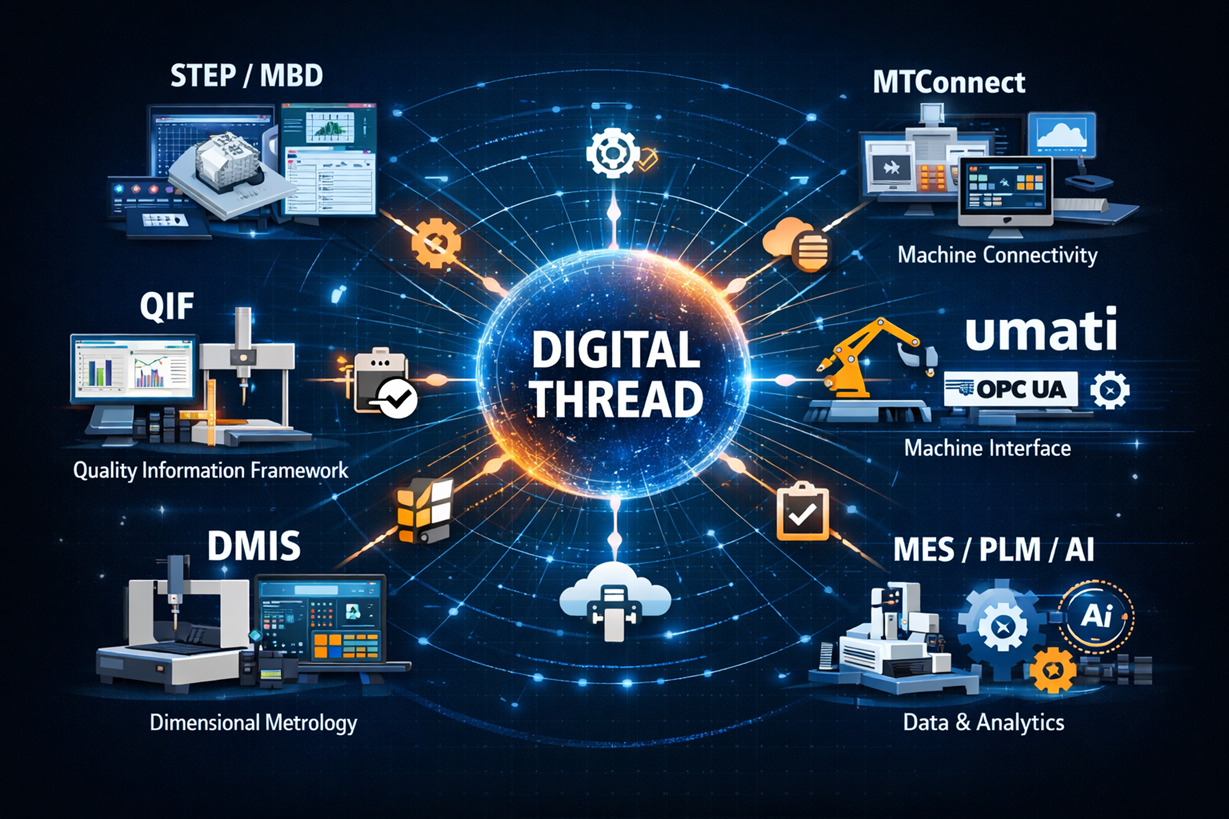
- STEP and MBD define authoritative product intent
- STEP-NC connects design to manufacturing strategy
- MTConnect and umati capture real manufacturing execution
- QIF and DMIS represent inspection and quality outcomes
Together, these standards form the fabric of a connected manufacturing ecosystem, enabling traceability, automation, and continuous improvement across the lifecycle.
For metrology professionals, understanding how these standards interact is essential. Interoperability is no longer an abstract goal – it is the practical foundation for digital, closed-loop, data-driven manufacturing.
Author: Gerald Jones Editorial Assistant