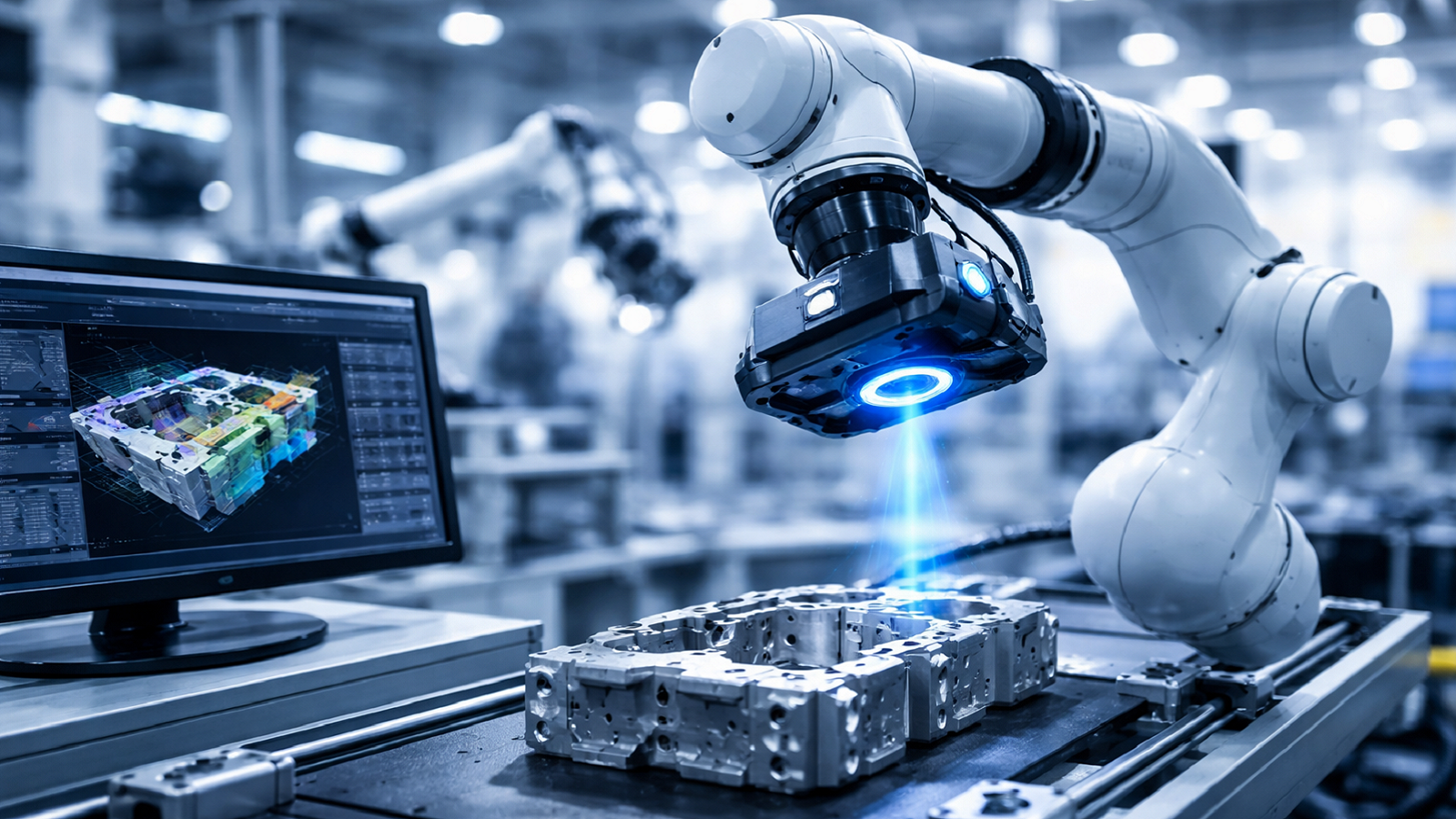
Visual Intelligence Powering Next-Generation Robotics
Machine vision has moved far beyond its early role as a digital replacement for human inspection. Today, it is becoming a core enabler of robotic intelligence, giving automated systems the contextual awareness, adaptability, and measurement capability required for high-mix, high-precision manufacturing.
As industrial robotics shifts from repetitive, pre-programmed motion toward flexible, data-driven decision-making, machine vision is emerging as the sensory backbone that connects automation with metrology-grade accuracy.
From Guidance to Measurement
Historically, vision systems in robotics were used primarily for presence detection, part localization, and basic pass/fail inspection. While these functions remain essential, they represent only a fraction of what modern vision technologies now contribute.
Advances in high-resolution industrial cameras, 3D imaging and structured light systems, edge AI processing, and deep learning-based defect recognition have elevated machine vision from a tool that simply “sees” into a system that effectively measures and controls. Robots no longer rely solely on fixed coordinates or mechanical fixturing. Instead, vision systems now deliver sub-millimeter positioning data, real-time dimensional verification, surface and geometric defect detection, and adaptive path correction.
In effect, vision is closing the gap between robotics and inline metrology, turning robots into mobile, measurement-aware platforms.
Enabling Flexible Manufacturing
One of the defining pressures in modern manufacturing is the shift toward high-mix, low-volume production. Traditional robotic automation thrives on consistency, while variation introduces uncertainty. Machine vision is what allows robots to handle that variation.
Vision-guided robotics enables systems to locate randomly oriented parts, correct orientation on conveyors, handle deformable or irregular components, and adjust tool paths based on part geometry. Rather than forcing parts to conform to automation constraints, vision allows automation to adapt to the parts themselves.
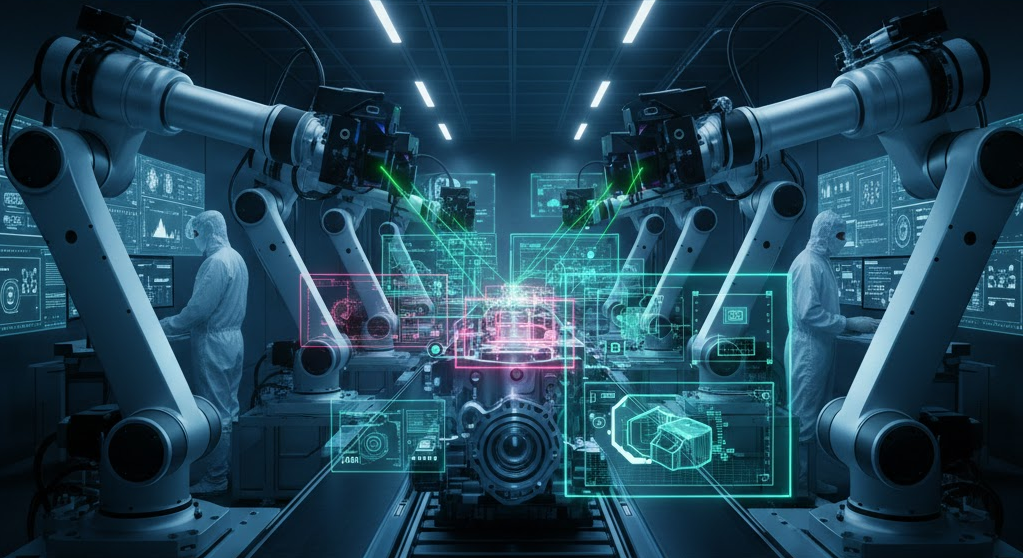
This flexibility is especially critical in industries such as automotive, where EV battery assemblies and lightweight structures introduce new geometries; aerospace, where composite parts and complex forms are common; electronics, where miniaturization pushes precision limits; and medical device manufacturing, where tight tolerances and product variability coexist.
3D Vision and the Rise of Spatial Awareness
The integration of 3D machine vision represents one of the most transformative developments in robotic automation. Technologies such as laser triangulation, stereo vision, time-of-flight sensing, and structured light are giving robots a form of spatial perception that was once limited to coordinate measuring systems.
With 3D vision, robots can measure part geometry before processing, compensate for tolerances in real time, verify assembly fit during operation, and detect warpage or deformation. This enables true closed-loop control, where measurement data continuously informs motion, force, and positioning.
Instead of operating on a ‘move and hope’ basis, robotic systems increasingly follow a measure, adjust, and execute model, where sensing and action are tightly coupled.
AI is Changing What Vision Can Understand
Traditional vision systems relied heavily on rules-based algorithms that performed well in structured environments but struggled with variability. Modern systems are increasingly powered by deep learning, enabling them to detect complex and subtle patterns that were previously difficult or impossible to define programmatically.
AI-enhanced vision allows robots to identify cosmetic defects, variability in natural or composite materials, surface texture anomalies, and context-dependent assembly deviations. These systems are not static; they can improve over time. When integrated with manufacturing data platforms, machine vision becomes part of a continuous improvement loop rather than a standalone inspection step.
This evolution also introduces new metrology considerations. Explainability of AI-driven decisions, validation of models, and traceability of inspection data are becoming as important as raw detection performance, particularly in regulated or safety-critical industries.
Inline Metrology and Process Control
Machine vision is increasingly used not only to verify finished outcomes but to control processes in real time. Vision systems guide robotic welding through seam tracking, adjust adhesive bead placement based on observed geometry, correct machining paths according to measured stock variation, and monitor additive manufacturing layers as they are built.
This marks a clear transition from inspection after the fact to quality assurance during the process itself. In this context, vision data feeds directly into manufacturing execution systems, digital twins, and statistical process control platforms, making it an integral part of the digital thread that connects design intent to production reality.
Human–Robot Collaboration and Safety
Machine vision also plays a central role in collaborative robotics. Vision systems support workspace monitoring, human presence detection, and dynamic speed and separation control, enabling robots to operate safely alongside people.
Beyond safety, vision helps robots understand shared workspaces and handoff conditions, supporting hybrid workflows where humans perform judgment-based or dexterous tasks while robots deliver precision, strength, and repeatability.
Challenges Ahead
Despite its expanding role, machine vision in robotics faces significant technical and operational hurdles. Industrial environments present lighting variability, reflective or transparent surfaces, and other optical challenges. Processing large volumes of high-resolution data at edge speeds remains demanding, particularly when 3D data and AI inference are involved.
There are also metrology-specific concerns, such as calibrating multi-sensor systems to traceable standards and integrating vision data into legacy automation architectures. At the same time, workforce skills must evolve. Engineers increasingly need expertise that spans optics, AI training, data science, robotics, and precision measurement, disciplines that have traditionally operated in silos.
Machine Vision as a Core Robotic Sense
The trajectory is clear: machine vision is evolving from a peripheral sensor into a primary robotic sense. Future developments are likely to include tighter fusion of vision with force and tactile sensing, self-calibrating robotic systems, AI models trained across global manufacturing datasets, and vision-driven adaptive fixturing or even fixtureless assembly.
As this convergence continues, the distinction between robotics, machine vision, and metrology will increasingly blur. Precision will be enforced not only through hardware tolerances but through continuous measurement intelligence embedded within automated systems. Machine vision is no longer just helping robots see. It is enabling them to measure, decide, and adapt in real time.
In precision manufacturing, that capability is rapidly becoming indispensable.
Author: Gerald Jones Editorial Assistant