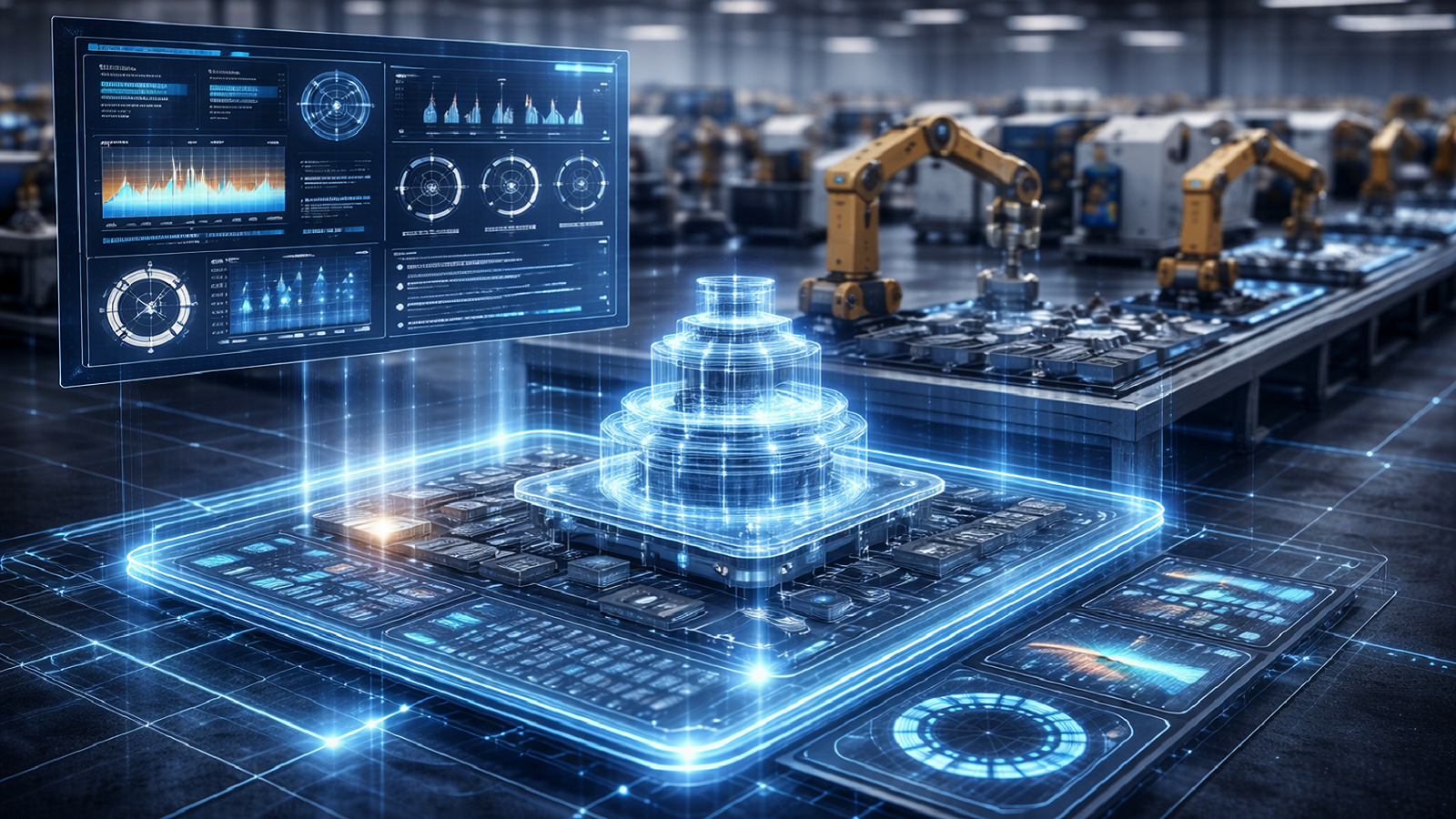
The Pursuit of Zero-Defect Manufacturing
Zero-defect manufacturing has long stood as one of the most ambitious goals in industrial quality control. For decades, however, it remained more of a guiding philosophy than a practical reality, limited by sampling inspection, human oversight, and delayed feedback from production. Digital twin technology is now reshaping that landscape, turning Zero-defect manufacturing into an achievable operational strategy rather than a distant ideal.
At its foundation, Zero-defect manufacturing is a quality management approach aimed at eliminating errors and defects throughout the production lifecycle. It emphasizes proactive control, continuous improvement, and workforce engagement, shifting the focus away from detecting failures after they occur. The historic barrier has been visibility. Manufacturers could not correct problems they could not observe as they developed. Digital twins can provide that missing visibility.
Moving Beyond Reactive Quality
Traditional quality control processes still rely heavily on manual inspection, offline testing, and statistical sampling. While these methods remain essential, they are inherently reactive. Defects are often discovered after a production stage has been completed, when scrap, rework, or delivery delays are already unavoidable. Because only a subset of parts is typically inspected, subtle process drift can remain hidden until it evolves into a larger quality issue. Human inspection, meanwhile, introduces variability due to subjectivity and fatigue. Compounding these challenges, measurement data, machine parameters, and process information often exist in separate systems, making thorough root-cause analysis difficult.
This model answers the question of what went wrong, but frequently too late to prevent cost and disruption. Zero-defect manufacturing requires a shift toward understanding what is happening now — and what is likely to happen next.
The Digital Twin as a Living Production Model
A digital twin is a dynamic, data-driven virtual representation of a physical asset, process, or entire production system. Unlike static simulation models, digital twins continuously ingest real-world data from sensors, machines, metrology equipment, and manufacturing software platforms. The result is a living model that evolves in step with the physical process.
Within a quality control framework, the digital twin becomes a comprehensive mirror of production reality. Measurement data from inline and at-line inspection systems is combined with machine tool parameters, performance metrics, environmental influences, and historical quality records. This unified context enables engineers to see not only whether a part meets specifications, but how process behavior is influencing outcomes.
Enabling Defect Prevention in Real Time
The most transformative contribution of digital twins to Zero-defect manufacturing is their ability to shift quality control from defect detection to defect prevention.
Continuous monitoring replaces periodic checks, allowing deviations from nominal process conditions to be identified as they emerge. Early signs of tool wear, thermal drift, vibration anomalies, or dimensional trends can be detected before they result in nonconforming parts. Because the digital twin reflects the current state of production, quality engineers gain immediate insight into process capability and stability.
This real-time awareness supports closed-loop manufacturing strategies. Measurement results can feed directly back into machine controls or process parameters, enabling automatic compensation. In this environment, quality control is no longer an external checkpoint applied after production, but an embedded, responsive element of the manufacturing process itself. The outcome is a measurable reduction in scrap, rework, and unplanned downtime — critical steps toward zero-defect performance.
From Historical Data to Predictive Quality
Digital twins extend beyond real-time monitoring by incorporating historical manufacturing data into predictive models. Patterns across previous production runs, material batches, and operating conditions can be analyzed to reveal relationships that may not be obvious to human observers.
Subtle correlations between environmental conditions and dimensional variation, between tool wear signatures and surface finish issues, or between material variability and downstream assembly problems can be identified and quantified. These insights allow manufacturers to anticipate the most probable future issues and act early by adjusting process parameters, scheduling maintenance, or refining inspection strategies. Zero-defect manufacturing thus evolves into a forward-looking discipline, grounded in data rather than hindsight.
Metrology at the Core of the Digital Twin
Metrology plays a central role in ensuring digital twins accurately represent physical reality. Advances in inline 3D scanning, non-contact optical systems, multi-sensor platforms, and automated inspection workflows are making it possible to supply high-density, high-frequency measurement data without slowing production.
Equally important is the software infrastructure that connects this data to CAD models, tolerances, process parameters, and statistical analysis. When measurement information is fully integrated into the digital thread, quality becomes traceable and transparent across the product lifecycle. Engineers can follow the link between design intent, manufacturing behavior, and final part performance with unprecedented clarity.
Elevating the Human Role in Quality
Despite the growing sophistication of digital twins, human expertise remains essential. Rather than replacing people, these systems shift the nature of their work. Engineers and operators spend less time on repetitive inspection tasks and more time interpreting trends, refining process strategies, validating predictive models, and leading continuous improvement efforts.
Digital twins provide a rich information foundation. It is human judgment and experience that transform that information into better decisions and more robust processes.
From Ambition to Operational Reality
Zero-defect manufacturing may still sound absolute, but digital twin technology makes it increasingly plausible in practical terms. By combining continuous monitoring, real-time feedback, predictive analytics, and integrated metrology, manufacturers can control variation at its source instead of managing its consequences.
The shift is fundamental. Quality control evolves from a gatekeeping function at the end of the line to an intelligent, embedded system guiding production moment by moment. In this environment, Zero-defect manufacturing is no longer just a quality slogan. It becomes a measurable, data-driven capability — and for manufacturers in high-precision, high-value industries, a defining element of competitive performance.
Author: Guest writer William Jones II