Surface Intelligence in Die Casting Using Spatially Resolved Fluorescence Measurement
A fluorescence laser scanner makes it possible to measure the application of release agents in die casting processes. The measurement data provides the basis for controlling the application of release agents in metal die casting processes. Fraunhofer IPM recently presented the new method together at the EUROGUSS 2026 exhibition.
In die casting processes, the optimal application of the release agent is crucial to the quality of the component, downstream processing and process stability. Insufficient application of release agent on the tools can impair demoldability, which may lead to component defects and even damage the molds. Using too much release agent is not only uneconomical but also leaves unwanted residues on the components. An innovative measuring method now provides data for controlled release agent application for the first time. This data is valuable for improving the understanding of the process or for introducing new die casting processes.
The researchers‘ goal is to further develop the system for genuine process control. The measurement signals should be transmitted in real time to a spraying system, enabling precise adjustment of the release agent quantity based on the spatially resolved scan.
Detailed Representation of the Quantitative Release Agent Coverage
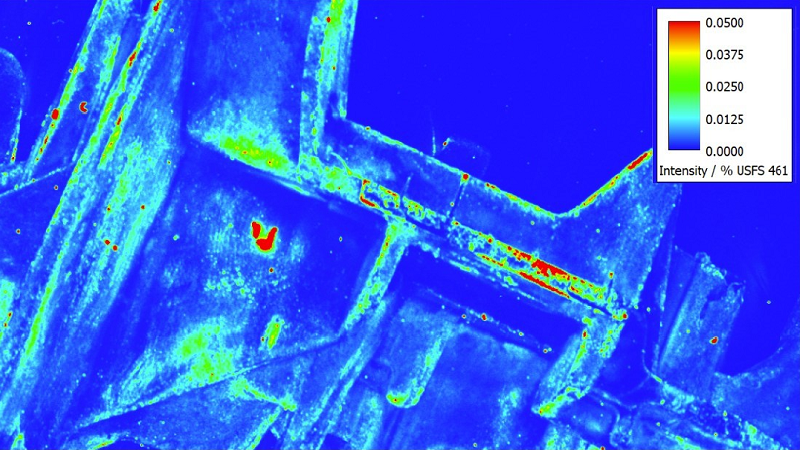
A fluorescence laser scanner captures the mold surface during each release agent application. To achieve this, the measuring system is moved between the open mold halves along with the spraying head, while the UV laser scans the surface. The UV laser excites the autofluorescence of organic components contained in the release agent. The fluorescence emission is measured by means of spectral filtering and sensitive detection, providing a detailed representation of the quantitative release agent coverage. The stronger the glow, the more release agent has been deposited on the surface. The measurement data provides the caster with visual support for precisely adjusting the release agent application. The compact, robust system is designed for the specific conditions in a die casting plant and was developed at Fraunhofer IPM as part of the InMoDie research project in collaboration with partners from research and industry as a demonstrator.
Optimizing Cleaning Processes
Fluorescence measurement technology can be used not only to measure the release agent coating on the tool but also to identify unwanted release agent residues on die-cast parts. Such residues can impair subsequent processing steps such as coating, bonding, or painting the components. Multi-stage, energy-intensive cleaning processes are currently standard practice for removing all residues. However, complete removal of the release agent is not always necessary. Combining residual contamination measurements with quality checks can help adapt cleaning procedures according to specific requirements of downstream processes. This too is the subject of future research.
The InMoDie project (Development of an inline measurement method for the spatially resolved detection of filmic contaminations on component surfaces and to support the application of release agents in the die casting process) is funded by the Federal Ministry for Economic Affairs and Energy as part of the Lightweight Construction Technology Transfer Program.
For more information: www.ipm.fraunhofer.de