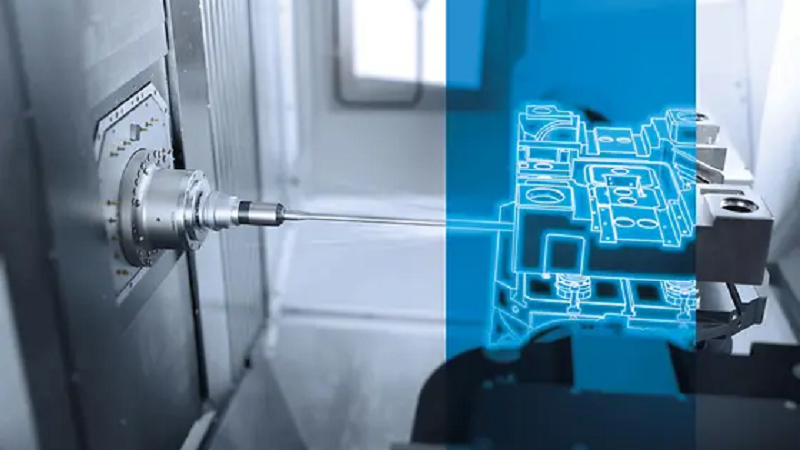
Standardising Deep Hole Drilling Through Adaptive Process Control
DMG MORI is introducing Adaptive Drilling Control (ADC), a new technology cycle designed to enhance process reliability, quality and ease of use for drilling applications on universal machining centres.
Transforming a Critical Machining Operation
Deep hole drilling and gun drilling are among the most demanding operations in metal cutting. Chip congestion, bore deviation, cross-holes and tool breakage can quickly result in scrap—particularly when machining high-value components such as crankshafts, injection systems, turbine components or medical implants. The financial consequences extend beyond material loss, potentially affecting delivery schedules and customer confidence.
As specialised deep drilling operations increasingly migrate from dedicated machines to universal machining centres, the demands on operators also change. Not every machining environment has in-depth expertise in deep hole drilling strategies. Conventional drilling cycles typically rely on rigid, predefined parameters. When variables such as material characteristics, tool wear or coolant behaviour deviate from optimal conditions, process risk rises significantly.
Adaptive Drilling Control addresses this challenge by converting an experience-driven process into an actively controlled and continuously monitored operation. Instead of simply executing fixed parameters, ADC uses integrated sensors to measure pressure, flow rate and spindle load in real time. These inputs feed a closed-loop control system that dynamically adjusts coolant supply and machining strategy throughout the drilling cycle. The result is a stable, predictable process that establishes measurable standards for reliability, quality, service life and energy efficiency.
One Scalable Cycle for Multiple Drilling Applications
ADC consolidates standard drilling, deep hole drilling and complex gun drilling into a single scalable technology cycle. In its basic configuration, the operator defines essential parameters such as drilling position, pattern and cutting data, while the system automatically determines and regulates coolant pressure and flow rate to ensure optimal conditions. For classic deep hole drilling applications, additional parameters can be entered within the same structured cycle. For more demanding operations—such as gun drilling, cross-holes, pilot hole offsets or adaptive feed adjustments—extended functions are available through an intuitive dialogue interface.
Across all applications, ADC continuously adjusts coolant pressure and flow according to material properties, tool condition and the respective drilling phase. This adaptive regulation compensates for chip accumulation, cross-drilling interruptions and increasing drilling depth, maintaining consistent chip evacuation and thermal stability. According to DMG MORI, the technology can extend tool life by up to 30 percent while reducing energy consumption by as much as 30 percent through optimised coolant delivery. High-pressure coolant systems exceeding 80 bar can be integrated, enabling complex deep drilling processes to be executed as controlled standard operations on universal machining platforms.
Developed with the DMQP Partner Network
The ADC cycle was developed in collaboration with partners from the DMG MORI Qualified Products network to ensure optimal coordination between machine, tooling and lubrication technology. Tool manufacturers botek Präzisionsbohrtechnik, Gühring, Kennametal and Walter contributed to the development of the adaptive process control strategy. Cooling lubricant specialist FUCHS Lubricants supplied formulations designed to maintain stable performance across a wide range of pressures and flow conditions. This coordinated ecosystem approach positions ADC as a comprehensive process solution rather than a standalone software feature.
Cost Control, Quality and Digital Traceability
Beyond process stability, ADC directly addresses cost drivers associated with deep hole drilling. Controlled chip removal, moderated load peaks and defined adaptive response logic significantly reduce the likelihood of tool breakage and scrap. At the same time, optimised coolant supply lowers energy consumption and promotes more consistent temperature control, further extending tool life. Improvements in bore quality, including hole trajectory and surface integrity, also contribute to reduced rejection rates.
All process data is automatically recorded and can be integrated into CELOS X and higher-level factory IT systems for monitoring and quality documentation. Industries with stringent accountability requirements, including aerospace, medical technology and automotive manufacturing, benefit from standardised drilling cycles and complete digital traceability for every bore produced.
ADC will initially be available on selected platforms including the monoBLOCK, duoBLOCK, DMC H monoBLOCK and DMC 55 H TWIN series, as well as portal and gantry machine ranges. Both Siemens and HEIDENHAIN control systems are supported.
DMG MORI positions Adaptive Drilling Control as a strategic component of its Machining Transformation (MX) initiative, which integrates sensor technology, control systems, software and partner expertise to improve productivity and efficiency in the machining of complex components. With ADC, deep hole drilling transitions from a high-risk specialist task to a digitally regulated, data-driven standard process aligned with the evolving demands of smart manufacturing.
For more information: www.dmgmori.com