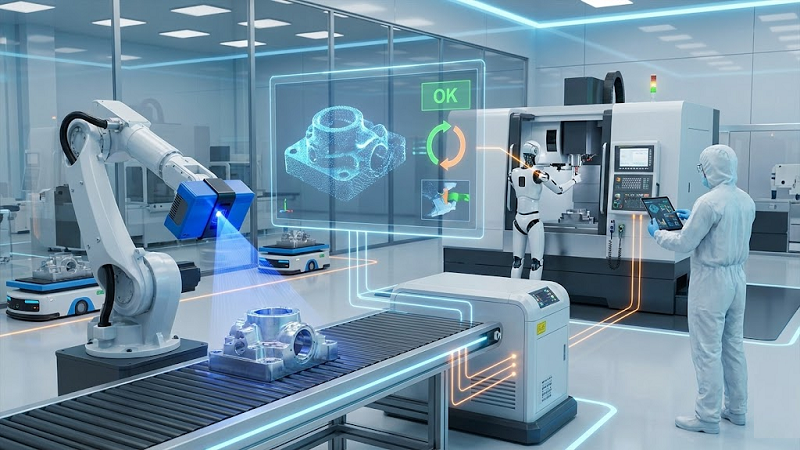
Smart Metrology Powering Factories of the Future
Metrology has always been the foundation of quality in manufacturing, providing the measurements and validation needed to ensure that parts, processes, and products conform to specifications. For decades, this role has largely been reactive. Measurements verified what had already been produced, and decisions were made after a problem surfaced. But as factories become digital, connected, and increasingly autonomous, the expectations placed on metrology are shifting dramatically. The concept pioneering this transformation is defined as Smart Metrology. It represents a philosophical and technological leap in how measurement contributes to production. Instead of simply checking quality, Smart Metrology becomes a dynamic, data-driven partner in controlling, optimizing, and improving manufacturing in real time.
From Reactive to Proactive Measurement
At its core, Smart Metrology redefines the purpose and process of measurement. Rather than striving for the highest possible accuracy at all times, it focuses on delivering just the right level of accuracy required by the process, at the moment it is needed, with the lowest possible cost and time investment. It promotes measurement systems that understand context, adapt to changing conditions, learn from data, and actively support optimized decision-making. As such, Smart Metrology aligns perfectly with the digital transformation movements reshaping global industry. It is essential to understanding how quality must evolve to meet the demands of Industry 4.0 and 5.0.
Meeting the Demands of Tomorrow’s Manufacturing
The origin of Smart Metrology can be traced to the realization that traditional metrology, with its emphasis on fixed procedures and absolute precision, is no longer sufficient in modern manufacturing environments. Today’s production lines can operate at exceptional speeds, often guided by automated equipment that performs machining, assembly, and inspection at volumes unthinkable only a few decades ago. Sensors collect data continuously and in enormous quantities. Machines adjust themselves automatically based on observed criteria. Decision-making is migrating from human operators to algorithms, and factories are gradually becoming cyber-physical systems in which data and machinery are intrinsically linked.
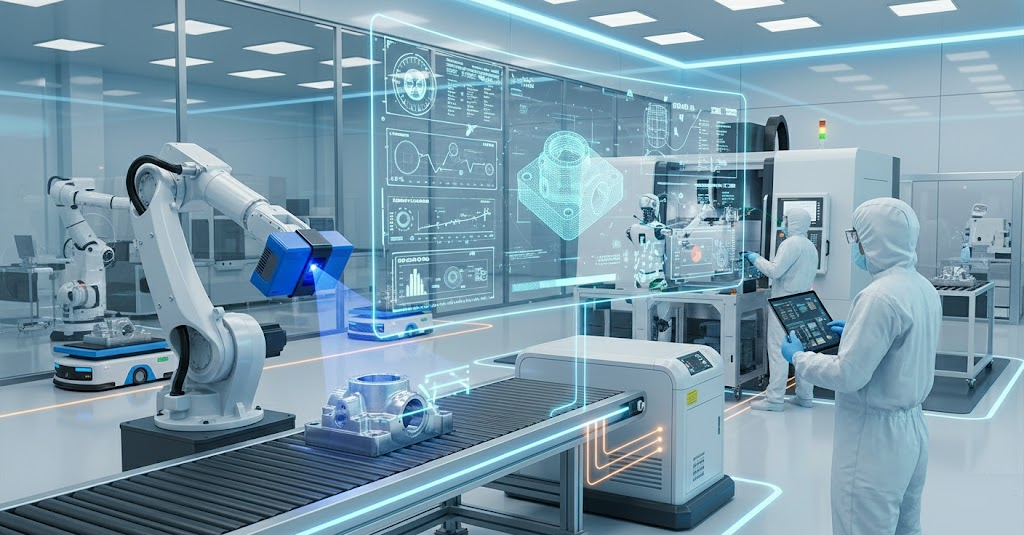
In this context, metrology must evolve from an isolated control function into an active and intelligent component of the manufacturing ecosystem. Smart Metrology is the discipline that enables this evolution. It emphasizes the principles of efficiency, relevance, adaptability, and connectivity. Instead of performing measurements for their own sake or adhering rigidly to traditional laboratory-style workflows, Smart Metrology ensures that measurement activities directly support production goals. It helps manufacturers reduce uncertainties strategically, focusing on the key metrics that have real impact on product quality or process stability. As a result, measurement becomes not just a diagnostic tool but a predictive and preventive force.
A fundamental concept behind Smart Metrology is the idea of metrological efficiency. Traditional approaches often assume that the highest precision is always preferable, but this mindset can lead to unnecessary cost, time consumption, and equipment complexity. Smart Metrology challenges this assumption by asking what level of uncertainty is truly necessary to make valid decisions. For example, a process may tolerate a certain amount of variability without affecting performance or compliance. In such cases, excessively precise measurement adds no value and may even slow down production. Smart Metrology advocates for contextualized accuracy – achieving the right measurement, at the right time, using the right tool.
Digitalization as the Backbone of Smart Metrology
Digitalization plays an essential role in the implementation of Smart Metrology. Measurement devices are increasingly connected to broader data ecosystems, enabling them to communicate directly with machines, analytics platforms, and quality systems. This connectivity allows metrology instruments to receive relevant information, such as current process parameters or production history, and adapt their measurement strategies accordingly. It also enables automated triggering of measurements, immediate evaluation of results, and the use of statistical models to predict trends before deviations occur.
Artificial intelligence and machine learning further enhance Smart Metrology by enabling systems to learn from experience. For instance, machine learning algorithms can analyze historical measurement data to identify patterns indicating drift in a machining center or degradation in a cutting tool. This knowledge allows the metrology system to shift from passive control to active prediction. Instead of detecting a problem after parts fall out of tolerance, Smart Metrology can prompt corrective action before scrap is produced. Predictive metrology, an emerging discipline within Smart Metrology, is becoming a crucial aspect of digital manufacturing strategies.
Another essential characteristic of Smart Metrology is flexibility. Modern production systems often run multiple part models, frequent design iterations, and fast changeovers. Metrology must keep pace with this agility. Smart Metrology utilizes adaptable measurement strategies, modular equipment, automated fixtures, and advanced software to change settings quickly and efficiently. Metrology procedures become dynamic rather than static. When a new part design is introduced or a process shift requires updated tolerances, the metrology system can adjust seamlessly without lengthy recalibration or manual intervention.
In the context of the digital thread, Smart Metrology plays a central role by ensuring that measurement information flows freely and accurately throughout the product lifecycle. From design to engineering, production, inspection, and service, Smart Metrology provides the validated data that allows teams to make informed decisions. It closes the loop between the virtual and physical worlds by confirming that manufactured parts match digital models and by feeding real-world results back into digital twins for ongoing optimization. Without Smart Metrology, the digital thread would contain weak links, and the promise of fully integrated manufacturing would remain unfulfilled.

One of the most practical contributions of Smart Metrology is its ability to move quality assurance closer to the manufacturing process. Historically, high-precision measurements were restricted to specialized labs where trained metrologists operated sophisticated instruments in controlled environments. Today’s factories demand faster feedback. Smart Metrology enables reliable measurement directly on the shop floor, even in challenging conditions. This is achieved through intelligent error compensation, robust hardware designs, environmental monitoring, and automated decision rules that determine when conditions might compromise accuracy. When the metrology system can understand its environment and compensate for it, the need for separate quality laboratories diminishes, and quality becomes embedded within production itself.
Metrologists Transition to Data Analysts
Human expertise remains vital in Smart Metrology, though the role of the metrologist evolves significantly. Instead of focusing primarily on manual measurement tasks, metrologists in smart factories become data analysts, system architects, and strategic contributors to process optimization. They validate automated measurement routines, interpret complex data patterns, and collaborate closely with production teams to ensure that measurement supports business goals. Smart Metrology does not eliminate human involvement; rather, it elevates metrologists into leadership roles within quality and manufacturing.
The rise of intelligent inline and near-line measurement technologies is a clear reflection of Smart Metrology principles. Systems equipped with high-speed sensors, machine vision, laser scanners, or tactile probes can evaluate every part or sample at rates compatible with fast production lines. These systems do more than simply flag bad parts. They provide real-time analysis of trends and drift that can automatically trigger adjustments to machining parameters. By combining metrology data with machine tool controls, manufacturers achieve closed-loop manufacturing, in which measurement and production operate as one coherent system. This level of integration is only possible through Smart Metrology.
Challenges and the Path Forward
The implementation of Smart Metrology requires a shift not only in tools but also in mindset. Organizations must move away from the belief that measurement exists only to check compliance or support audits. Instead, they must view metrology as a strategic source of actionable intelligence. The return on investment can be substantial. Manufacturers adopting Smart Metrology report reduced downtime, lower scrap rates, improved process stability, faster product launches, and more consistent quality performance.
Despite its advantages, Smart Metrology also introduces challenges. Data integration remains a significant hurdle, as many factories still operate with equipment from multiple vendors and legacy systems that were not designed to communicate with one another. Ensuring interoperability between machines, sensors, and software requires standardized protocols and a clear digital architecture. Cybersecurity is another concern, as connected metrology devices become potential pathways for unauthorized access. Effective implementation therefore requires robust IT strategies and collaboration between metrology, quality, engineering, and information security teams.
The future of quality in manufacturing will depend heavily on the successful integration of Smart Metrology. As factories move toward fully autonomous production systems, measurement must become autonomous as well. Sensors will continuously assess not only the parts but also the measuring devices themselves, ensuring sustained accuracy through self-qualification and automatic recalibration. Metrology systems will communicate directly with machines, materials, and operators, forming a distributed intelligence network across the factory. In this future environment, Smart Metrology becomes the nervous system of manufacturing, connecting actions with outcomes and enabling production that is flexible, reliable, and self-optimizing.
A Paradigm Shift for Quality and Productivity
In essence, Smart Metrology represents a paradigm shift. It transforms metrology from a passive checkpoint into an active driver of operational excellence. It aligns measurement with digital transformation goals and ensures that quality remains a competitive advantage rather than a regulatory obligation. As industry embraces data-driven manufacturing and seeks higher levels of automation and efficiency, Smart Metrology will be indispensable. It is not simply an upgrade to measurement technologies; it is a reinvention of how measurement contributes to modern manufacturing.
Manufacturers that adopt Smart Metrology gain the ability to foresee problems rather than react to them, to optimize processes intelligently, and to integrate quality seamlessly into the digital fabric of production. As the industry continues to evolve, Smart Metrology will shape the factories of the future and play a crucial role in achieving the speed, adaptability, and precision that global markets demand.
Editor