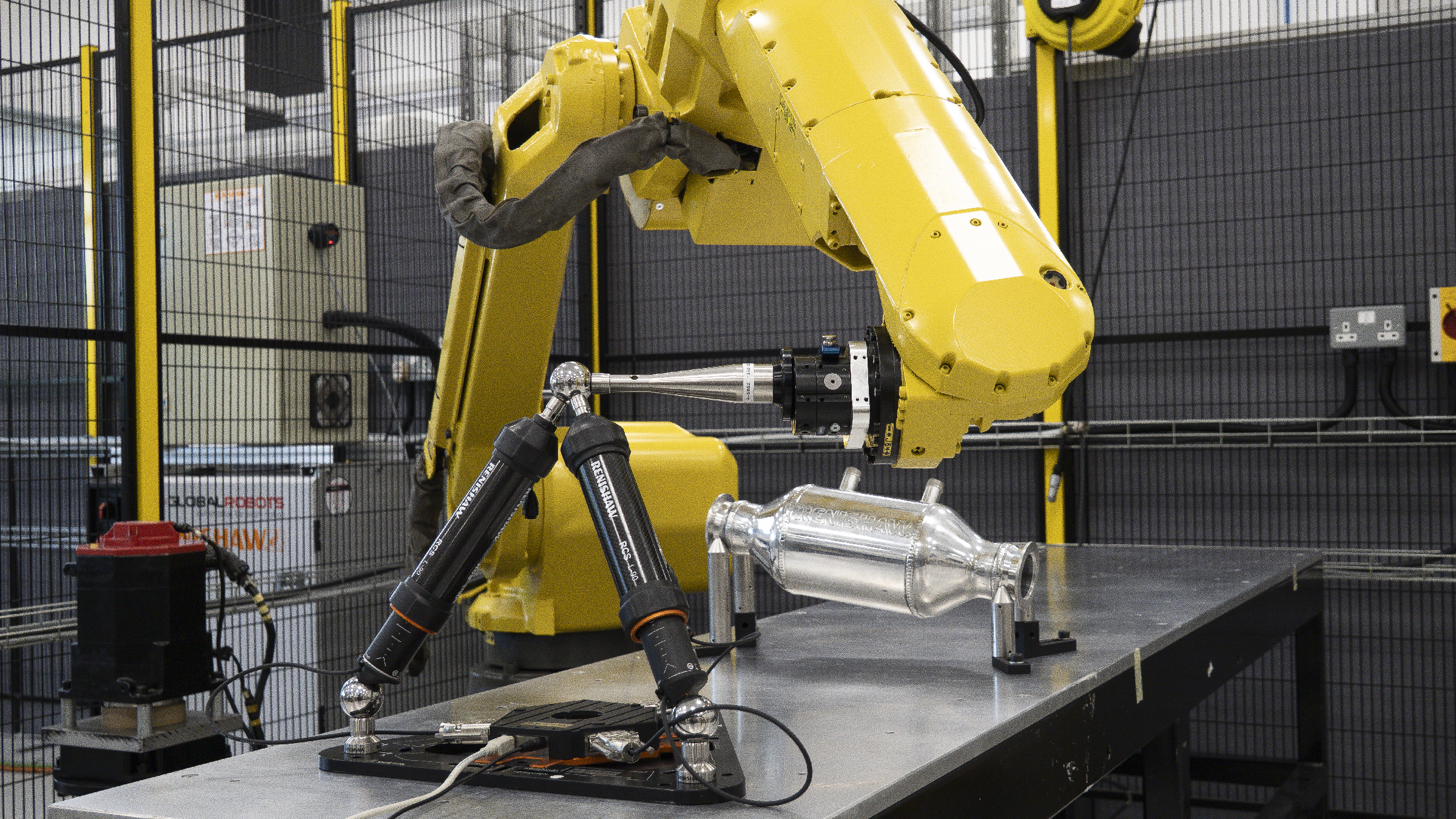
Robot Accuracy – The Missing Link in Smart Manufacturing
Industrial robots have become the backbone of modern smart factories. Across sectors such as automotive, aerospace, electronics, and medical manufacturing, robots deliver the speed, repeatability and flexibility required for high-volume production. However, as manufacturing shifts toward digitalised, data-driven environments, a critical challenge of robot accuracy is emerging.
In many traditional automation environments, repeatability was enough. Robots could reliably return to the same programmed position again and again. But today’s smart manufacturing systems demand far more. Robots are increasingly expected to perform high-precision tasks, interact with metrology systems, and adapt dynamically to changes within the production cell.
This evolution places robot calibration and performance validation firmly in the spotlight.
Repeatability vs. Accuracy
Industrial robots are inherently highly repeatable but not inherently accurate.
Repeatability refers to a robot’s ability to return to the same point consistently. Accuracy, however, describes how close that point is to its intended programmed position. Mechanical tolerances in robot joints, link geometry, thermal effects, gravitational loads and wear over time can all introduce positional errors.
Historically, this limitation meant robots were often unsuitable for high-precision operations such as machining, metrology-assisted assembly, or adaptive inspection.
As manufacturers pursue greater levels of automation, these limitations must be addressed. This is where robot calibration and performance verification technologies become essential.
Bringing Metrology Principles to Automation
For more than five decades, Renishaw has built its reputation on precision measurement and metrology technologies. Increasingly, that expertise is being applied to the automation space through the Renishaw RCS series of robot calibration tools.
The RCS portfolio includes portable toolkits and in-process probing solutions designed specifically for six-axis industrial robots, allowing manufacturers to validate robot performance, improve positional accuracy and reduce downtime.
By combining calibration hardware with dedicated analysis software, the systems allow manufacturers to quantify robot behaviour and compensate for errors that would otherwise limit performance.
Improving Robot Accuracy with Calibration
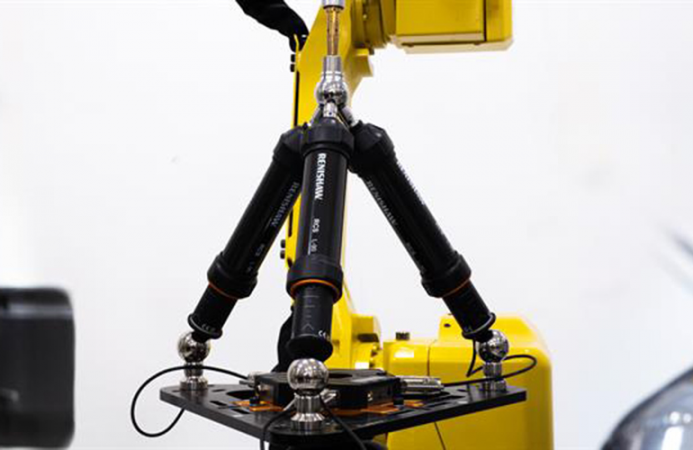
At the core of the solution is the RCS T-90 tri-ballbar system, which measures robot joint offsets and mechanical errors. By identifying deviations caused by link tolerances and gravitational loading, the system enables manufacturers to calibrate the robot’s kinematic model.
Once these offsets are identified, they can be compensated for in the robot controller, significantly improving positional accuracy.
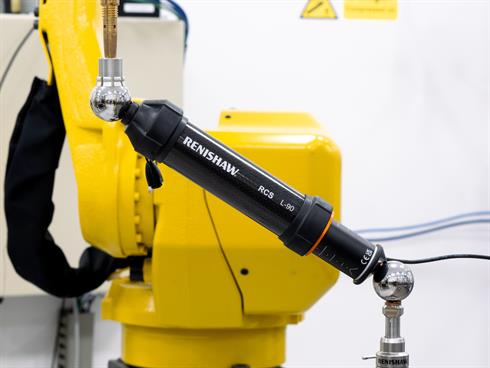
In addition to calibration, the RCS L-90 linear ballbar system evaluates robot path accuracy and joint repeatability. By testing how well the robot follows programmed trajectories, manufacturers can identify performance issues such as backlash, joint wear or controller problems.
These insights allow maintenance teams to diagnose issues quickly and determine whether repairs, recalibration or upgrades are required.
Reducing Robot Programming and Set-Up Time
Robot programming can be one of the most time-consuming elements of automation deployment. Any disturbance to the cell, such as a collision, maintenance intervention or relocation, can require hours of re-teaching positions.
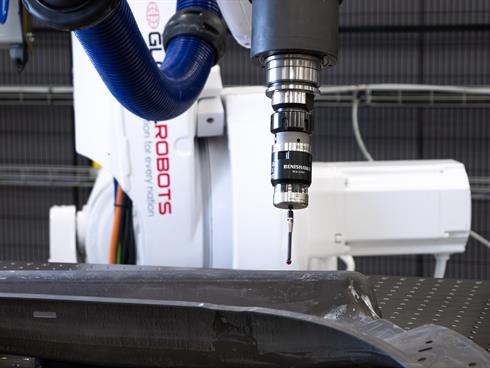
Integrating the RCS P-series probing system into a robot cell helps streamline this process. Probes can quickly establish tool frames and part frames using automated alignment routines, reducing manual programming effort.
If a robot requires maintenance, the joint offsets measured using the T-90 can be recorded before service and restored afterwards. This allows the robot to return to its previous operational state, ensuring existing routines continue to function without extensive reprogramming.
As a result, production cells can be restored in minutes rather than hours, significantly reducing downtime.
Enabling Reliable Offline Robot Programming
A further reason why robot accuracy is becoming increasingly important is the growing adoption of offline robot programming and virtual cell development. In many modern manufacturing environments, engineers now create and optimise robot programs within digital simulation platforms before deploying them to the physical production cell.
Offline programming dramatically reduces commissioning time, allowing new robot routines to be tested, validated and refined in a virtual environment. However, the effectiveness of this approach depends heavily on how accurately the digital robot model reflects the real robot’s physical behaviour.
If a robot’s kinematic model does not accurately represent its true geometry and joint offsets, programs developed offline may require extensive adjustment once deployed on the shop floor. Engineers then need to spend valuable time manually editing robot positions and re-teaching points, negating much of the productivity advantage of virtual programming.
Accurate robot calibration ensures the digital twin of the robot closely matches its real-world performance, allowing programs created offline to run correctly the first time. By eliminating the need for time-consuming physical adjustments, manufacturers can significantly accelerate commissioning, improve consistency between production cells, and maximise the efficiency of virtual engineering workflows.
Recovering Production Cells after Disturbances
Smart factories must be resilient to change. Robots may be moved, cells relocated, or equipment disassembled and rebuilt on site. Traditionally, such changes would require extensive manual re-teaching.
Renishaw’s RCS solutions support cell alignment recovery, enabling robots to be restored to a known state without manually reprogramming every position.
The part frame recovery capability also improves production efficiency. Using RCS P-series probes – available in hard-wired, radio and optical variants – the system can automatically relocate part frames following disturbances, collisions or cell movement.
This automated recovery capability supports higher levels of production continuity and operational resilience.
Supporting High-Precision Robotic Applications
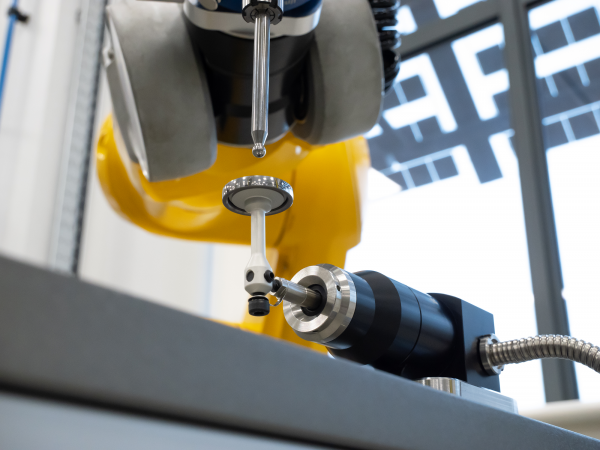
As robots increasingly take on complex tasks, the need for precise tool positioning becomes critical.
The RCS system supports a range of calibration routines designed to enhance precision in demanding applications:
- TCP reorientation routines ensure the robot can achieve the same position regardless of its pose or orientation.
- Gripper calibration automates the set-up and verification of a gripper’s tool centre point (TCP), eliminating manual adjustments.
- Spindle calibration allows rapid five-degree-of-freedom calibration of robot-mounted spindles, supporting precision robotic machining.
These capabilities enable robots to perform intricate operations with greater confidence, opening new possibilities for robotic machining, assembly and inspection.
Future of Precision Robotics
As manufacturers move toward fully connected smart factories, the line between automation and metrology continues to blur. Robots are no longer simply programmable motion systems – they are increasingly integrated into closed-loop manufacturing processes where accuracy and measurement data are critical.
Calibration technologies such as the Renishaw RCS series demonstrate how metrology principles can enhance robotic performance, enabling robots to move beyond repeatability toward true precision. For manufacturers seeking to deploy robots in increasingly demanding roles, ensuring robot accuracy is no longer optional – it is a fundamental requirement for the next generation of intelligent manufacturing systems.
For more information: www.renishaw.com