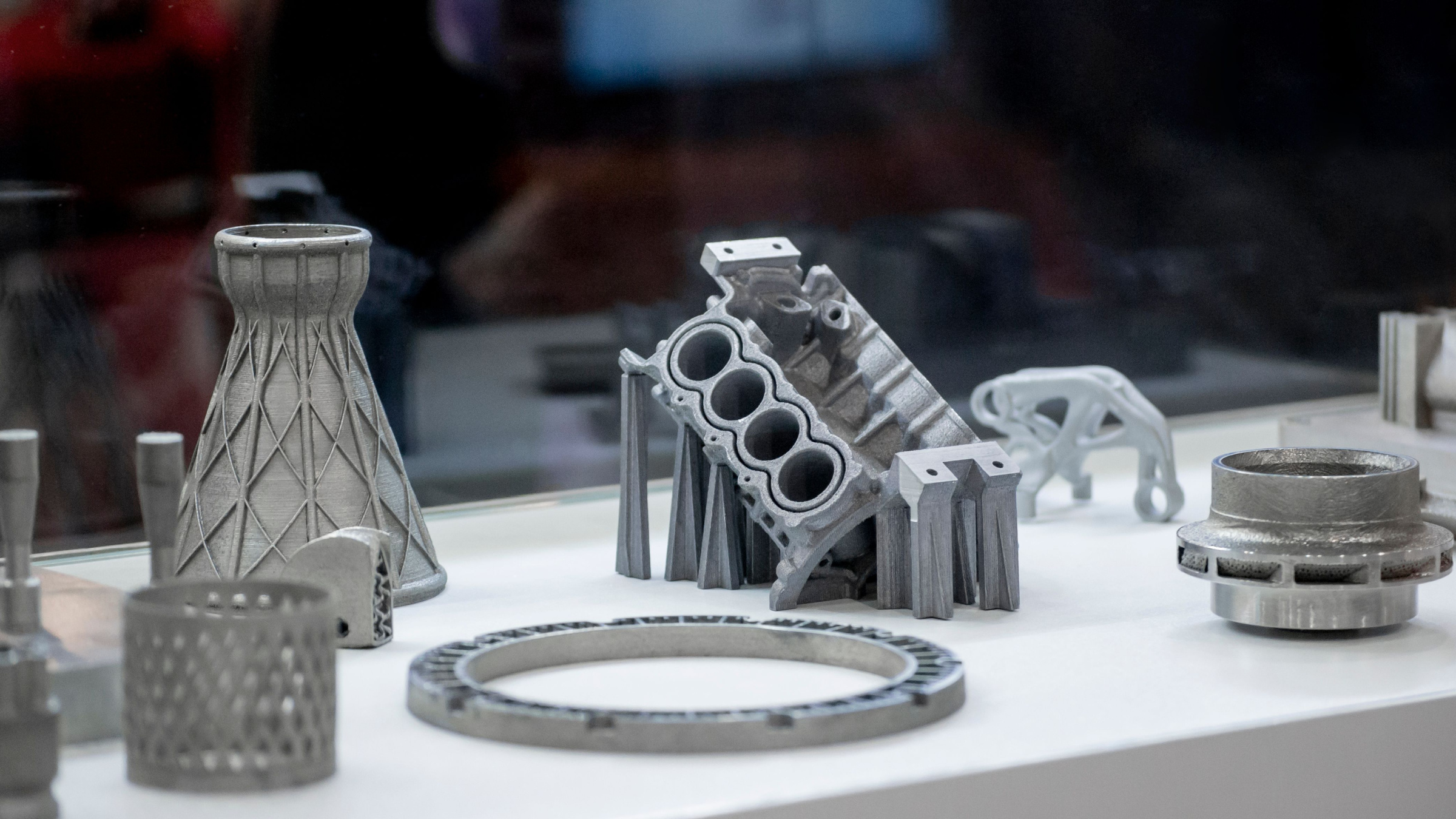
Researchers Unveil AI-Driven Method For Improving Additive Manufacturing
Many industries rely on metal additive manufacturing to rapidly build parts and components. Rocket engine nozzles, pistons for high performance cars, and custom orthopedic implants are all made using additive manufacturing, a process that involves building parts layer-by-layer using a 3D printer.
Additive manufacturing allows users to build complex parts quickly, but structural defects that form during the building process is one of the reasons that have prevented this approach from being widely adopted. Researchers from the U.S. Department of Energy’s (DOE) Argonne National Laboratory have developed a new method for detecting and predicting defects in 3D printed materials, which could transform the additive manufacturing process.
The method was recently published in the journal Science by a research team led by Argonne and the University of Virginia (UVA). The scientists used various imaging and machine learning techniques to detect and predict the formation of pores in 3D printed metals in real time with near-perfect accuracy.
The metal samples used in the study were created using a process called laser powder bed fusion, in which metal powder is heated by a laser and then melted into the proper shape. But this approach often leads to the formation of pores that can compromise a part’s performance.
 Many additive manufacturing machines have thermal imaging sensors that monitor the build process, but these can miss the formation of pores because they only image the surface of the parts being constructed. The only way to directly detect pores inside dense, metal parts is by using intense X-ray beams, such as those generated by the Advanced Photon Source (APS), a DOE Office of Science user facility at Argonne.
“Our X-ray beams are so intense that we can image more than a million frames per second,” said Samuel Clark, an assistant physicist at Argonne. These images allowed the researchers to see pore generation in real time. By correlating X-ray and thermal images, the scientists discovered that pores formed within a sample cause distinct thermal signatures at the surface that thermal cameras can detect.
Then, the researchers trained a machine learning model to predict the formation of pores within 3D metals using only thermal images. They validated the model using data from the X-ray images, which they knew accurately reflected the generation of pores. Then, they tested the model’s ability to detect thermal signals and predict pore generation in unlabeled samples.
“The APS offered the 100% accurate ground truth that allowed us to achieve perfect prediction of pore generation with our model,” said Tao Sun, an associate professor at UVA.
Many additive manufacturing machines on the market already have sensors, but they aren’t nearly as accurate as the method the researchers discovered. “Our approach can readily be implemented in commercial systems,” said Kamel Fezzaa, a physicist at Argonne. “With only a thermal camera, the machines should be able to detect when and where pores are generated during the printing process and adjust their parameters accordingly.”
For example, if a major defect is detected by a machine early in the manufacturing process, the machine can automatically stop building a part. Even if the build process isn’t halted, the new approach can provide information on where pore defects might be within the part, saving users time during inspection.
“If you have a log file that tells you these four locations could have defects, then you’re just going to check out these four locations instead of looking at the entire part,” said Sun.
The ultimate goal is to create a system that not only detects defects, but repairs them during the manufacturing process. Moving forward, the researchers will study sensors that can detect other types of defects that occur during the additive manufacturing process. “In the end, we want to develop a comprehensive system that can tell you not only where you possibly have defects, but also what exactly the defect is and how it might be fixed,” Sun said.
About the Advanced Photon Source
 The U. S. Department of Energy Office of Science’s Advanced Photon Source (APS) at Argonne National Laboratory is one of the world’s most productive X-ray light source facilities. The APS provides high-brightness X-ray beams to a diverse community of researchers in materials science, chemistry, condensed matter physics, the life and environmental sciences, and applied research.
These X-rays are ideally suited for explorations of materials and biological structures; elemental distribution; chemical, magnetic, electronic states; and a wide range of technologically important engineering systems from batteries to fuel injector sprays, all of which are the foundations of our nation’s economic, technological, and physical well-being.
APS scientists and engineers innovate technology that is at the heart of advancing accelerator and light-source operations. This includes the insertion devices that produce extreme-brightness X-rays prized by researchers, lenses that focus the X-rays down to a few nanometers, instrumentation that maximizes the way the X-rays interact with samples being studied, and software that gathers and manages the massive quantity of data resulting from discovery research at the APS.
For more information: www.anl.gov