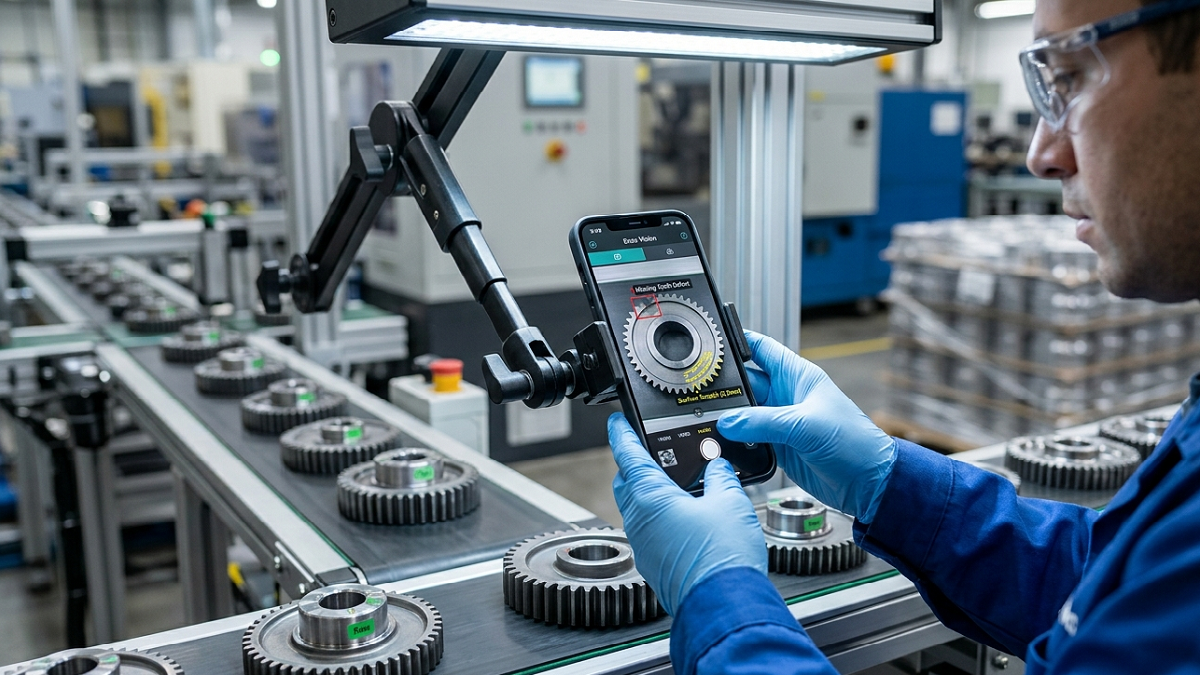
Reinventing End-of-Line Inspection with iPhone + AI
End-of-line (EOL) inspection is the final checkpoint before a product leaves your factory. If one defective item or pallet slips through, it lands with the customer. Now you have a recall.
This inspection is your last chance to catch a defect. If your quality inspection depends on tired human eyes or rigid rule-based cameras, you are taking unnecessary risks in 2026. That’s where AI-powered vision inspection comes in. With customers that have high quality standards, from the F&B industry to automotive manufacturers, companies have added AI-based quality control to the end of the production line.
What is End-of-Line inspection?
End-of-line (EOL) inspection is a quality check that comes at the end of the production process. This is where finished products are tested for completeness, quality, and functionality before they ship.
In industries like automotive, electronics, pharma, and medical devices, EOL testing isn’t optional. It’s how companies stay compliant, keep customers safe, and protect their brand.
Common EOL visual inspections include:
Surface defects (scratches, cracks, burns, discoloration)
Assembly verification (wrong components, missing parts or items)
Label and code accuracy (barcodes, lot numbers)
Seal and packaging integrity
The Gaps in Manual and Rules-Based Inspection
With limited technologies in the past, it seemed to be a choice between human experience and rules-based machine speed. Many companies that cared about quality and budgets chose to stay with manual inspections. Companies that chose automation usually worked with fast cameras that had rigid rules for detecting defects.
Older automated defect detection models generally had high-quality cameras with rigid software. Even though cameras had high frame-rate and resolutions to work on fast-paced production lines, the software analysis didn’t always work. This is because older machine vision systems usually needed thousands of defect samples to train the models. Systems might have used only anomaly detection, passing and failing products without a description. And still, they might not catch defects if there was no data.
Human inspectors are essential for their decision making and expertise. But the biggest challenge is fatigue and consistency. After hours on the line, attention drops. What one inspector flags as a defect, another passes. A growing business also means training new staff, which takes time and money. On a fast-moving line, critical defects get missed. For precision manufactured parts, a research study by Judi See showed that inspectors correctly rejected 85% of defective items, and incorrectly rejected 35% of acceptable parts.
That missing 15% has real costs: rework, written off stock, and warranty claims from unhappy customers. In the worst case scenario, especially with precision manufacturing, it is a safety issue and that can have large recalls. In 2025 alone, over 30 million vehicles in the US were affected by recalls due to vehicle and equipment issues that posed safety risks, according to the country’s National Health Transportation Safety Association.
With AI developments, it’s not an either-or between humans and automated defect detection anymore, but a team effort.
How AI-Based Quality Control Supports EOL Vision Inspection
AI and hardware developments have made vision inspection more accessible than ever before. Specialised cameras can be replaced with iPhones that can take poster quality photos. Rules-based anomaly detection is now improved with defect detection that can describe the problem and set acceptable bounds. The hardware can now be installed quickly without stopping a production line and can run all day.
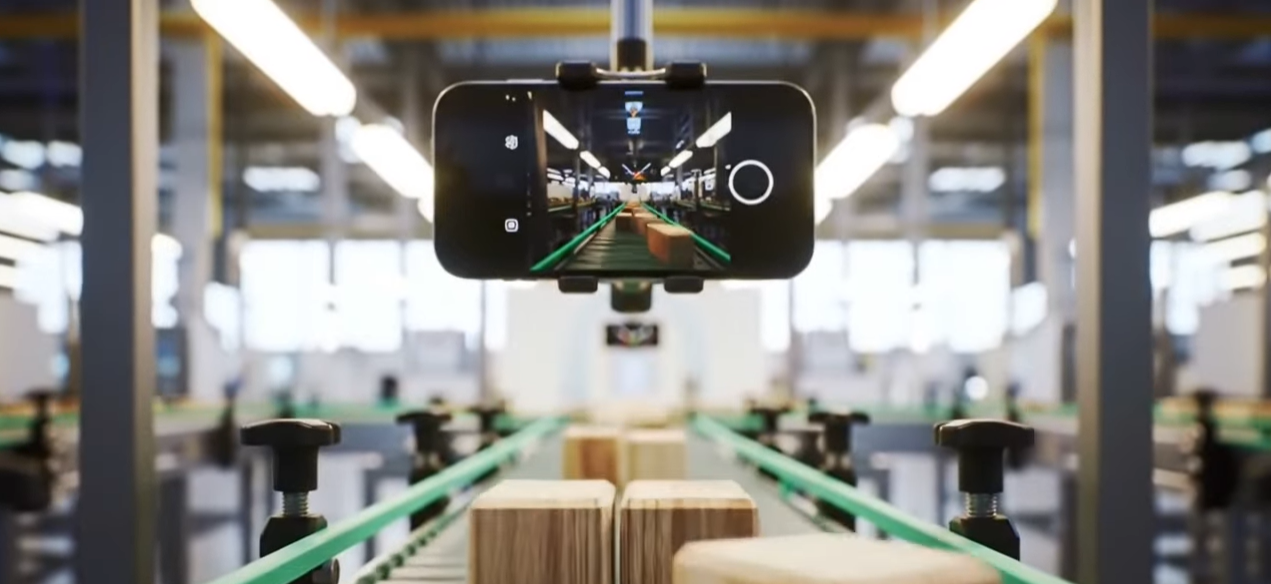
Its not suggested that manual vision inspection be fully replaced by machines. Instead, AI-based automated quality control can help people focus on the items with problems.
For example, Enao Vision’s AI-powered EOL inspection systems use deep learning software trained on real production data. The system learns what ‘good’ looks like — and flags anything that falls outside that standard. Staff on production lines can see what the issue is (discoloration, missing parts, etc.) and decide if the item needs to be removed. This focuses limited human energy on the critical task of handling of cases.
How Supervised AI Quality Vontrol is Better Than Traditional Machine Vision
Traditional rule-based vision systems need every possible defect to be pre-programmed. If a new defect type appears, the system misses it. Generalised AI models, like Enao Vision’s, work out of the box and learn from new data inputs. The Enao machine vision model does surface inspection and detects defects even without examples because it understands the overall pattern of quality. This generalisation also translates effectively to new product variations, saving inspectors time the longer the model is on the production line. In contrast, traditional machine vision requires a large sample of defects for every new product.
What Enao Vision’s EOL Systems Inspect for Customers
Enao Vision’s customers have used its solution for many different cases. Some examples include checking package completeness before household electronics are sealed or screw counts and hole sizes for automotive parts. The EOL inspection cases fall into these common production types:
Injection-molded plastic parts (flash, cracks, sink marks, contamination)
Rubber seals and gaskets (tears, surface defects, dimensional issues)
Metal components (scratches, dents, corrosion, weld defects)
Electronic assemblies and PCBs (missing components, solder defects)
Packaging and labels (seal integrity, misalignment, OCR verification)
Medical devices (burrs, particulates, fill levels)
Using AI quality Control Inline, End of Line, or Standalone
AI quality control doesn’t just have to be for EOL. It can be used anywhere in the production process. This is true of many solutions providers. For Enao users, they can even fit into manual assembly stations and tight spaces because our camera is just an iPhone and does not require proprietary hardware or special setups.
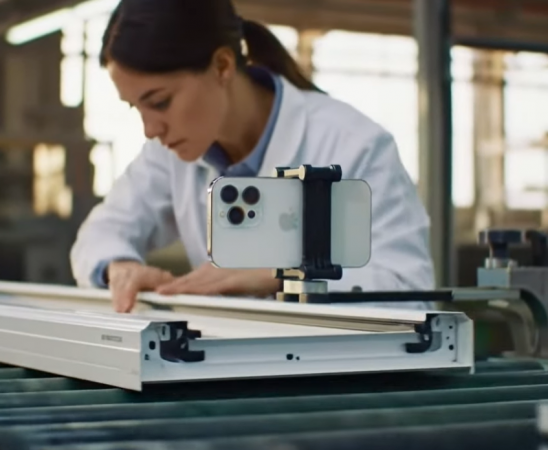 Adding an generalised AI quality control solution like Enao Vision is also not an either-or. If customers have an existing automated optical inspection system, it can be kept as a baseline to test with Enao Vision. Or, customers can test with a small production line that is still doing manual inspection. The lightweight setup is designed to work out of the box: an iPhone with a 5G hotspot included, mount, and lighting dedicated to the application needs.
A solution today should work with no production slowdown. It should not take months to wait for specialised lighting and hardware to begin testing whether an AI vision inspection solution works.
Moreover, users should have full traceability of the items inspected. With Enao Vision, every item inspected is logged. Every defect is documented with images, timestamps, and classification data. This supports the quality management system (QMS) and audit readiness as well and is possible because of the user-centric software built for production lines.
Defects that escape the production line cost far more to fix than defects caught at the end-of-line. The good news is that automated quality inspection has become more accessible than ever to manufacturers. It is faster to deploy, cost-effective, and low-risk compared to traditional industrial solutions with years-long contracts. AI-powered EOL inspection is the reliable, scalable way to protect manufacturing quality.
For more information: www.enaovision.com