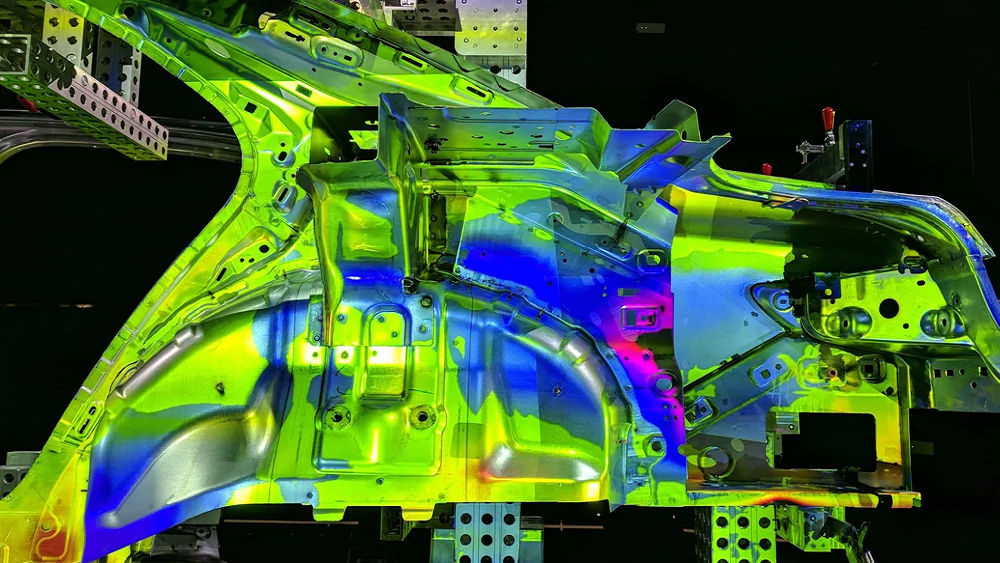
Real-Time Metrology Reshaping Automotive Production
Automotive manufacturing is entering a new era – one defined by precision, speed, and adaptability. Vehicle platforms are multiplying, component complexity is increasing, and production cycles are shrinking. Yet many factories still operate with processes designed for a slower, less data-intensive past. In this environment, competitive advantage no longer comes solely from faster machines or higher levels of automation, but from the ability to connect every phase of manufacturing through accurate, timely information.
At Polyrix, the belief is clear: the next leap in efficiency will be driven by connected manufacturing. By ensuring that the right data is available at the right moment, manufacturers can simplify automation, accelerate decision-making, reduce waste, and improve quality across the entire automotive ecosystem.
Rethinking Automotive Production
For decades, automotive manufacturing has followed a linear model. Design hands off to production, production hands off to inspection, and feedback loops, if they exist at all, are slow and costly. When issues are detected late in the process, teams are forced to retrace steps, resulting in rework, scrap, and production delays.
The challenge is not a lack of expertise. Engineering, production, and quality teams each operate at a high level. The problem lies in fragmentation. When critical data remains siloed, decision-making slows and quality issues surface only after they become expensive to correct.
Leading automotive manufacturers are now shifting away from segmented workflows toward connected ecosystems. In these environments, quality data flows seamlessly and in real time between design, production, and inspection. This shift enables earlier detection of issues, faster reaction times, and continuous improvement—without disrupting throughput.
Design: Smarter, Faster, More Predictive
Modern automotive design no longer relies solely on physical prototypes to validate concepts. Digital simulation, AI-driven analysis, and fast metrology feedback are transforming how engineering teams work.
With access to inspection data early in the development cycle, designers can:
- Identify feasibility issues before tooling is created
- Explore more design alternatives in less time
- Validate tolerances against real production conditions rather than assumptions
When inspection data feeds directly back into design, engineering becomes proactive rather than reactive. Problems are resolved virtually, long before they reach the factory floor. This not only reduces development costs, but also shortens time-to-market for new vehicle models—an increasingly critical metric in today’s competitive landscape.
Production: Data-Driven Agility on the Line
Once designs are finalized, production becomes the engine that transforms concepts into physical reality. However, even the most advanced production systems are vulnerable to inefficiencies when actionable data is missing or delayed.
In a connected manufacturing environment, production teams gain real-time visibility into part quality and process stability. This enables them to:
- Detect deviations as they emerge
- Reduce reliance on physical prototypes
- Adjust tooling and programs in near real time
- Maintain consistency across high-mix, high-volume operations
Rather than reacting to problems after they occur, production teams can anticipate and correct issues early. The result is a more agile manufacturing environment—one where flexibility increases, costs decrease, and throughput remains uncompromised.
Inspection: From Final Gatekeeper to Strategic Asset
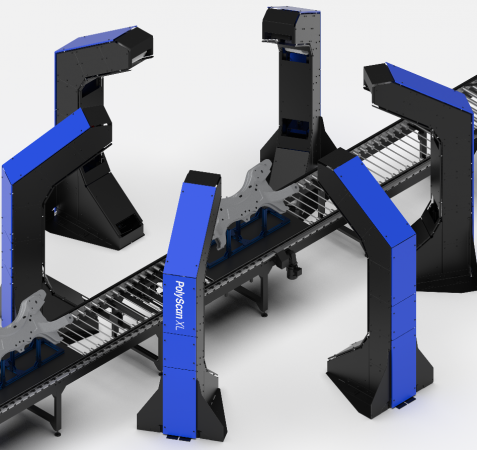 Traditionally, inspection has been treated as a final checkpoint – a necessary step to verify compliance before parts move downstream. In this model, inspection often acts as a bottleneck, slowing production rather than enabling it.
Cutting-edge manufacturers are redefining inspection as a strategic asset. With Polyrix’s motionless 3D scanning technology, inspection becomes fast, repeatable, and fully integrated into the manufacturing workflow.
Motionless 3D scanning delivers:
Speed: Capturing full-part coverage in seconds
Repeatability: Eliminating operator-dependent variation
Integration: Feeding high-density measurement data directly into design and production systems
Instead of being an end-of-line gate, inspection becomes the engine of continuous improvement. Quality data is no longer static – it becomes a living input that drives smarter decisions across the factory.
The Impact: Less Waste, More Precision, Better Vehicles
When design, production, and inspection are connected through real-time data, manufacturers unlock benefits that were previously difficult to achieve at scale:
Early defect detection – eliminating downstream rework
Traceable, high-density measurement data – simplifying compliance and root-cause analysis through a digital twin of each part
Shorter development cycles – accelerating innovation and model launches
Greater process stability – improving safety, reliability, and customer satisfaction
Lower operating costs – driven by fewer prototypes, reduced scrap, and faster troubleshooting
This is more than incremental optimization. Connected manufacturing creates a structural advantage – one that allows automotive leaders to outperform competitors still relying on traditional checks and balances.
Motionless 3D Scanning Technology
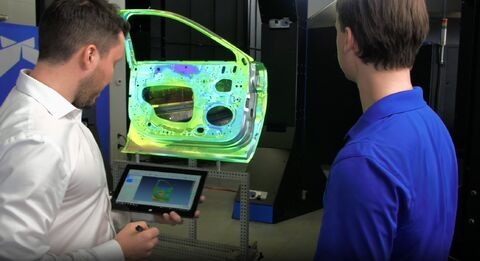 Polyrix’s motionless 3D scanning technology is purpose-built for demanding production environments where speed, precision, and reliability are non-negotiable. By eliminating unnecessary robot paths and reducing system complexity, Polyrix enables automated inspection even for large, complex automotive components.
The core contribution is simple but powerful: delivering accurate information at the exact moment it is needed. Once that information is available, automation becomes not only possible, but straightforward.
Conclusion: The Future Belongs to Connected Manufacturing
The automotive industry is evolving rapidly, and manufacturers that embrace connected workflows are setting the pace. By enabling real-time communication between design, production, and inspection, organizations reduce waste, improve agility, and deliver higher-quality vehicles faster.
While the concept of Industry 4.0 can appear complex, its foundation is surprisingly simple: access to the right information at the right step in the process. When data flows freely, automation becomes easier, decisions become faster, and manufacturing becomes more human-centered and efficient.
Polyrix supports this transformation with advanced metrology technologies designed for the future of automotive manufacturing – where precision, speed, and connectivity define success.
For more information: www.polyrix.com