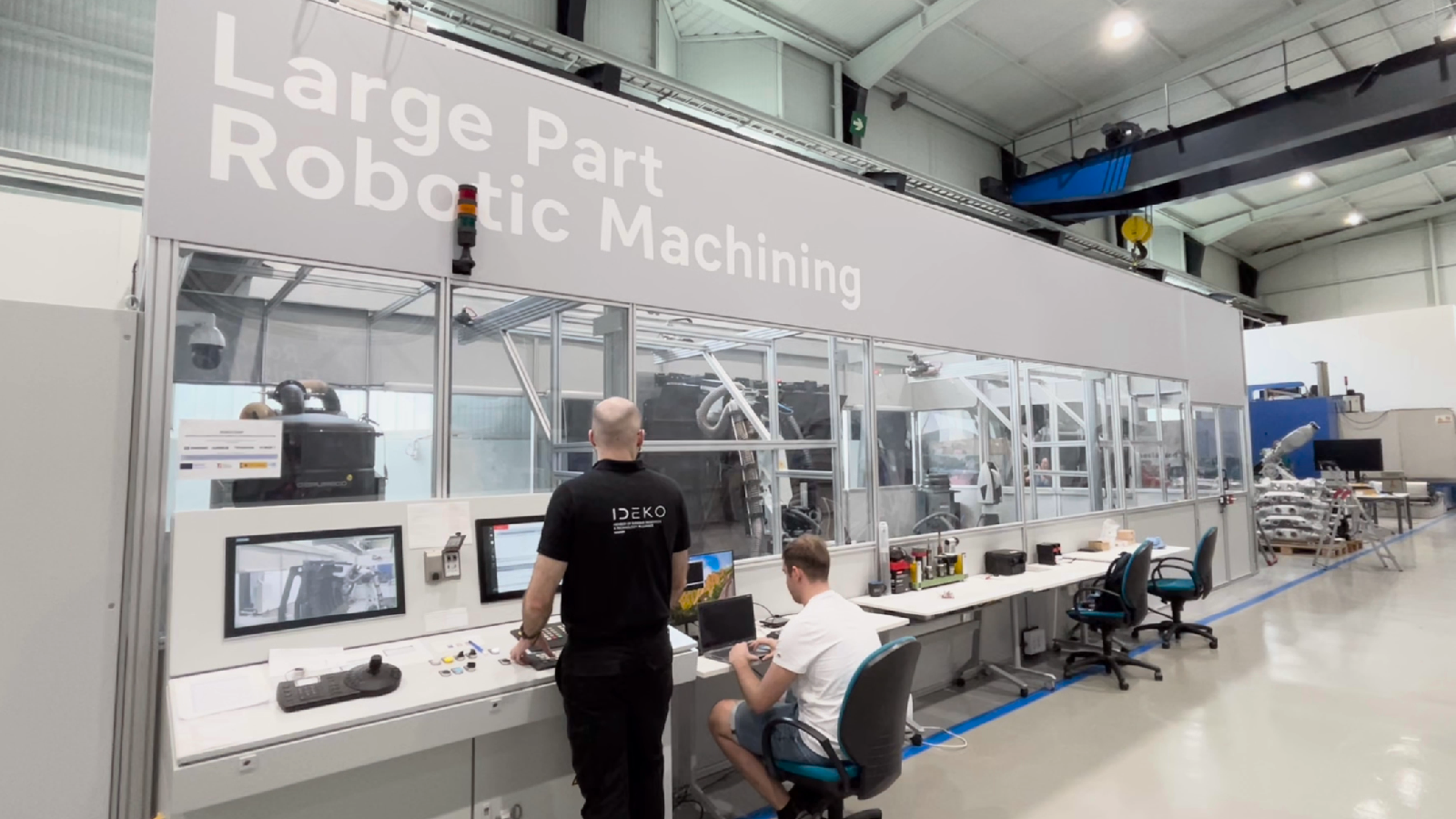
New Generation Robotic Cells to Drive Flexible Aerospace Manufacturing
The aeronautical industry faces a dual challenge: achieving net-zero emissions by 2050 while enhancing competitiveness through reduced production costs. Today, these goals are constrained by heavy, costly, and inflexible machinery that dominates traditional manufacturing processes.
To address this, the Basque technology centre IDEKO has played a key role in developing a new generation of flexible, sensorised, and connected robotic cells as part of the ROBOCOMP project. Led by the DANOBAT cooperative, the initiative seeks to transform the production of aeronautical components.
“The new solutions are designed to replace conventional systems and automate critical machining operations on carbon fibre parts, such as milling, drilling, and trimming, improving efficiency and reducing energy consumption,” says Asier Barrios, a researcher at IDEKO.
Flexible Machining for Complex Geometries
ROBOCOMP responds to the limitations of existing machinery. Traditional large-scale equipment typically machines parts in a horizontal orientation, limiting access to complex geometries. The project’s robotic cells, by contrast, can operate on vertically positioned components, enabling greater flexibility and scalability in production. This adaptability allows manufacturers to respond rapidly to changing production demands.
Precision, Autonomy, and Real-Time Monitoring
IDEKO’s contribution has been crucial in equipping these cells with advanced intelligence. Research efforts focused on enhancing robot precision through improved mechatronics and system calibration – a necessity for meeting aerospace standards.
Autonomous operation is enabled through integrated sensors and artificial vision systems, allowing the robots to monitor processes in real time, detect deviations instantly, and ensure part quality. Additionally, energy-efficient machining strategies for composite materials have been implemented, advancing both sustainability and operational performance.
Industrial Collaboration and Cross-Sector Potential
The success of ROBOCOMP has relied on a robust industrial consortium covering the entire value chain. Alongside DANOBAT’s leadership and IDEKO’s scientific expertise, Airbus contributed end-user insights, Robotnik brought experience in mobile robotics, and Industrial Olmar provided autoclaves and pressure equipment expertise.
The technologies developed are transferable to other machining-intensive industries, including automotive, energy, and capital goods. This broad applicability strengthens the competitiveness of small and medium-sized enterprises and opens opportunities in advanced services and smart maintenance.
The project has been funded by the Centre for the Development of Industrial Technology (CDTI) under the Aeronautical Technology Programme (PTA), as part of Spain’s Recovery, Transformation, and Resilience Plan.
IDEKO is a member of the Basque Research and Technology Alliance (BRTA) with over 40 years of experience in R&D for advanced manufacturing. The centre focuses on precision machinery, manufacturing processes, and AI-driven solutions, providing innovations that enhance industrial competitiveness.
For more information: www.ideko.es