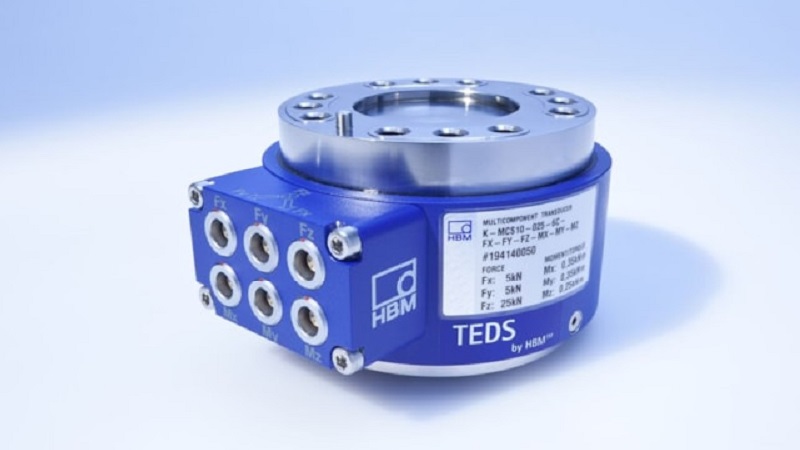
Multi-Axis Sensor Enhances Robotic Precision and Advances Testing Capabilities
Hottinger Brüel & Kjær (HBK) has introduced a new low-capacity variant to its MCS10 multi-axis sensor family, strengthening its portfolio for precision measurement in machine automation, production testing, and advanced R&D environments. The latest model has been engineered to help manufacturers and system integrators meet the rising performance demands of modern automated machinery and industrial test stands, where compact, accurate, and highly reliable force and moment measurement is essential.
Capture Six Components Simultaneously
The MCS10 series is designed to capture up to six components simultaneously – three forces in the X, Y, and Z directions and three moments around each axis. Engineers can configure each sensor with the exact number of measurement channels required, tailoring the device to specific application needs while controlling cost by avoiding unused capacity. With accuracy class up to 0.1 and advanced crosstalk compensation, the MCS10 ensures that each channel delivers clean, dependable data, even when measuring complex, dynamically changing loads.
The new low-capacity model extends the family with force ranges of 2 kN (Fz) and 0.5 kN (Fx and Fy), and bending moment measurement up to 20 Nm. These specifications open the door for more sensitive applications in robotics, lightweight assemblies, miniature mechanisms, and small-scale automated stations where high precision at lower forces is critical. The expanded seven-model lineup now spans capacities up to 200 kN / 40 kN / 40 kN, with custom options available for even higher load requirements.
A defining advantage of the MCS10 is its ability to minimize signal interference between channels. In typical multi-axis sensors, forces and moments often influence each other, creating crosstalk that degrades measurement fidelity. HBK’s optimized mechanical design, combined with an available individual compensation matrix, reduces these interactions to a minimum. When paired with an HBK measuring amplifier, the compensation process can be handled automatically, simplifying setup and calibration while maximizing accuracy.
To further streamline integration, the MCS10 supports TEDS (Transducer Electronic Data Sheet) technology. Once connected, the sensor can be automatically recognized by the data acquisition system without manual parameter entry, making commissioning faster and reducing the risk of configuration errors. This plug-and-measure functionality is especially valuable in automated factories and test environments where multiple sensors must be deployed or exchanged quickly.
Durability has also been prioritized in the new model. The sensor meets IP67 protection standards, ensuring resistance to dust, moisture, vibration, and other environmental stresses commonly found in industrial settings. It can withstand overloads of up to 200 percent, offering robust protection against unexpected mechanical impacts or operational faults.
With the addition of the new low-capacity version, HBK strengthens the versatility of the MCS10 family as a universal tool for capturing multi-axis loading scenarios with high precision. Whether in production-level control tasks, end-of-line inspection systems, automated handling equipment, or research test benches, the MCS10 provides a three-dimensional understanding of mechanical behavior that can significantly improve system performance and reliability.
By combining the insight gained from years of developing custom transducers with the cost efficiency and availability of a standard product, HBK continues to position the MCS10 series as a dependable solution for modern multi-axis load measurement across industrial and scientific domains.
For more information: www.hbkworld.com