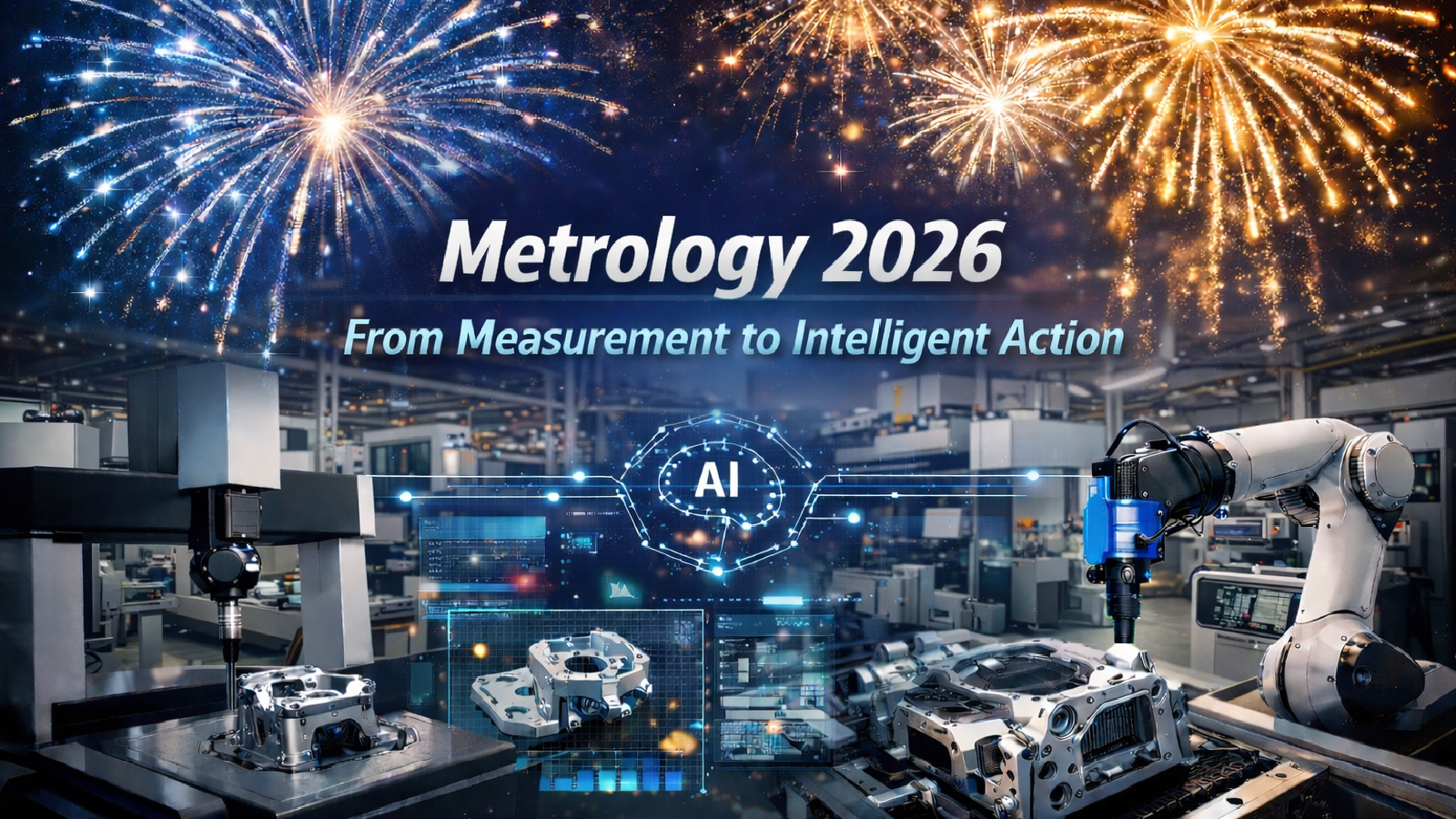
Metrology 2026: From Measurement to Intelligent Action
As 2026 begins, industrial metrology is undergoing a decisive shift – from a discipline focused on verification to one centered on intelligence, integration, with real-time impact.
For decades, metrology has played a critical but often downstream role in manufacturing. Parts were made first, measured later, and decisions followed after the fact. In 2026, that model is rapidly giving way to something far more dynamic. Driven by advances in artificial intelligence, digital thread integration, inline sensing, and software-centric platforms, metrology is moving directly into the flow of production.
The year ahead will not be defined by a single breakthrough technology, but by the convergence of these trends into practical, scalable solutions that deliver measurable value on the shop floor.
AI Moves from Experiment to Expectation
Artificial intelligence is no longer an experimental concept in metrology – it is becoming an expected capability.
In 2026, AI will increasingly be embedded across the inspection lifecycle. Measurement software will automatically generate and optimize inspection routines and adapt strategies based on part complexity and historical performance. More importantly, AI-driven analytics will help identify subtle trends and correlations that traditional statistical methods often miss.
Rather than simply reporting out-of-tolerance conditions, metrology systems will point toward likely root causes – linking dimensional variation to tooling wear, thermal effects, or upstream process drift. This marks a clear transition from quality reporting to quality intelligence.
Crucially, trust will be a defining factor. The industry is moving toward explainable AI, where models provide confidence indicators, traceability, and human-in-the-loop validation. Metrologists remain firmly in control, using AI to amplify expertise rather than replace it.
The Digital Thread Becomes Measurable
The digital thread has long been discussed as a strategic vision. In 2026, it becomes operational – and metrology is one of its most critical data sources.
Measurement results are increasingly linked directly to CAD models, simulation environments, manufacturing execution systems (MES), and quality management systems (QMS). This bidirectional flow allows inspection data to inform machining offsets, validate simulations, and even trigger design refinements.
By closing the loop between design intent and manufacturing reality, metrology enables faster product launches and more robust process validation. Digital twins are no longer static models; they evolve continuously as real measurement data updates virtual representations of parts and processes. For manufacturers under pressure to reduce time-to-market, metrology’s role in the digital thread becomes a competitive differentiator.
Inline and In-Process Metrology Gain Ground
One of the most visible changes heading into 2026 is the expanding adoption of inline and in-process metrology.
Advances in optical sensing, laser-based systems, computed tomography, and hybrid sensor technologies are making it feasible to measure parts at production speed and directly within manufacturing environments. What was once limited to specialized applications is becoming accessible across a wider range of industries.
The impact is significant. Quality shifts upstream, scrap and rework are reduced, and inspection evolves from a gatekeeper into an active process control tool. In high-mix, low-volume production, where traditional sampling strategies struggle, real-time measurement provides the consistency manufacturers need.
In 2026, the question is no longer whether inline measurement is possible, but how to intelligently balance measurement density with throughput and cost.
Software-First Metrology Takes Center Stage
While hardware innovation continues, software will clearly define the future of metrology in 2026. Cloud and edge computing architectures will enable scalable data processing, while advanced visualization tools will make complex measurement data easier to interpret.
Virtual inspection and simulation will also gain traction. Engineers can validate inspection strategies, assess measurement uncertainty, and explore tolerance scenarios before the first physical part is produced. This software-first approach reduces risk, shortens ramp-up time, and supports smarter decision-making earlier in the product lifecycle.
Metrology is increasingly defined not by the machine alone, but by the intelligence of the software ecosystem around it.
Automation with Transparency
Automation continues to expand across metrology, particularly in sectors such as automotive, aerospace, electronics, and medical manufacturing. Automated inspection cells can now handle loading, measurement, analysis, and reporting with minimal intervention.
However, full autonomy remains the exception rather than the rule. In 2026, successful automation will be characterized by transparency. Systems must clearly explain results, document decision logic, and maintain traceability – especially in regulated environments. Human expertise remains essential for exception handling, system validation, and continuous improvement. Automation will work best when it augments skilled professionals rather than isolating them from the process.
Looking Ahead
As 2026 begins, metrology stands firmly at the intersection of quality, productivity, and digital transformation. AI-driven insight, digital thread connectivity, inline sensing, and software-first platforms are reshaping how measurement contributes to manufacturing success.
For manufacturing industry the message is clear – metrology is no longer just about confirming conformance. It is about enabling faster decisions, tighter process control, and more resilient production systems.
 For professionals in metrology and manufacturing, this year promises a wealth of news, innovations, and trends to track. Metrology News will be at the forefront, reporting the developments that shape the industry, the tools that drive smarter decisions, and the technologies that redefine quality. In 2026, metrology is truly evolving into ‘Measurement to Intelligent Action’. Staying informed, embracing AI and digital integration, and applying insights in real time will be key to turning data into tangible outcomes. Those who fully adopt this approach will define the next era of manufacturing quality.
Metrology 2026 New Year’s Resolution
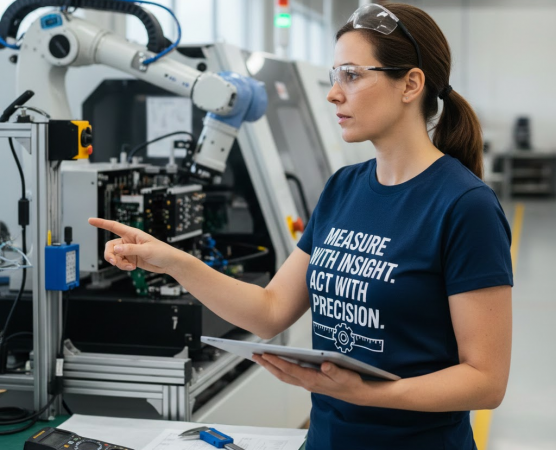
“Measure with Insight. Act with Precision”
Happy New Year – Editor