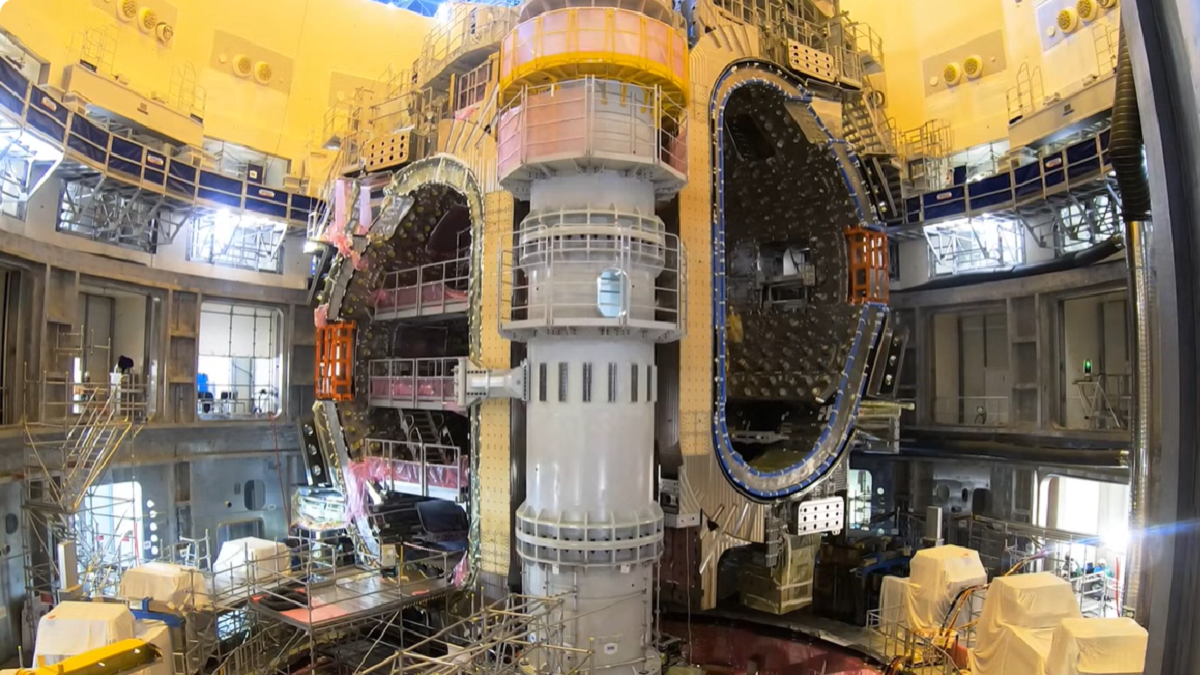
ITER Achieves Precision Milestone with Installation of Europe’s First Vacuum Vessel Sector
In a landmark achievement for the world’s largest fusion experiment, ITER has successfully positioned Sector Module #5 – the third vacuum vessel module to enter the Tokamak pit and the first manufactured in Europe. While the heavy-lift operation officially began at 6:00 a.m. on November 24th, the real work started days earlier, driven by a metrology-rich regime of preparation, calibration, and precision verification.
Metrology at the Heart of Mega-Lifting
Before a single tonne was lifted, ITER’s maintenance and crane operations teams conducted an exhaustive series of technical checks. These activities, often overlooked in the drama of a 400-tonne lift, are foundational to ensuring accuracy and safety.
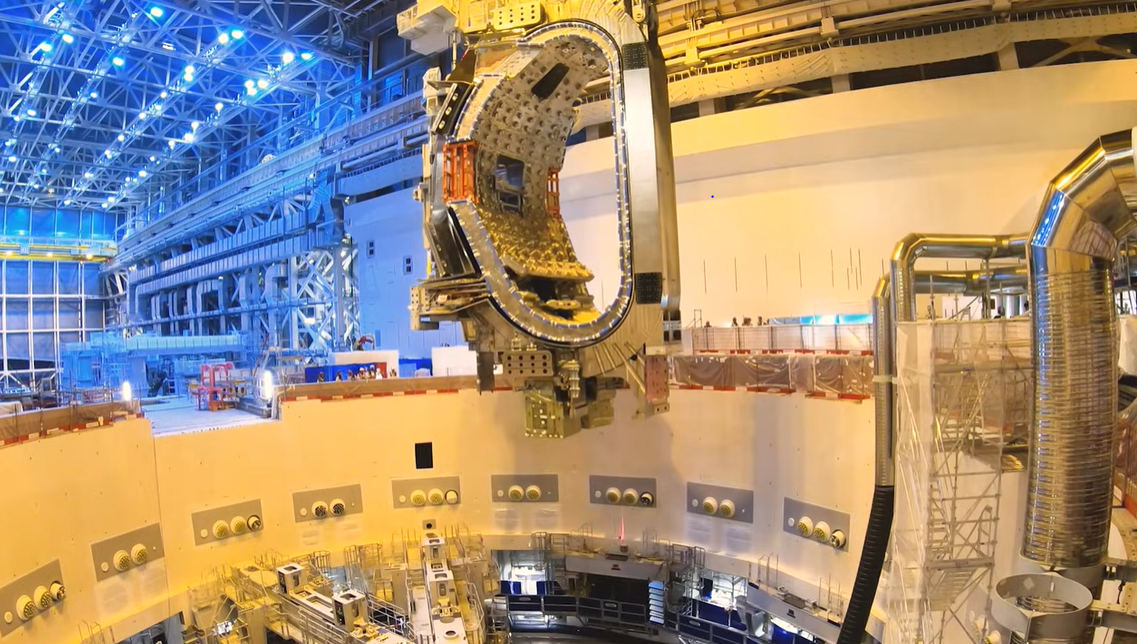
“We do the pre-checks—greasing, alignment checks, sensor checks, rope inspections,” explained one of the lifting supervisors. “We also discharge the variable-speed drives to eliminate electromagnetic disturbance.”
Central to these preparations was the RAS/RACS hook calibration procedure – a process ensuring that every crane sensor aligns to a unified positional baseline. In ITER’s vast crane hall, two overhead cranes with four synchronized hooks were calibrated to carry a massive dual-crane spreader beam. This beam would later support the rigging frame that ultimately connected to Sector Module #5.
A 24-Hour Operation Where Every Millimeter Counts
At dawn, the dual-crane lift commenced. Over the next 24 hours, the teams operated under continuous pressure. The movement of the vessel sector, comparable in scale to a multi-story building segment, was controlled with metrological rigor.

Reflective targets installed on the module played a key role in guiding the operation. Working in tandem, laser trackers and total stations captured real-time 3D positional data, allowing engineers to assess the relationship between the module’s current coordinates and the Tokamak pit’s reference frame.
“Based on the readings, we know the actual position of the sector,” said a member of the alignment team. “We also know our reference—the pit. With both, we can guide the mechanical team to bring the sector exactly into the mechanical position we aim for.”

The intricate interplay between metrology, motion control, and mechanical assembly underscores how precision engineering enables ITER to handle components weighing hundreds of tonnes with millimeter-level accuracy.
A New Milestone for ITER—and a ‘New Baby in the Nest’
By 5:00 a.m. the following morning, Sector Module #5 was settling into its final alignment within the Tokamak pit. As the team stepped back from the long night’s effort, relief and pride were palpable.
“It’s the achievement of teamwork,” said the crane operations lead, acknowledging the collaboration between ITER Organization construction crews, assembly contractors, SMSA’s lifting specialists, and the crane maintenance teams. “It is like a new baby in the nest.”
The installation marks another major stride toward completing ITER’s complex vacuum vessel—a core structure that will eventually confine plasma heated to 150 million degrees Celsius.
As fusion’s most ambitious construction project continues, the precision-driven orchestration of heavy-lift operations like this one highlights the critical role of metrology in enabling the future of clean, limitless energy.
For more information: www.iter.org