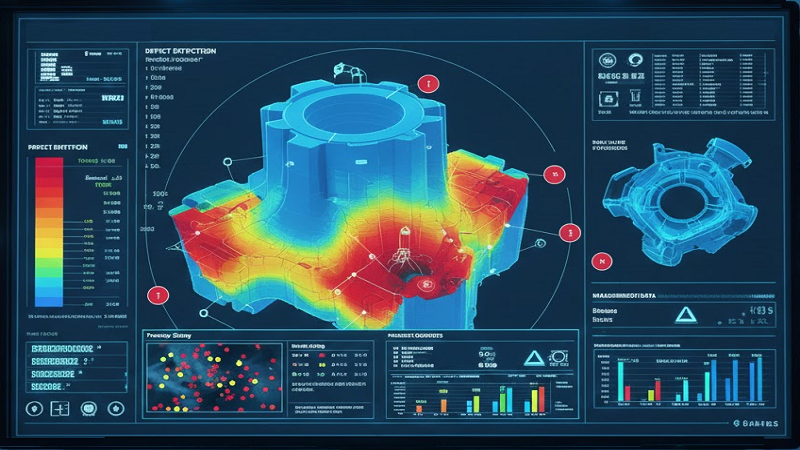
Intelligent Inspection – The Role of AI in Next-Generation CT Workflows
Where precision tolerances and complex geometry components challenge traditional quality assurance, computed tomography (CT) has become an indispensable tool for non‑destructive inspection. From additive manufacturing to aerospace castings, CT provides engineers with the ability to visualize and measure internal structures that would otherwise remain hidden. Now, artificial intelligence (AI) is transforming CT workflows, automating defect detection, improving accuracy, and accelerating throughput.
Convergence of AI and Industrial CT

Traditional CT inspection has relied on skilled operators to segment, measure, and interpret volumetric data. As production scales and tolerances tighten, manual analysis becomes a bottleneck. AI, particularly machine learning and deep learning, enhances CT by detecting anomalies, classifying defects, and compensating for noise and imaging artefacts reducing subjectivity and improving consistency.
ZEISS: ZADD Segmentation and Intelligent CT Inspection
ZEISS offers ZEISS Automated Defect Detection (ZADD) Segmentation, integrated with its INSPECT X‑Ray software. ZADD leverages deep learning to detect, segment, and classify internal defects, from pores and inclusions to complex structural anomalies, even in noisy or lower-resolution CT datasets. Integrated with ZEISS METROTOM CT hardware, ZADD provides automated evaluation metrics and robust reporting, enabling faster and more reliable inspection outcomes.
Hexagon: AI‑Enhanced VG Software
Hexagon’s VGSTUDIO MAX includes AI-assisted Porosity & Inclusion Analysis (PIA) tools. These allow automated detection and characterization of internal defects in metals, plastics, and composites. Hexagon also integrates CT inspection with simulation and FEA workflows, enabling a tighter connection between inspection, design, and process optimization.
Waygate Technologies: Automated Defect Recognition and Intelligent Workflows
Waygate Technologies brings decades of industrial inspection experience to CT. Its Automated Defect Recognition (ADR) software, often paired with the X|approver tool, uses AI to identify pores, cracks, inclusions, and other anomalies automatically. The system learns from real inspection data, improving detection accuracy over time.
Waygate’s InspectionWorks platform further complements its Phoenix and Seifert CT systems by providing automated data capture, centralized analysis, and actionable insights enabling scalable, data-driven quality control for both lab and production environments. These AI-driven workflows are particularly impactful in high-volume sectors such as battery manufacturing, automotive, and aerospace, where rapid, reliable defect detection is critical.
Nikon Metrology: AI-Augmented CT Imaging and Automation
Nikon Metrology has advanced industrial CT capability with AI Reconstruction, a deep learning-based technology that distinguishes structural information from noise and artefacts. This approach produces clearer volumetric datasets while allowing faster scanning, enabling detection of minute internal defects that traditional methods might miss.
Nikon also supports automated CT inspection workflows for production environments, with robotic part loading and end-to-end scanning. Results can be integrated into manufacturing execution systems for real-time quality control. Advanced techniques like Limited Angle CT further allow high-resolution inspection of complex or large components, extending CT’s applicability to electronics, EV batteries, and aerospace parts.
Lumafield: Cloud-First, High-Throughput AI CT
Lumafield combines integrated CT hardware with cloud-native AI software to bring high-speed, automated inspection to both lab and production environments. Its Neptune scanner provides rapid internal imaging for defect detection, while Voyager, a cloud-based platform, enables real-time visualization, measurement, and collaboration.
For production-scale inspection, Triton offers ultra-fast CT scans and real-time go/no-go decisions, turning CT into a factory-floor asset. Lumafield’s AI tools automatically detect defects, transform scan data into actionable insights, and support high-volume, repeatable workflows, making CT practical for routine quality control at scale.
Industrial Impact and Trends
AI in CT is enabling automation, digitalization, and smart quality systems. By reducing reliance on operator expertise, manufacturers can achieve more consistent inspection results, supporting zero-defect ambitions. Future systems may integrate closed-loop feedback, where AI not only identifies defects but predicts causes and recommends process corrections, connecting inspection directly with production optimization.
AI is reshaping computed tomography from a manual, operator-dependent process into an intelligent, automated, and adaptive inspection workflow. ZEISS, Hexagon, Waygate Technologies, Nikon Metrology, and Lumafield exemplify how industrial CT is evolving: combining hardware, software, and AI to deliver faster, more reliable, and more scalable defect detection. As these technologies mature, CT inspection is set to become a cornerstone of smart manufacturing and digital quality assurance.
Editor