Hyundai Motor Group To Accelerate Human–Robot Collaboration in Smart Manufacturing
At CES 2026, Hyundai Motor Group has introduced its AI Robotics Strategy under the theme “Partnering Human Progress,” outlining a roadmap to position the company as a leader in the emerging Physical AI era. The strategy emphasizes human-centered robots that operate in real-world environments, learning continuously from measured data to collaborate safely and effectively with people.
For smart manufacturing and metrology professionals, the announcement highlights a critical shift: robotics driven not just by automation hardware, but by real-time sensing, data validation, and software-defined factories.
From Automation to Human-Centered Physical AI
Hyundai defines Physical AI as AI systems embedded in physical machines that collect real-world data through sensors and hardware, enabling autonomous decision-making. This approach mirrors trends already reshaping advanced manufacturing – where continuous measurement, digitization, and feedback loops drive performance improvement.
By digitizing data across its entire value chain—from manufacturing and logistics to deployment and service—the Group aims to establish a closed-loop system where AI learning is constantly refined by measured reality and reapplied to physical operations.
Partnerships Powering Strategy
Hyundai’s robotics vision is anchored in three strategic partnerships. The first focuses on human–robot collaboration, starting in manufacturing environments where robots take on hazardous and repetitive tasks while humans maintain oversight.
The second integrates Hyundai’s global manufacturing scale with Boston Dynamics’ robotics expertise, creating an end-to-end AI robotics value chain spanning development, training, validation, mass production, and service.
The third pillar involves partnerships with AI leaders such as NVIDIA, enabling advanced simulation, AI infrastructure, and accelerated Physical AI development.
A Humanoid Robot Built for Industry
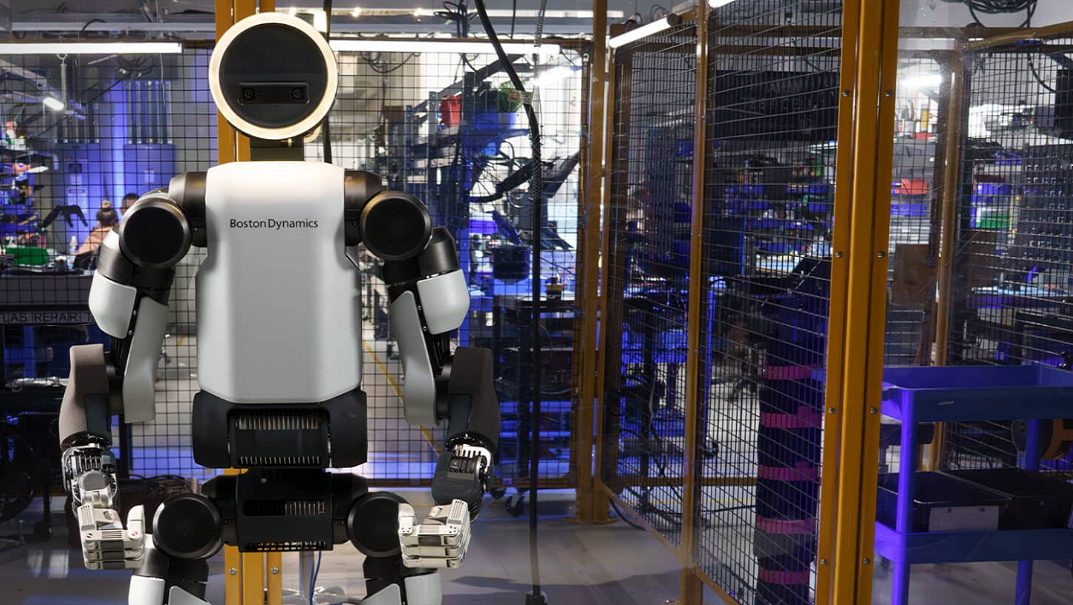
Unveiled at CES 2026, the Atlas humanoid robot represents a move toward production-ready, general-purpose industrial robots. Designed to work in spaces built for humans, Atlas features 56 degrees of freedom, tactile sensing hands, and fully rotational joints, allowing it to perform tasks such as parts sequencing, machine tending, and assembly.
Atlas can be trained for most tasks in under a day, lift payloads up to 50 kg, and operate autonomously with self-managed power systems. Its rugged, water-resistant design and wide operating temperature range make it suitable for real factory conditions rather than controlled lab environments.
Data-Driven Validation in Software-Defined Factories
Hyundai’s Physical AI strategy relies heavily on Software-Defined Factories (SDFs), where production processes are continuously monitored and optimized using real-world data. First deployed in Singapore and now expanded at Hyundai Motor Group Metaplant America (HMGMA), SDFs generate the datasets needed to train and validate intelligent robots.
Complementing this is the Robot Metaplant Application Center (RMAC), opening in the U.S. in 2026. RMAC provides a controlled environment where robots learn human movements and behaviors, which are then refined using operational data from SDF facilities. This closed-loop learning model enables continuous improvement in speed, accuracy, and safety.
Scaling Robotics with Automotive Manufacturing Discipline
A key differentiator for Hyundai is its ability to apply automotive-scale manufacturing expertise to robotics. Through its Group Value Network, affiliates such as Hyundai Mobis and Hyundai Glovis contribute standardized components, logistics optimization, and supply chain resilience.
This approach supports Hyundai’s goal of producing 30,000 robot units annually by 2028, a significant milestone for humanoid robotics. For the metrology community, this scale underscores the importance of standardized measurement, calibration, and quality assurance across large robot fleets.
Robotics as a Service and Lifecycle Optimization
Hyundai is extending its robotics offerings through a Robotics-as-a-Service (RaaS) model, providing robots via subscription with integrated maintenance, remote monitoring, and over-the-air software updates. This shifts value from one-time deployment to continuous performance optimization driven by real-world operational data.
RaaS deployments with partners such as DHL, Nestlé, and Maersk demonstrate applicability across logistics, warehousing, and industrial operations.
Toward a Measured, Human–Robot Future
Hyundai expects humanoid robots to become the largest segment of the Physical AI market. Atlas deployment will begin with highly validated processes such as parts sequencing in 2028, expand to assembly by 2030, and gradually take on more complex and physically demanding tasks.
Throughout this evolution, humans remain central – training, supervising, and working alongside robots. For smart manufacturing and metrology professionals, Hyundai’s strategy reinforces a clear message: the future of robotics depends on continuous measurement, real-world validation, and tightly integrated physical–digital feedback loops.
For more information: www.hyundainews.com