High-Fidelity Scan Data Integration Enables Machine-Specific Compensation in 3D Sand Printing
By integrating precision scanning and calibration into their workflow, Humtown can now optimize 3D models, extract precise 3D inspection profiles from 3D printed sand parts, and compare them back to the original SolidWorks design in real time. This eliminates the need for time-consuming third-party standalone solutions and leverages the engineering team’s existing SolidWorks expertise. Using this data, Humtown can calibrate their twelve 3D sand printers, ensuring uniformity across their production line. This streamlined approach has enabled Humtown to target a 40% or greater increase in production capacity, a leap that once seemed out of reach.
As one of the top 30 sand printing companies in the world, Humtown Additive operates twelve ExOne S-Max printing machines at its Ohio facility. However, despite this impressive lineup, production capacity remained underutilized due to variations in dimensional output across machines.
“Our printers performed exceptionally, but each machine had slight variances in output,” explains Zachary Johnston, Coach of New Markets. “That meant we had to restrict each customer order to a single machine, effectively reducing our overall throughput.”
This constraint led to:
- Inefficient capacity utilization, capped at just 68% of the theoretical maximum
- An inability to confidently distribute large production runs across multiple machines
- A growing need for quantifiable, data-driven quality assurance
- Lost revenue opportunities from reverse engineering services and legacy pattern digitization
SolidWorks Integration with Scan-to-CAD
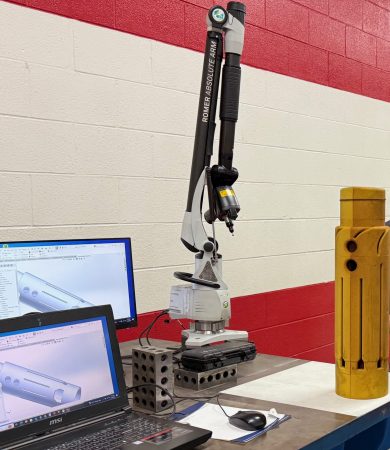 To address these challenges, Humtown leveraged a 7-axis Hexagon Absolute Scan arm PCMM for high-precision scanning but lacked the software integration necessary to harness its full potential. The missing link? ReverseEngineering.com’s SCAN-to-CAD add-in, a SolidWorks Gold Partner solution that seamlessly integrates high-fidelity scan data into the CAD environment.
“We had world-class scanning hardware,” says Zachary Johnston, Coach of New Markets, “but without the right software integration, we were only scratching the surface of what was possible.”
With the investment in the ReverseEngineering.com software, Humtown unlocked new capabilities:
- Direct point cloud acquisition within the familiar SolidWorks interface
- Automated surface reconstruction and deviation analysis
- Real-time comparison of 3D inspection profiles to original SolidWorks models
- Machine-specific calibration adjustments to ensure uniformity.
Precision in Action – Proving the Process
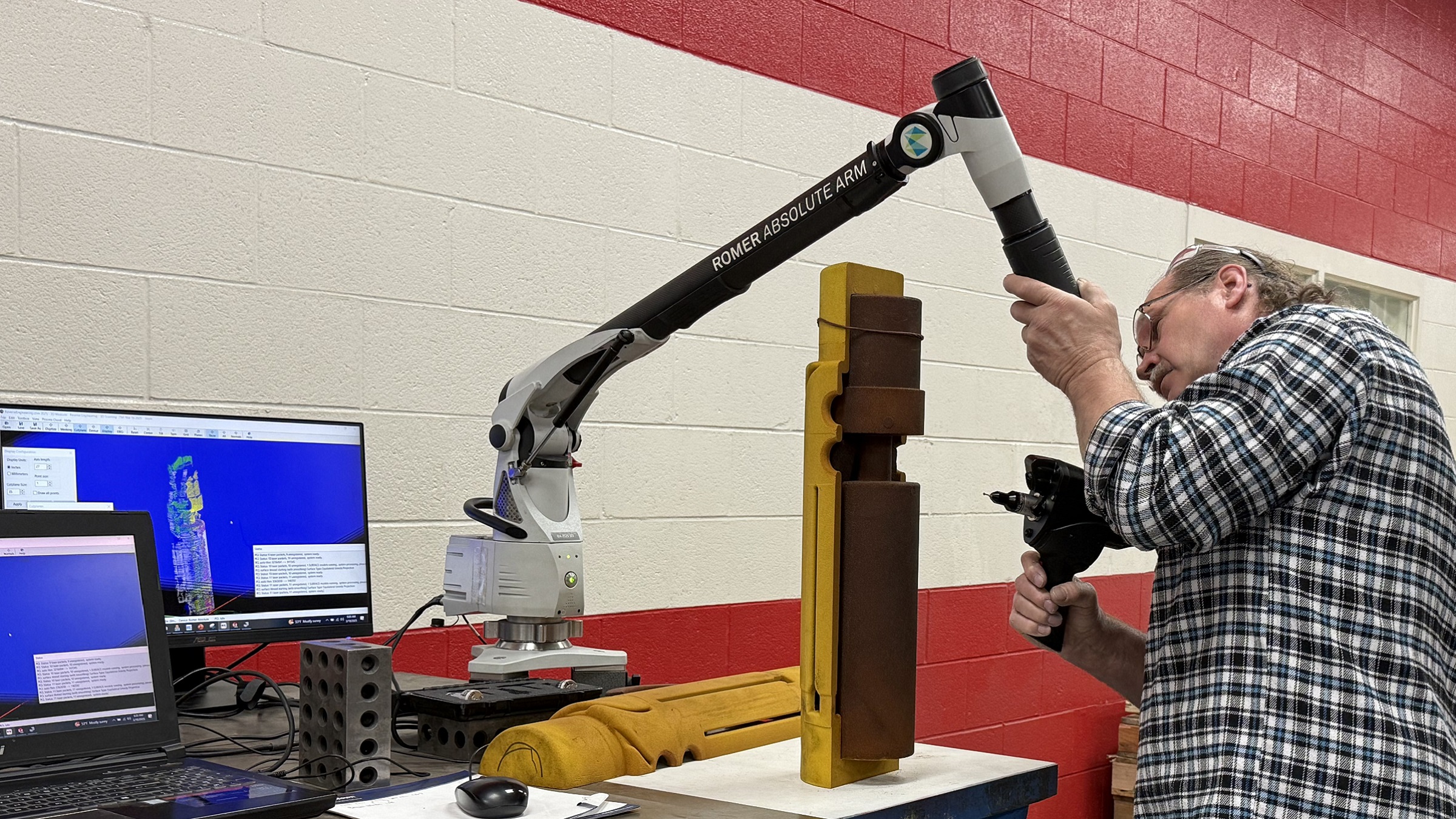
On the first day of training, Mark Lamoncha, Humtown President & CEO, reviewed a physical submarine part from the US Navy and challenged the team to prove the Scan-to-CAD process with the part. This exercise was designed to demonstrate a revenue-generating application that would directly benefit Humtown’s service offerings.
 “We wanted to ensure the team understood the real-world value of this technology,” says Mark Lamoncha. “By focusing on a tangible, high-value application like reverse engineering a Navy submarine part, we could immediately see how this solution would add value to our customers and our business.”
“Using and reading analog measuring tools can be difficult and inconsistent especially when writing down the results. Digital consistency will futureproof consistency for the manufacturing community. Industrial Athletes can only perform when they have world class equipment, SCAN-to-CAD is one of those tools” commented Mark Lamoncha, President & CEO, Humtown Products
During the three-day on-site training Humtown tested their new workflow on real-world applications:
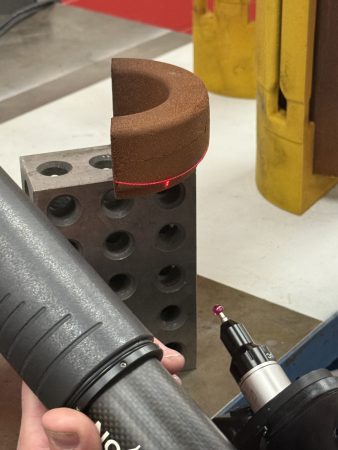
Complex 3D Printed Sand Part: A part with intricate geometry was scanned, analyzed, and compared to its original CAD model using color-mapped deviation analysis. The team confirmed the scan’s micron-level accuracy with calipers and gauge blocks.
US Navy Submarine Pattern Assembly: The multi-piece legacy pattern for a Navy submarine was reverse-engineered and reconstructed into a parametric model in SolidWorks. This validated the system’s ability to digitize legacy components with precision.
“The accuracy and ease of integration into SolidWorks were game-changing,” recalls Zachary Johnston, Coach of New Markets. “Seeing our scan data match up perfectly with our manual measurements gave us full confidence in the system.”
A Digital Thread for Quality Control
To fully leverage the new workflow, Humtown implemented a structured approach:
- Establish baseline dimensional performance on the newest S-Max printer.
- Generate precise deviation analysis in SolidWorks.
- Apply machine-specific calibration adjustments.
- Scale the process across all twelve production units to ensure consistency.
By capturing and analyzing real-time scan data, Humtown created a repeatable calibration process that ensures uniformity across all machines.
Enhanced Quality Assurance
- Standardized calibration across all 3D printers
- Data-driven verification of part accuracy
- Pre-shipping dimensional analysis for quality control
- Comprehensive measurement reports for customers
“This integration gives us a continuous digital thread from design to production and back to verification,” explains Johnston “It’s a closed-loop system that ensures accuracy at every stage.”
Increased Production Efficiency
- Large orders distributed across multiple machines with confidence.
- Maximized machine utilization with proactive calibration.
- Minimized waste and rework through precise dimensional control.
- Estimated 30-40% increase in effective capacity.
“By optimizing our existing machines instead of adding new ones, we’re scaling up production without additional capital investment,” notes their Production Systems Engineer. “The ROI is undeniable.”
New Revenue Opportunities
Beyond internal efficiency, Humtown is now offering:
- Reverse engineering of legacy patterns, including those dating back to 1923
- Digital conversion of customer-supplied traditional patterns
- Comprehensive measurement and documentation services
“Our customers rely on historical patterns, many without digital records,” states Johnston. “With this technology, we’re bridging the gap between legacy manufacturing and modern digital workflows.”
A Clear Path Forward: Innovation and Growth
“With this SolidWorks integration, we’re not just improving efficiency—we’re redefining how we manufacture,” summarizes Zachary Johnston. “This is a foundational step toward a fully integrated digital manufacturing ecosystem, where precision, scalability, and data-driven quality control drive our competitive advantage.”
Humtown’s roadmap for the future includes exploring additional SolidWorks add-ins, such as ScanTo3D and MBD (Model-Based Definition), to unlock even greater capabilities. ScanTo3D will enable advanced reverse engineering workflows, while MBD will allow Humtown to embed manufacturing information directly into 3D models, eliminating the need for 2D drawings and streamlining communication across design, engineering, and production teams.
From SolidWorks’ perspective, MBD is a game-changer for modern manufacturing. It replaces traditional 2D drawings with 3D models that contain all necessary manufacturing information, such as dimensions, tolerances, and surface finishes. This approach reduces errors, speeds up production, and ensures that all stakeholders are working from a single source of truth. For Humtown, adopting MBD could further enhance their ability to deliver precision parts faster and more efficiently.
This commitment to continuous innovation aligns with the broader industry shift toward digital manufacturing, where seamless integration of design, production, and quality control is becoming the standard. By leveraging tools like ScanTo3D and MBD, Humtown is positioning itself as a leader in the next generation of additive manufacturing.
For more information: www.reverseengineering.com