GoPxL Toolchains Reflect the Evolution of Inline 3D Metrology
Inline metrology continues to shift from isolated inspection tasks toward fully integrated, sensor-resident measurement workflows. As manufacturers demand faster cycle times, higher data fidelity, and tighter integration with automation systems, inspection software is increasingly expected to operate directly at the sensor level – delivering actionable dimensional data without reliance on external PCs or complex post-processing pipelines.
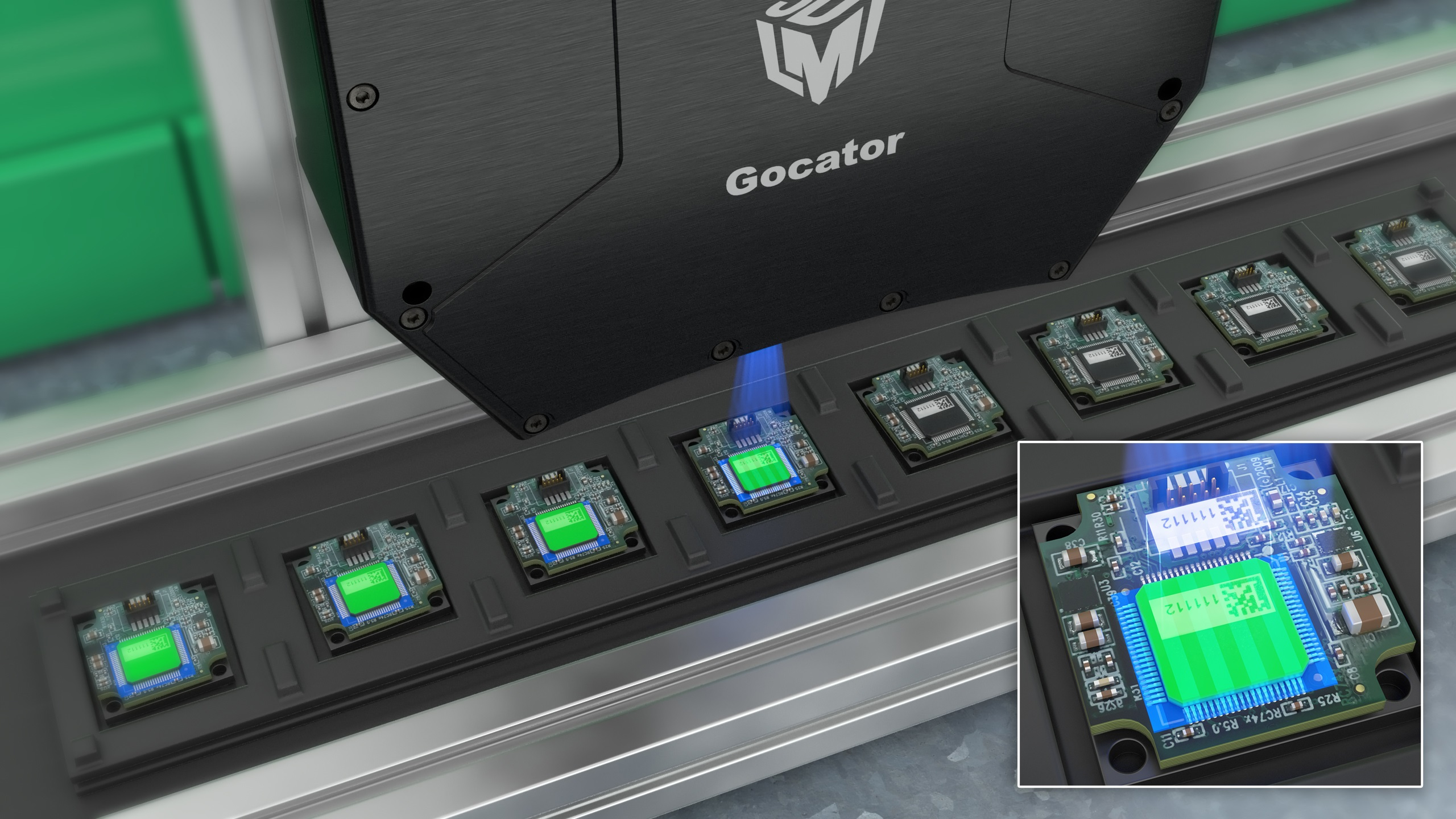 LMI Technologies’ GoPxL software is an example of this broader trend. Designed for deployment on the LMI Gocator family of 3D smart sensors, GoPxL enables engineers to configure end-to-end inline inspection toolchains that combine filtering, feature extraction, and dimensional measurement within a single, web-based environment. Rather than focusing on individual tools in isolation, GoPxL emphasizes structured workflows that align with the realities of high-speed production environments.
The following two representative applications, fastener measurement and connector pin inspection, illustrate how this approach aligns with current directions in inline 3D metrology.
Fastener Measurement: Reducing Complexity at the Sensor
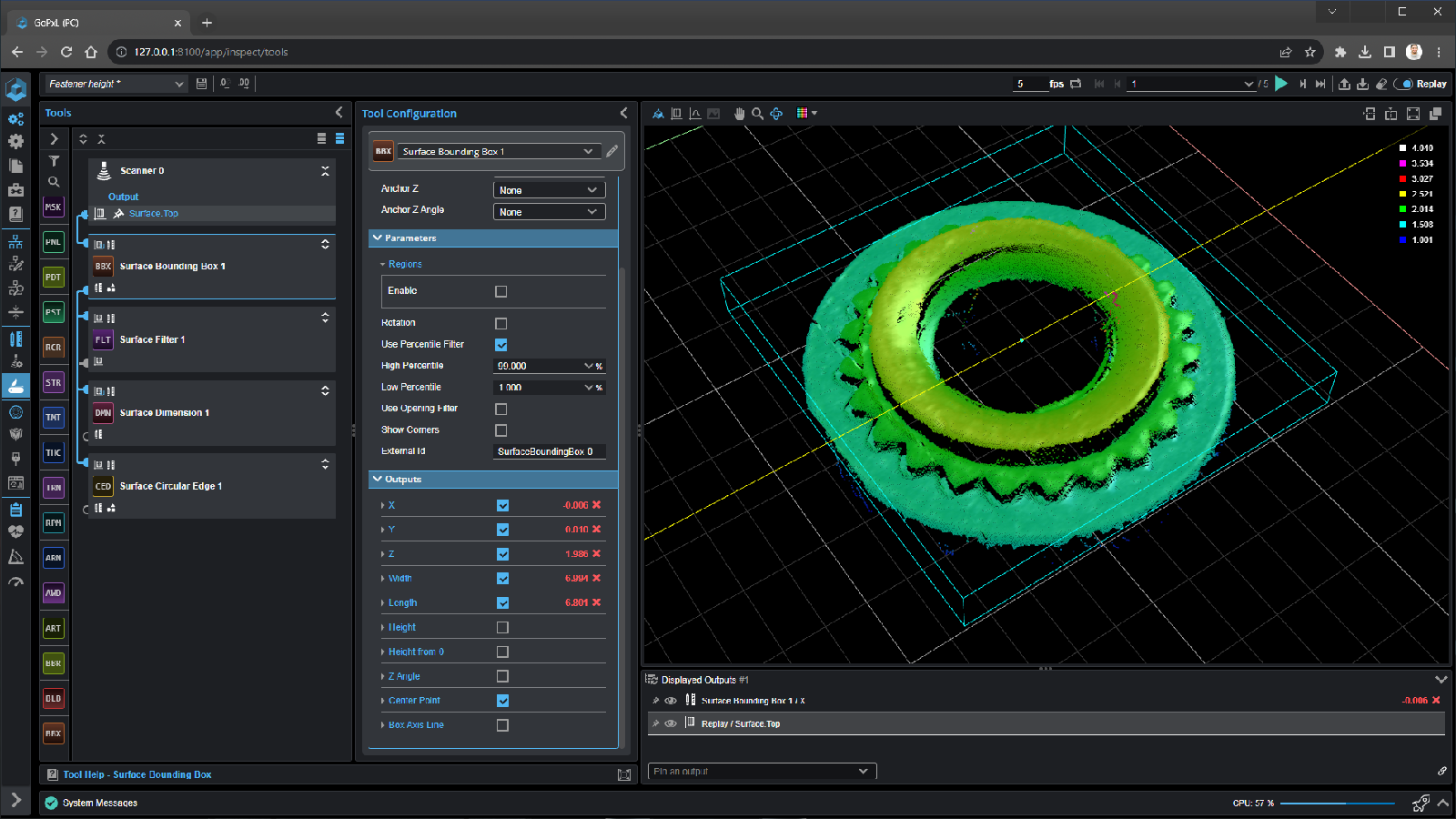
Fasteners remain a common but nontrivial inline inspection target, particularly when reflective surfaces and complex geometries are involved. In this example, dual Gocator 2520 3D laser line profilers are used to measure surface-to-surface height and the radius of a notched ring feature.

From an inline metrology perspective, the significance lies less in the specific dimensions being measured and more in how they are obtained. Reflection noise is addressed directly at the sensor level using percentile-based surface filtering, improving robustness before measurement data is generated. A surface bounding box establishes positional stability, accommodating part-to-part variation without requiring mechanical constraints or external alignment logic.
GoPxL’s support for circular regions within its surface dimension tools allows multiple measurements to be derived from the same surface data without masking or manual segmentation. The notched ring is characterized using a surface circular edge tool that samples the feature at configurable intervals, demonstrating how complex geometries can be handled within a streamlined inline workflow.
The result is a compact measurement toolchain that reflects a key trend in inline metrology: shifting decision-making and data conditioning closer to the sensor, reducing downstream processing overhead.
Connector Pin Inspection: Scaling Measurements Through Arrays
Connector inspection presents a different challenge – high feature density and repetition. In the case of a POWER/LAN connector inspected using a Gocator 3506 3D snapshot sensor, the task is to detect, count, and report the positions of 14 individual pins.
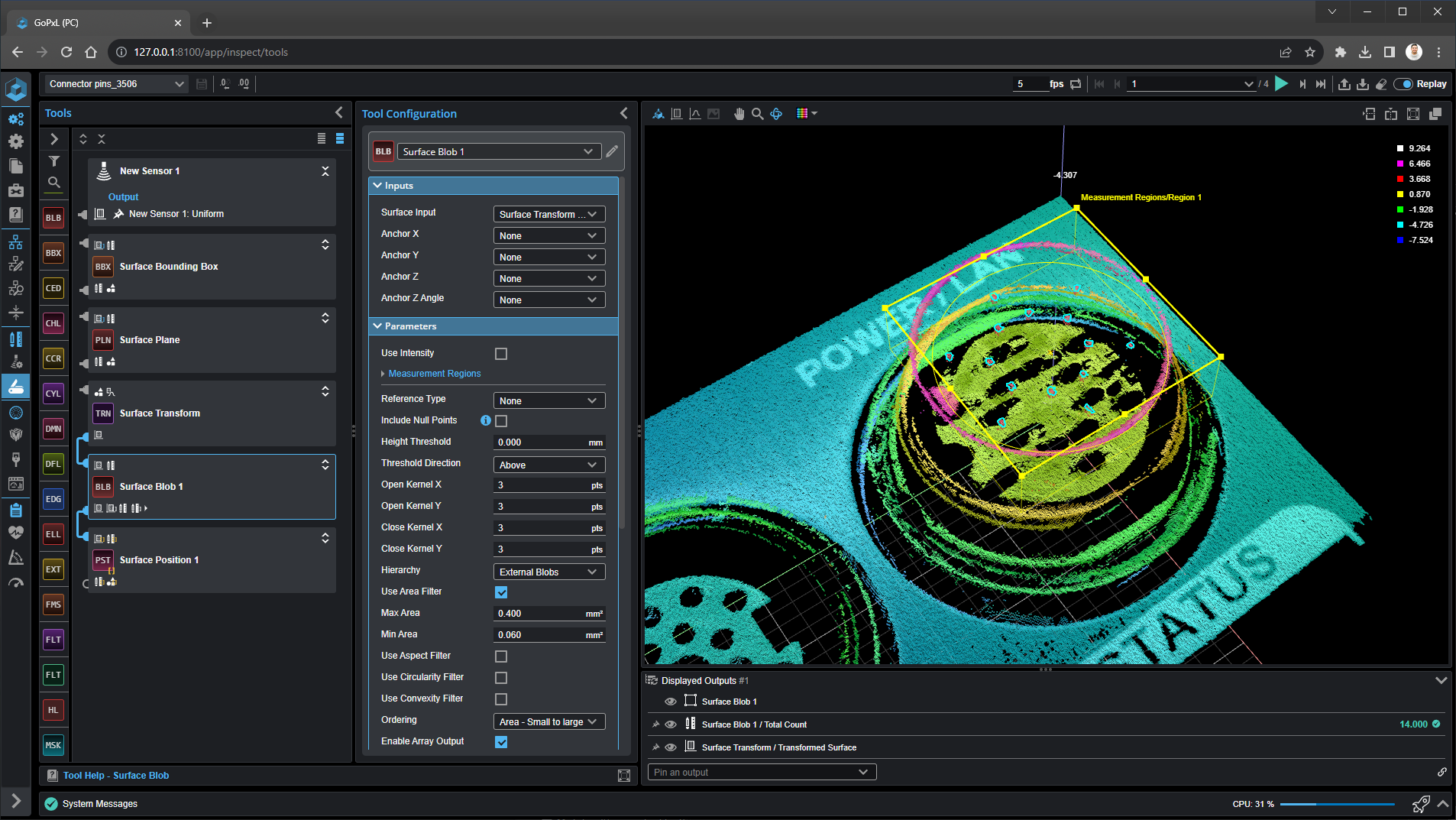 Here, GoPxL’s array-based processing model aligns closely with the needs of modern production lines. Rather than duplicating tools for each feature, a single workflow is applied across an array of detected pin surfaces. A reference plane establishes a consistent measurement baseline, while a surface transform normalizes the coordinate system for subsequent analysis.
Pin tips are detected using surface blob analysis and output as an array, enabling batch processing of positional measurements. X, Y, and Z coordinates for all pins are reported within a single toolchain execution, supporting high-throughput inspection without sacrificing detail.
This approach reflects a broader movement in inline metrology toward scalable measurement strategies—where increasing part complexity does not necessarily translate into increased system complexity.
Inline Metrology Beyond Individual Tools
Viewed in isolation, these applications demonstrate practical inspection techniques. Viewed in context, they reflect a larger industry shift toward integrated, software-defined inline metrology systems. Measurement logic, data conditioning, and feature extraction are increasingly embedded within smart sensors themselves, reducing latency and simplifying system architectures.
As manufacturing environments continue to adopt closed-loop quality control, digital threads, and real-time process feedback, inspection software must evolve accordingly. Toolchain-based approaches such as those demonstrated with GoPxL suggest a direction where inline metrology is less about assembling individual tools and more about orchestrating coherent measurement workflows that operate reliably at production speeds.
For engineers evaluating inline 3D inspection strategies, these examples underscore an important point: the future of inline metrology is not only about sensor performance, but about how effectively measurement intelligence is deployed where the data is first captured.
For more information: www.lmi3d.com