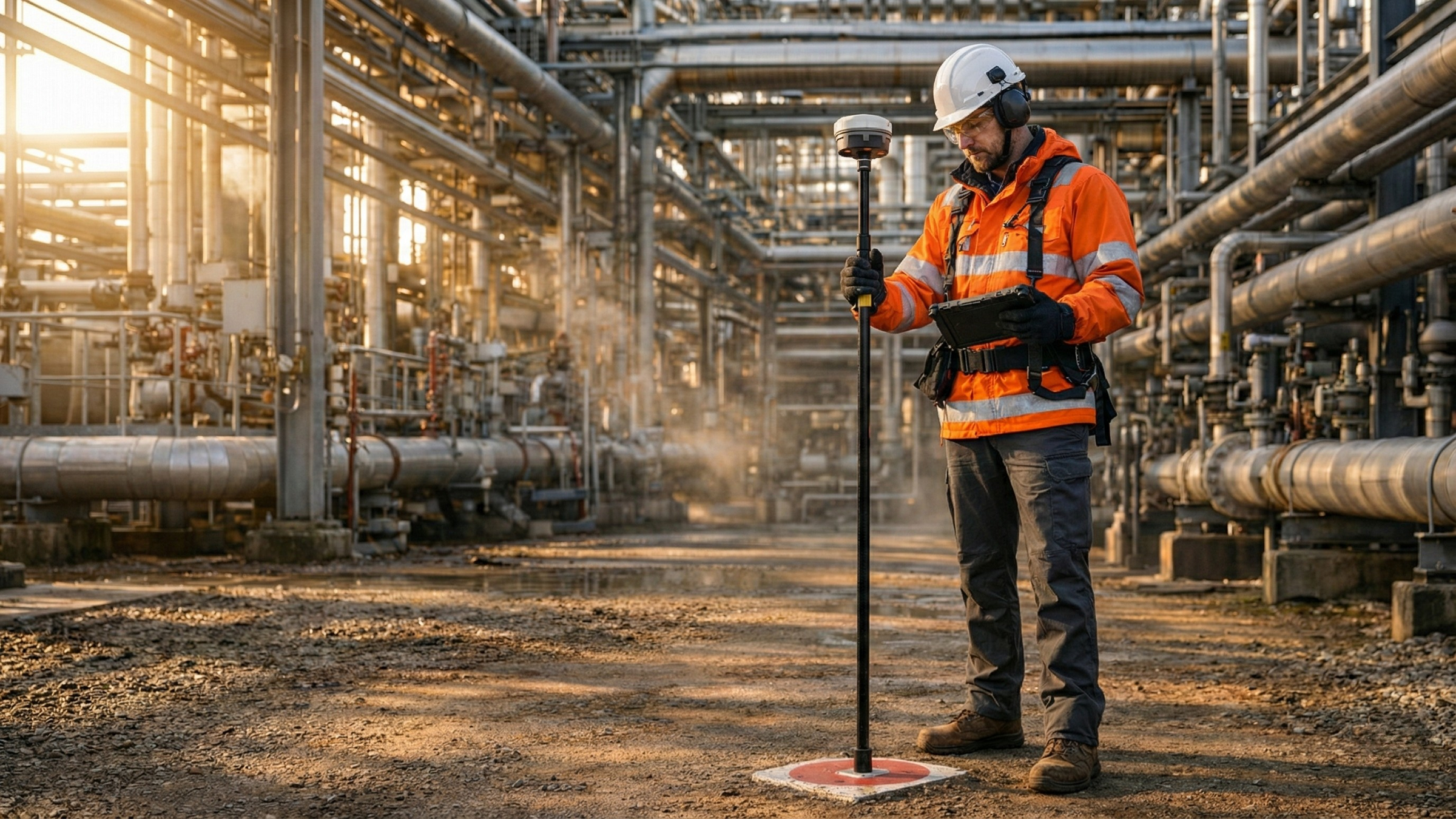
Georeferenced Precision for Industrial As Built Documentation
As built documentation has evolved from 2D redlines to georeferenced 3D point clouds and BIM integrated models. Refineries, chemical plants, power generation facilities, and shipyards demand dimensional records that reflect actual installed conditions rather than design intent. When modifications accumulate over decades of operation, accurate as built data becomes essential for maintenance planning, retrofit design, and regulatory compliance. Network RTK positioning via NTRIP protocol delivers the 1 to 2 cm accuracy that anchors these reality capture workflows to consistent global coordinate frames.
The Georeferencing Challenge in Brownfield Sites
Industrial facilities present hostile environments for survey equipment. Electromagnetic interference from high voltage systems, multipath reflections from steel structures, and restricted access zones complicate positioning workflows. Traditional approaches relied on established control networks, but these monuments often disappear during plant modifications or suffer displacement from ground settlement and thermal cycling.
Terrestrial laser scanners, mobile mapping systems, and handheld SLAM devices capture geometry efficiently, but raw point clouds lack absolute position unless tied to georeferenced control. Network RTK enables rapid control point establishment without transporting base station hardware through security checkpoints and confined space permits. Survey crews arrive, configure NTRIP credentials, and begin capturing georeferenced data within minutes.
Industrial Documentation Applications
Petrochemical facilities require periodic as built verification for pipe rack modifications, vessel replacements, and safety system upgrades. Georeferenced scans document existing conditions before engineering begins, reducing field conflicts during installation. The same coordinate reference supports clash detection between proposed designs and captured reality, identifying interferences before fabrication commits resources.
Power generation plants face similar documentation demands. Turbine hall surveys, cooling tower inspections, and switchyard mapping all benefit from consistent georeferencing that persists across multiple survey campaigns. When point clouds from different dates register to identical coordinate frames, change detection algorithms identify structural movement, corrosion progression, or unauthorized modifications automatically.
Technical Integration
GNSS receivers from Trimble, Leica, Topcon, Hexagon, and Emlid connect to NTRIP correction streams via cellular data or facility WiFi networks. RTCM 3.2 corrections supporting GPS, GLONASS, Galileo, and BeiDou arrive continuously, maintaining 1 to 2 cm horizontal and 2 to 3 cm vertical accuracy throughout the survey session. Fix convergence occurs within 10 to 30 seconds under open sky conditions typical of
outdoor process areas.
Distributed reference station architectures provide inherent redundancy. Individual station outages trigger automatic failover without operator intervention, critical for multi day survey campaigns where positioning continuity affects data registration. The network interpolatesatmospheric corrections to each rover position, maintaining consistent accuracy regardless of distance to physical reference infrastructure.
RTKdata aggregates corrections from over 20,000 reference stations across 140 countries through unified NTRIP access.
For more information: www.rtkdata.com
Author: Konstantin Nidens, Co-Founder of RTKdata