Function-First Robot To Redefine Factory Automation
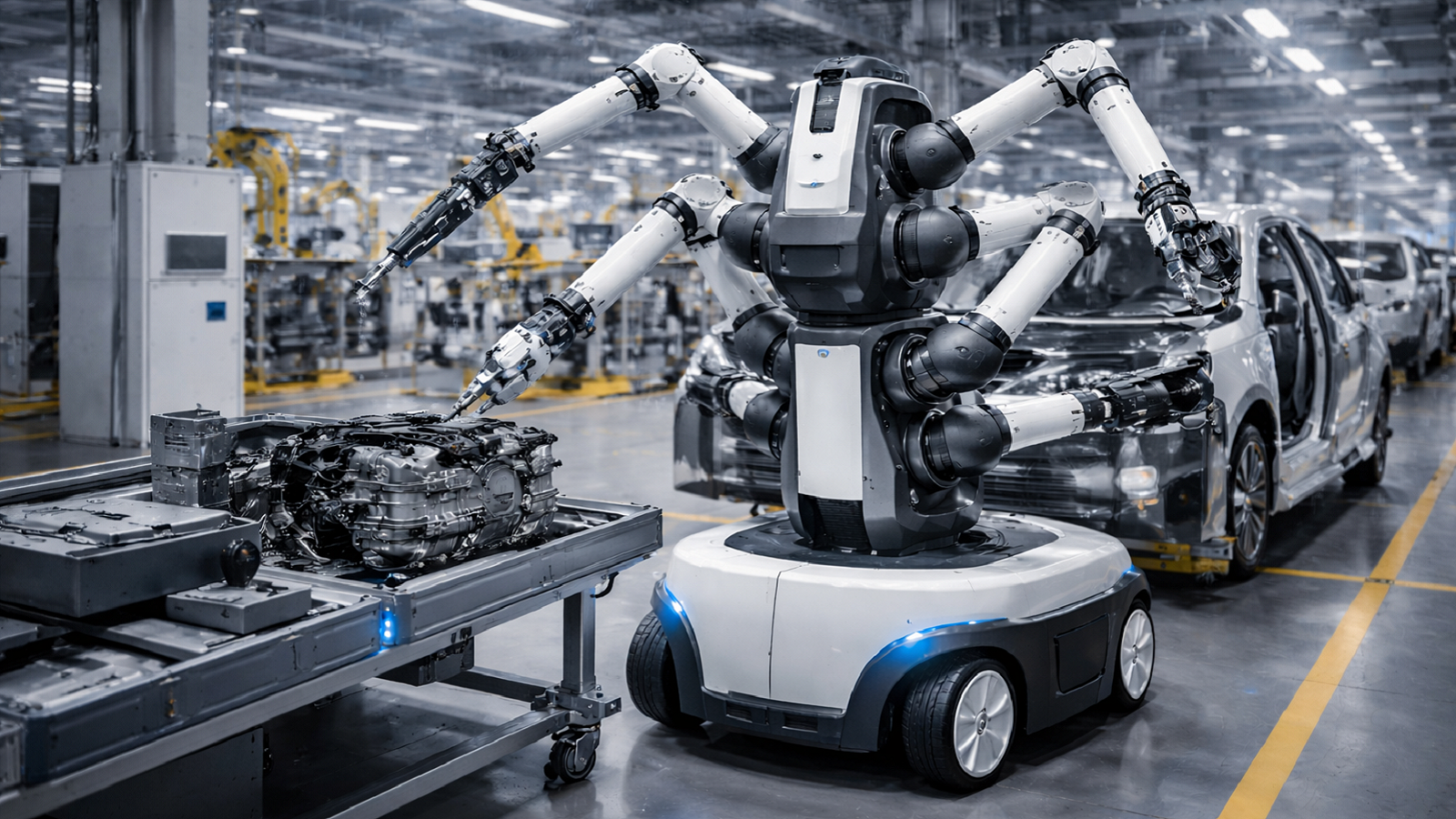
Chinese home appliance giant Midea Group has introduced a striking new entrant into the industrial robotics landscape: the MIRO U. Unlike the growing wave of humanoid robots designed to mimic human form, MIRO U takes a radically different path. It prioritizes function over form, embodying a purpose-built architecture engineered specifically for industrial efficiency, adaptability, and seamless integration into modern production environments.
With its six robotic arms mounted on a mobile wheeled base, MIRO U represents a departure from both traditional fixed robotic arms and emerging humanoid platforms. Its design philosophy signals an important shift in how manufacturers are thinking about automation – not as a human replacement, but as a highly optimized tool designed around the realities of factory operations.
Recent robotics headlines have been dominated by humanoid robots promising to work alongside humans in shared environments. Companies such as Tesla and Boston Dynamics have showcased machines designed with two arms, two legs, and anthropomorphic movement patterns.
Humanoid Robots Introduce Engineering Compromises
While visually compelling, humanoid robots introduce engineering compromises. Replicating human locomotion and anatomy requires significant computational overhead, complex balance systems, and energy-intensive actuation. These requirements can limit payload capacity, operational endurance, and reliability – factors that remain critical in industrial settings where uptime, repeatability, and throughput are paramount.
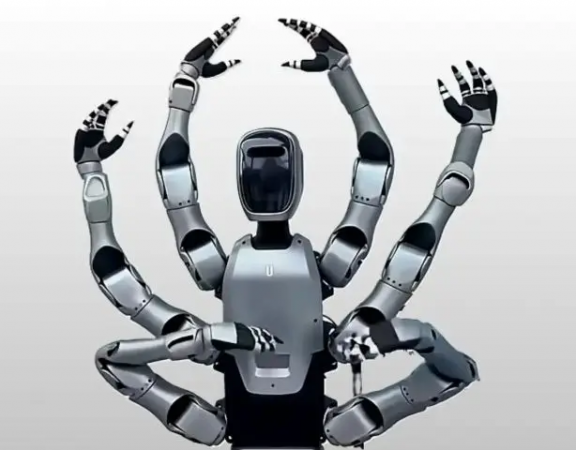
MIRO U sidesteps these constraints entirely. Its wheeled base provides stable, energy-efficient mobility, while its six-arm configuration dramatically expands its manipulation capability without introducing unnecessary structural complexity. This function-first approach aligns with a central truth of industrial automation: factories are optimized for productivity, not anthropomorphic compatibility.
The defining feature of MIRO U is its six independent robotic arms. This multi-arm configuration allows a single robot to perform tasks that would traditionally require multiple fixed robots or human workers. Instead of sequentially completing one operation at a time, MIRO U can perform parallel operations, allowing different arms to work simultaneously on different stages of an assembly process. This reduces overall cycle times and improves production throughput.
The architecture also enables complex manipulation scenarios. Some arms can stabilize or position components while others perform fastening, assembly or inspection tasks. This coordinated manipulation enhances precision while reducing the need for dedicated fixtures and tooling. Because the arms can dynamically shift roles depending on production requirements, the robot can adapt to different products or assembly sequences without major hardware changes.
By consolidating multiple robotic functions into a single mobile unit, MIRO U effectively becomes a flexible manufacturing cell capable of handling diverse operations while minimizing the overall automation footprint.
MIRO U’s wheeled base introduces autonomous mobility as a core capability. Traditional industrial robots are typically fixed in place or integrated into dedicated production cells. While effective for high-volume, repetitive production, these fixed installations limit flexibility and make production line reconfiguration both costly and time-consuming.
A mobile robotic platform changes this dynamic. MIRO U can be deployed where automation is needed most, allowing manufacturers to dynamically respond to production demands. The robot can move between stations, support different assembly areas, and adapt to changing workflows without requiring physical relocation of production infrastructure.
This mobility aligns with the growing shift toward flexible manufacturing, where production systems must accommodate shorter product lifecycles, increased customization, and fluctuating demand. Mobile robots enable automation to become a shared, adaptable resource rather than a fixed, single-purpose investment.
Implications for Metrology and Quality Assurance
For the metrology sector, the emergence of robots like MIRO U carries significant implications. Industrial robots are increasingly evolving into active participants in quality assurance processes rather than simply performing mechanical assembly tasks.
A multi-arm mobile platform creates opportunities to integrate measurement directly into production workflows. Robotic arms equipped with optical scanners, laser sensors, or tactile probes can be envisaged performing dimensional inspection at multiple locations on a part without requiring separate measurement stations. This approach accelerates inspection cycles and supports inline quality control.
Because the robot could manipulate and measure components within the same coordinated system, it reduces repositioning variability and improves measurement consistency. Mobile capability further enhances inspection flexibility by allowing measurement systems to be deployed wherever needed on the factory floor.
Such systems support closed-loop manufacturing, where measurement data feeds directly back into production processes. This enables real-time process adjustments, improving product quality while reducing scrap and rework.
Strategic Context: China’s Expanding Robotics Ecosystem
Midea’s investment in robotics reflects a broader strategic effort to strengthen its position in industrial automation. The company significantly expanded its robotics expertise with the acquisition of German automation leader KUKA in 2017. That acquisition provided advanced capabilities in robot design, motion control, and industrial integration.
China’s robotics sector continues to grow rapidly, supported by strong domestic demand and national automation initiatives. Traditional companies such as ABB, FANUC, and Universal Robots remain major global players, but Chinese manufacturers are increasingly developing competitive and innovative solutions.
MIRO U demonstrates China’s shift toward creating advanced, flexible robotic platforms designed to address modern manufacturing challenges rather than simply replicating traditional automation models.
“The core value of Meiluo U lies in breaking through form imitation and achieving a leap in operational efficiency in industrial scenarios. This is a key breakthrough in the practical application of humanoid robot technology” stated Wei Chang Vice President and Chief Technology Officer (CTO) of Midea Group. He added that Midea Group’s more than 100 smart manufacturing plants and whole-house smart appliance ecosystem globally provide a natural platform for scenario verification and data accumulation for robot technology.
Function-First Robotics and the Future of Factory Automation
MIRO U’s design reinforces a key principle in industrial robotics: optimal performance depends on functional efficiency rather than human resemblance. By prioritizing mobility, multitasking capability, and operational flexibility, MIRO U offers a practical solution tailored to the needs of modern factories.
This approach aligns with broader Industry 4.0 trends emphasizing flexible automation, digital integration, and real-time process optimization. Robots capable of moving freely within production environments and performing multiple coordinated tasks represent a natural evolution in manufacturing automation.
For metrology professionals, these developments present new opportunities to integrate measurement and inspection directly into production workflows. Robots capable of combining manipulation and inspection functions can support continuous quality verification and enable real-time process feedback.
A Glimpse Into the Autonomous Factory
Midea’s MIRO U represents more than an incremental advancement in robotic design. It reflects a shift toward autonomous, adaptive manufacturing systems where robots operate as intelligent, mobile production assets.
For the metrology sector, the implications are profound. Measurement and quality assurance can increasingly occur within the flow of production itself, enabling faster feedback, improved accuracy, and more efficient manufacturing processes.
MIRO U illustrates how function-first robotics may shape the next generation of factory automation – bringing greater flexibility, efficiency, and intelligence to industrial production.
Editor