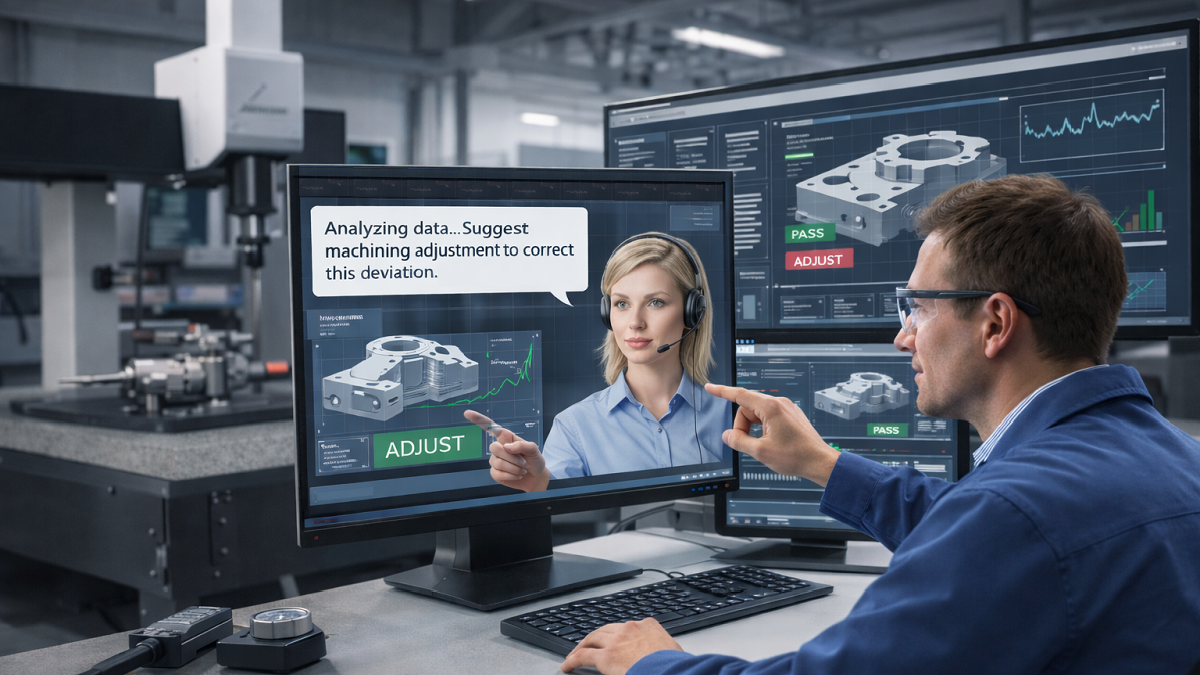
From Data to Insight – How AI Is Transforming Manufacturing Software
For decades, metrology software has focused on one core task: accurately measuring parts and reporting deviations against nominal values. While automation, CAD integration, and digital reporting have steadily improved efficiency, the responsibility for interpreting results and deciding next actions has largely remained with human experts.
That boundary is now beginning to shift.
In recent weeks, multiple manufacturing and metrology software providers have unveiled AI-assisted “copilot” features, marking a significant shift in the industry — from metrology systems functioning solely as measurement tools to context-aware decision engines integrated into the digital manufacturing thread.
From Data Output to Actionable Guidance
Unlike earlier automation tools that relied on scripting, templates, or rules-based workflows, AI copilots function as interactive, context-aware assistants. They guide inspection planning, flag anomalies, interpret measurement results, and recommend corrective actions — often in real time. Powered by large language models (LLMs) and machine learning, these intelligent virtual assistants help users complete tasks more efficiently, enhance decision-making, and automate routine work. Within applications AI copilots collaborate with users by suggesting responses, summarizing data, and streamlining complex workflows through natural, human-like conversation, serving as partners rather than mere tools.
Recent examples of AI copilot launches include:
Siemens has integrated an AI copilot into its NX product engineering suite, enhancing model-based definitions and downstream quality workflows. This allows the copilot to interact with metrology processes directly as part of engineering design and inspection planning.
Sandvik has introduced an AI Manufacturing Copilot designed to simplify the user experience in CAM software and help customers maximize productivity. The copilot is now integrated into the latest versions of Cimatron (die and mold), GibbsCAM (advanced machining), and SigmaNEST (sheet metal fabrication), providing AI-driven guidance across CAD and CAM workflows.
Metrologic Group recently launched Metrolog Copilot, an AI-powered digital assistant aimed at streamlining and accelerating everyday use of their software suite. Available 24/7, Metrolog Copilot delivers instant, contextual guidance to support users at every stage of the inspection process.
ZEISS has introduced Microscopy Copilot, an AI-driven assistant integrated into the ZEN software environment. Microscopy Copilot provides expert guidance directly within the imaging workflow, helping users optimize experimental setups, navigate image acquisition and processing, and access contextual procedural advice.
Closing the Loop Between Measurement and Manufacturing
One of the most significant implications of AI copilots is their role in closed-loop manufacturing. As inspection data becomes more tightly connected to machining, production planning, and quality systems, AI can act as the connective tissue that interprets results and feeds them back into upstream processes.
This approach aligns closely with the broader digital thread concept gaining traction across advanced manufacturing. Instead of inspection acting as a downstream verification step, metrology becomes an active participant in production optimization.
AI-assisted tools can identify recurring deviations, correlate them with specific machines or tools, and recommend adjustments – often faster than manual analysis would allow. For high-mix, low-volume environments or complex parts with tight tolerances, this capability offers measurable gains in throughput and scrap reduction.
Augmenting Expertise, Not Replacing It
Despite growing interest, vendors are careful to position AI copilots as decision-support tools, not autonomous authorities. Traceability, standards compliance, and auditability remain critical requirements in metrology – particularly in regulated industries such as aerospace and medical devices.
As a result, current implementations focus on augmenting expert judgement, not replacing it. Recommendations are typically transparent, explainable, and grounded in validated data rather than opaque ‘black box’ outputs.
This distinction is important. Metrology professionals still define inspection strategies, approve corrective actions, and ensure compliance with standards such as ISO and ASME. AI copilots are intended to accelerate insight, reduce repetitive analysis, and make expert knowledge more accessible across teams.
Software Takes Centre Stage
The emergence of AI copilots reinforces a trend that has been building for several years: software is becoming the primary innovation driver in metrology.
While hardware advances in sensors, optics, and scanning technologies continue, the competitive differentiation increasingly lies in how measurement data is contextualised, analysed, and integrated with manufacturing systems. AI provides a scalable way to extract value from the growing volume of inspection data generated by modern factories.
This shift is particularly visible in smart manufacturing and inline inspection environments, where real-time decision-making is essential. AI-driven interpretation allows metrology systems to keep pace with production, rather than acting as a bottleneck.
Early Signals of an Industry Inflection Point
What makes this moment notable is that AI copilots are no longer conceptual demonstrations or roadmap promises. They are appearing in shipping software releases, supported by real customer use cases and integrated into existing workflows.
As adoption grows, several questions will shape the next phase:
- How quickly will manufacturers trust AI-generated recommendations in critical quality decisions?
- Will copilots remain operator-facing tools, or evolve toward greater autonomy?
- How will standards bodies and auditors adapt to AI-assisted decision processes?
What is clear is that metrology is entering a new phase – one where measurement is only the starting point, and value is increasingly defined by the speed and confidence of decisions that follow. For an industry built on precision, AI copilots represent a careful but decisive step toward smarter, more responsive quality control in manufacturing.
Editor