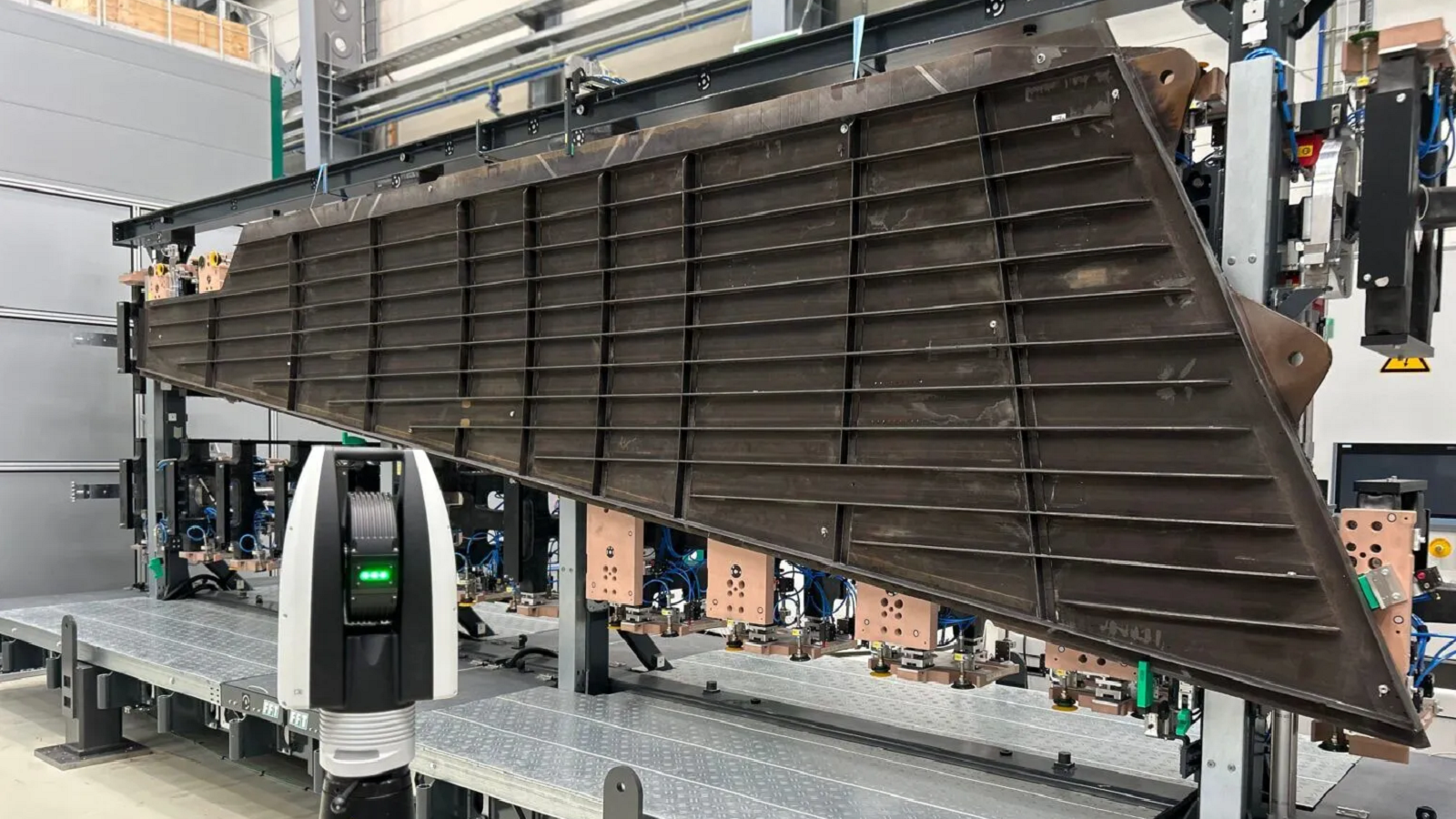
Direct Scanning Laser Trackers – A New Era for Quality Control
Precision drives the success of every modern manufacturing line with mounting pressure to deliver flawless components while managing limited factory space and a shortage of skilled operators. To meet these demands, inspection systems that deliver absolute certainty without slowing down production are a key pillar. Laser trackers provide that certainty and have long served as the backbone of large-volume quality control.
Now, the technology is taking a monumental leap forward. Direct scanning fundamentally changes how we measure, inspect, and validate complex parts. This article explores why laser trackers remain essential, how direct scanning transforms measurement, and what actionable strategies can be gained.
The Critical Role of Laser Trackers in Manufacturing
Quality management requires constant vigilance. Every component that leaves a facility must meet exact specifications. When inspecting large aerospace, energy or shipbuilding structures, traditional hand tools and other measuring techniques can be limiting. They either lack the necessary scale or require you to move massive parts off the production line.
Laser trackers solve this problem. They bring the metrology directly to the factory floor. By providing highly accurate, large-volume 3D measurements, trackers empower you to inspect parts exactly where they sit. This adaptability eliminates the time wasted transporting components. It also minimises production bottlenecks and ensures seamless quality control.
Trackers enable the quality team to build a data-driven quality framework. They capture precise measurements that validate vendor accountability and reduce costly scrap. However, as measurement tasks increasingly involve hard-to-reach areas, tighter time constraints, and greater emphasis on operator safety, standard reflector-based tracking must evolve to meet these challenges.
Direct Scanning: A Monumental Leap Forward
Traditional laser trackers require an operator to hold a reflector or probe against the part being measured. This manual process takes time. It also proves difficult when measuring hidden edges, fragile surfaces, or hard-to-reach features.
Direct scanning eliminates these barriers. It allows the tracker to project a measurement beam directly onto the surface of the part, capturing precise data without a physical target. This represents a complete transformation in automated efficiency. Users can now digitise large surfaces and complex geometries from a distance.
Introducing the Leica Absolute Tracker ATS800
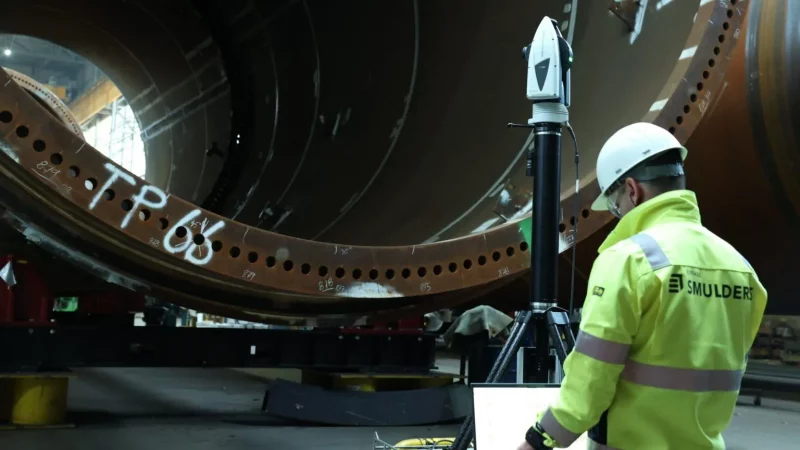 The Leica Absolute Tracker ATS800 was developed to lead this revolution. This system combines traditional measurement with advanced direct scanning in a single, compact design solution. It serves as a true 2-in-1 laser tracker.
With the ATS800, customers gain the ability to measure features and edges with precision across a massive volume. The system identifies precise edge boundaries and surface contours automatically. Users no longer need to compromise between speed and accuracy. The tracker transitions seamlessly from high-speed reflector tracking to direct scanning, streamlining processes and cutting inspection times dramatically.
Overcoming Core Manufacturing Challenges
Traditional laser tracker inspection methods require extensive training and specialised knowledge. Direct scanning simplifies the measurement workflow. The ATS800 integrates smoothly into automated routines by automating complex inspection paths achieving a reduction and reliance on manual operations. This shift lowers the learning curve for the inspectionteam and frees up experienced personnel to focus on higher-value data analysis.
Transform Quality Control
The demand for perfection will only increase. Tighter tolerances, faster production schedules, and the rise of the digital twin require a new approach to measurement. Direct scanning provides the adaptability and data-driven insights needed to stay ahead. The Leica Absolute Tracker ATS800 delivers precision and automated efficiency in one adaptable package.
Download the direct scanning white paper: www.hexagon.com