CMM Adaptation to Future Manufacturing Demands
In manufacturing today the Coordinate Measuring Machine (CMM) is a cornerstone of precision inspection and quality assurance. From its origins as a precision measuring tool housed in controlled metrology labs to today’s shop-floor capable systems, CMM technology continues to evolve in response to ever-increasing demands for speed, accuracy, flexibility, and automation. As manufacturing moves further toward high-mix production, digital transformation, and adaptive process control, CMMs are being reinvented – not merely as measuring devices, but as integral components of smart, automated factories.
From Lab-Grade Precision to Shop-Floor Hardening
Historically, CMMs were seen as delicate measuring instruments – powerful, but isolated from the factory floor. They lived in climate-controlled metrology rooms to avoid vibration, temperature drift, and contamination. But modern shop floors demand inspection systems that can keep pace with production without special environmental isolation.
Today’s shop-hardened CMMs are designed to withstand typical factory conditions: temperature variations, airborne contaminants, and mechanical vibration due to nearby machining or automation. Manufacturers have adopted robust structural materials and advanced error compensation strategies to preserve dimensional accuracy in harsher environments. Temperature compensation algorithms, better thermal stability in machine construction, and sealed bearings and guide-ways allow these CMM systems to operate reliably where they are most needed – close to production.
Rather than shipping parts off to a dedicated inspection room, manufacturers can integrate CMMs directly into production cells. This transition accelerates quality feedback, reduces part handling, and aligns measurement with manufacturing takt times.
Automation and the Rise of Integrated CMM Cells
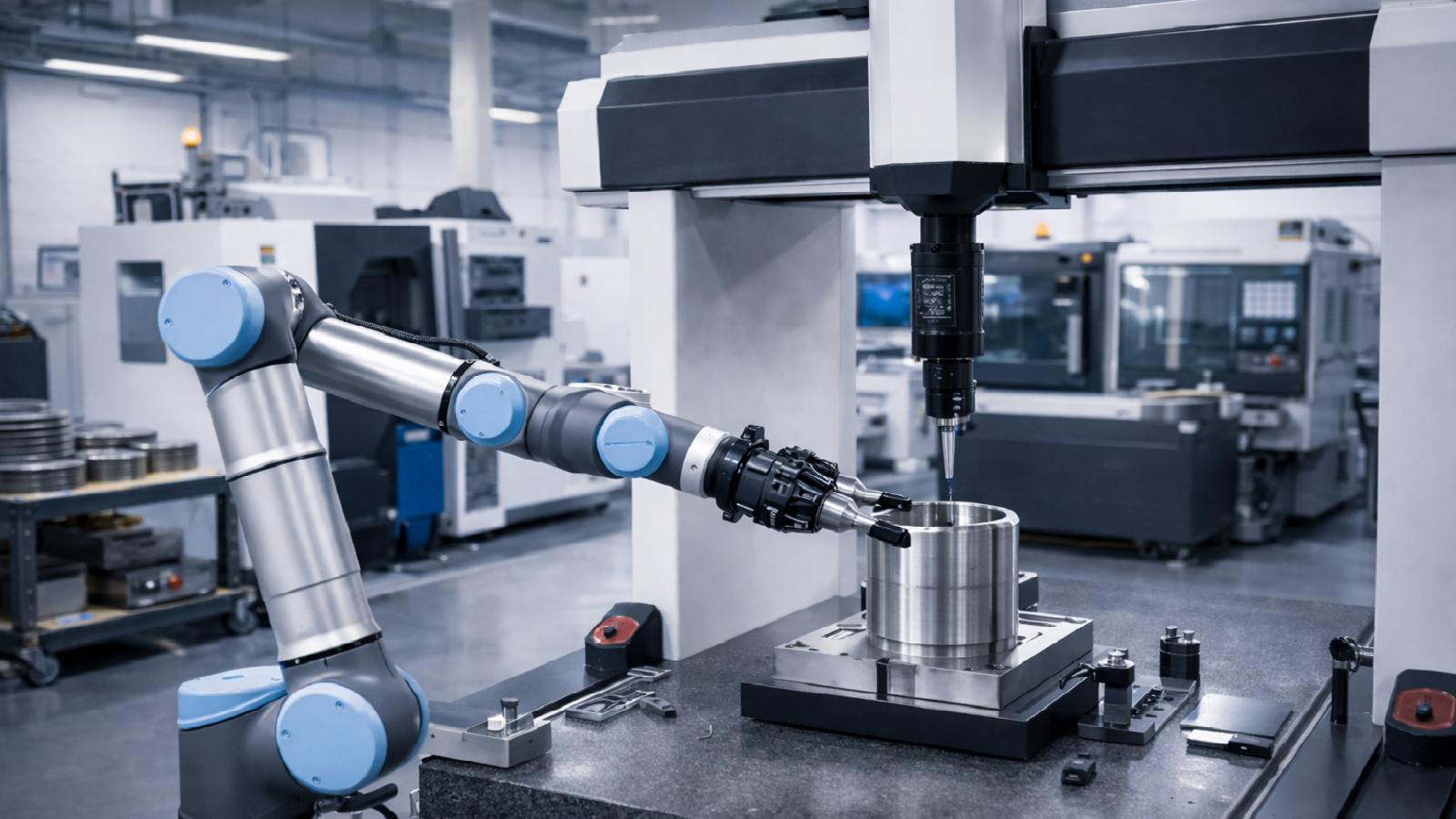
 A defining trend shaping the future of CMM technology is the deeper integration of these systems into automated production workflows. Robots, part-handling systems, fixtures, and conveyors are increasingly linked with CMM inspection stations to create autonomous metrology cells.
In such configurations, parts are transferred automatically from machining or assembly equipment to the CMM, measured, and then routed based on pass/fail decisions. This reduces human intervention, accelerates throughput, and supports high-volume environments where cycle time is critical. Moreover, automated CMM cells form the backbone of closed-loop quality systems, where measurement data can trigger real-time adjustments to upstream manufacturing processes.
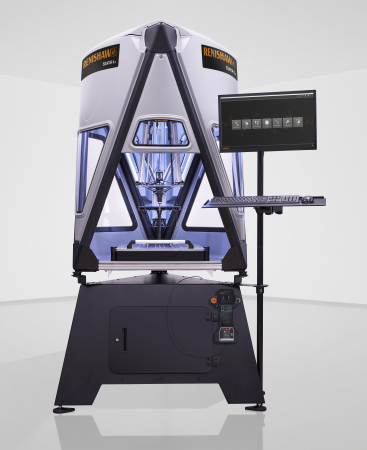
The recent launch by Renishaw of the Equator-X represents a next-generation gauging and measurement system, engineered specifically for high-speed shop-floor inspection and automation integration. Unlike traditional CMMs, the Equator-X uses adaptive comparative measurement techniques. Its design allows rapid cycle times without sacrificing repeatability, making it suitable for in-line inspection and high-mix production environments. The Equator-X blurs the line between gauging and coordinate measurement, reinforcing the shift toward automated and flexible metrology.
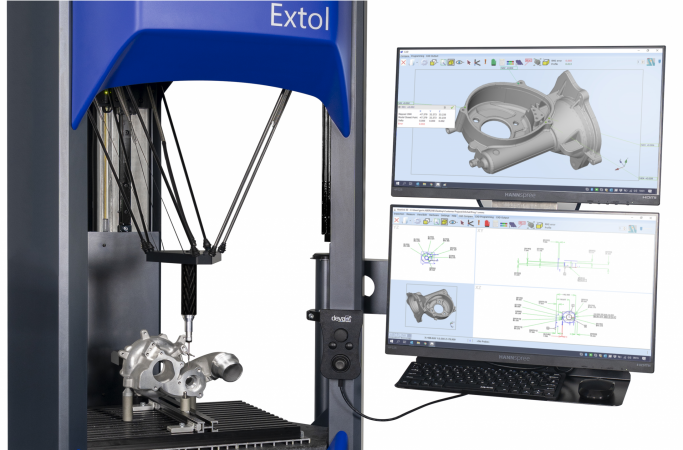 Another compelling example of a next-generation shop-floor CMM is the Aberlink Extol. Like the Renishaw Equator-X, the Extol is designed with a remarkably small footprint, making it well-suited for environments where shop-floor space is at a premium. Both the Extol and Equator-X combine compact, robust designs with high-speed, high-accuracy measurement capabilities, allowing them to be positioned directly within production areas. This spatial efficiency is increasingly critical as manufacturers pursue flexible, automated production layouts, enabling rapid part inspection and tighter integration with machining and assembly operations without requiring extensive floor space.
Another approach to shop-floor CMM design is the cantilever-style CMM equipped with mechanical bearings specifically engineered for industrial environments. This architecture offers a rigid, compact measurement platform capable of maintaining high accuracy even under the vibrations, temperature fluctuations, and particulate exposure typical of a manufacturing floor. Unlike traditional bridge CMMs, the cantilever design minimizes structural footprint while providing easy part access, making it ideal for inline inspection or integration with automated cells. Representative examples of this approach include the Zeiss Duramax, which combines cantilever geometry with precision mechanical bearings to deliver reliable, shop-hardened performance for both medium and high-volume production environments, and the Hexagon TIGO SF and Wenzel SF, both of which provide compact, resilient designs with multi-sensor capabilities and robust shop-floor performance suitable for integration into automated manufacturing workflows.
Speed Without Compromising Accuracy
In a manufacturing context where throughput is paramount, speed has become as important as measurement precision. Conventional CMMs, which historically conducted discrete point-by-point probing at relatively slow rates, have been augmented with technologies that dramatically reduce cycle times without compromising accuracy.
The introduction of continuous tactile scanning is a case in point. Continuous scanning allows the probe to traverse a surface while collecting thousands of data points in a smooth single motion. This method unlocks high-speed data acquisition and delivers rich surface information. Continuous scanning bridges the gap between traditional point measurement and full surface characterization, especially on complex geometries like freeform or organic surfaces.
High-speed CMMs equipped with advanced motion control and servo systems can execute these scans with both the dynamic precision and repeatability needed for industrial metrology. As sensors become faster and processing power increases, the time required for comprehensive inspection shrinks – enabling real-time quality decisions at production speeds previously unthinkable.
Convergence of Measurement Modalities
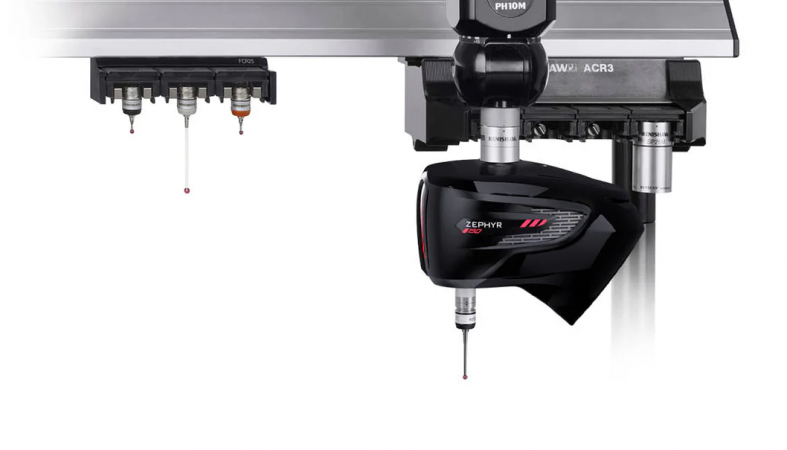
The future of CMM technology is not limited to a single measurement method. Instead, it embraces multi-sensor CMMs that integrate a suite of technologies namely tactile probes, laser scanners, white light sensors, vision systems, structured light, and more into unified platforms with each sensor modality bringing unique measurement capabilities.
By combining these modalities, multi-sensor CMMs empower manufacturers to select the right tool for each part feature – increasing flexibility and measurement richness in one machine. Software orchestrates sensor switching and data fusion, allowing output in coherent formats for analysis and reporting.
Redefining Surface Inspection
Among non-contact technologies, laser scanning has emerged as a transformative force. Laser scanners mounted on CMMs capture vast arrays of 3D points that constitute a detailed surface map. Unlike traditional tactile probing, which captures discrete points, laser scanning offers continuous coverage – a critical advantage for complex freeform surfaces, tight tolerances, and surfaces with micro-features.
The proliferation of laser scanning in CMMs addresses several trends: the rise of additive manufacturing with complex geometries, the need for deformation and surface texture analysis, and the push toward digital twins of parts and assemblies. Rapid advances in sensor technology, including blue-light and multi-wavelength lasers, have improved accuracy and surface compatibility – enabling reliable measurement even on challenging materials or finishes.
Closing the Loop Between Measurement and Manufacturing
Ultimately, the evolution of CMM technology is not an isolated trajectory – it is part of a larger vision of adaptive process control. In this model, real-time measurement data feeds directly back to manufacturing systems to adjust machining parameters, tooling paths, or machine behavior. Inspection is no longer a post-process check but an integral component of process intelligence.
Adaptive process control relies on rapid, repeatable, and context-rich measurement data. Shop-floor CMMs, integrated automation, and connected sensor networks make this possible. Coupled with data analytics and AI-driven decision engines, this feedback can enable machines to self-optimize, correct, or compensate – improving yield and reducing scrap.
In this environment, CMMs evolve from tools of verification to instruments of control. Inspection becomes a continuous, embedded function of production — not a bottleneck or afterthought.
The Future of CMMs Is Connected, Intelligent, and Agile
The evolution of CMM technology is driven by the demands of modern manufacturing: higher speeds, increased complexity, automation, and real-time quality assurance. From shop-floor hardened systems and automated inspection cells to multi-sensor platforms and laser scanning, CMMs are adapting in powerful ways.
Next-generation systems like the Renishaw Equator-X exemplify this shift: performing high-speed measurement, enabling flexible inspection, and integrating seamlessly with automated production. Continuous motion sensors, multi-modal measurement, and adaptive process control are reshaping CMMs into essential elements of the smart factory.
As manufacturing moves toward tighter integration between design, production, and inspection, CMM technology will continue to innovate – not just to measure parts more accurately, but to empower manufacturers to build better parts faster, smarter, and with greater confidence.