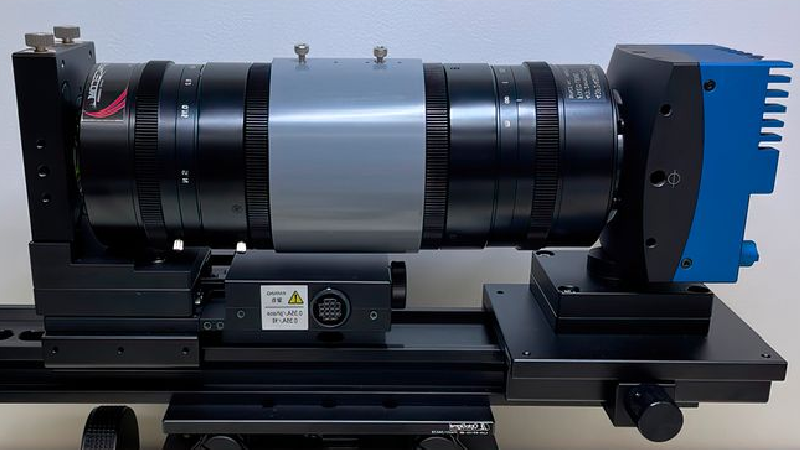
Camera Powers Lens-Coupled High-Speed X-Ray Imager for Real-Time 4D Computed Tomography
Allied Vision has announced that its EoSens 1.1CXP2 high-speed CMOS camera has been selected as the core imaging engine in ‘Hayaka,’ a lens-coupled high-speed X-ray system developed by a team from Tohoku University and Nishikyushu University, Japan. The name ‘Hayaka’ means ‘very fast’ in a Japanese dialect – an apt description for a system that delivers a minimum exposure time of 1 µs and a maximum frame rate of 5,000 fps.
Designed for quick X-ray absorption fine structure imaging and time-resolved high-speed computed tomography (4D-CT) using synchrotron radiation (SR), the Hayaka camera system enables researchers to observe ultra-fast structural changes and chemical state transitions in real time. This breakthrough high-speed 4D-CT technique opens entirely new possibilities for three-dimensional analysis of complex dynamic processes across food science and materials engineering.
Precision-Engineered System Architecture
The Hayaka system integrates five purpose-built components: a scintillator that converts incident X-rays into visible light; a high-performance lens system; the EoSens 1.1CXP2 high-speed CMOS camera; a precision focus adjustment mechanism; and a rigid mounting base. The scintillator converts incoming X-ray photons into visible light, which is then relayed to the camera’s image sensor through an advanced lens system employing a back-to-back configuration—two high-numerical-aperture (high-NA) lenses positioned with their rear elements facing each other—maximizing optical throughput for high-speed X-ray imaging.
Built for Speed
At the heart of Hayaka is the EoSens 1.1CXP2, a CMOS camera with global shutter delivering the resolution, speed, and data throughput required for synchrotron-based imaging. Key specifications include a 1.1 megapixel sensor resolution of 1280 × 864 pixels with a 13.7 µm pixel size and 10-bit depth (stored as 16-bit), providing excellent dynamic range. The camera achieves 3,660 frames per second at full resolution and 5,000 fps at an 800 × 400 region of interest (ROI). Its CoaXPress 2.0 interface utilizes four channels to transfer image data to the host PC at speeds up to 50 Gbit/s—ensuring zero-bottleneck data acquisition even at the highest frame rates.
Proven Performance at the Synchrotron
A feasibility study validated the Hayaka system’s exceptional imaging capabilities using both white and monochromatic synchrotron radiation. The EoSens-powered system captured fine X-ray images with a spatial resolution of 77 µm at an exposure time of just 10 µs—demonstrating the camera’s ability to freeze ultra-fast phenomena with outstanding clarity. In X-ray absorption fine structure mode, the system – combined with high-speed energy scanning—acquired complete spectral image data in as little as 0.5 seconds.
The research team further demonstrated the system’s capability by pairing Hayaka with a high-speed rotation table to capture the boiling process of Japanese noodles over 150 seconds with a time resolution of 0.5 s – providing an unprecedented real-time, three-dimensional view of a dynamic cooking process.
Next-Generation Applications on the Horizon
The research team is already planning the next phase of Hayaka-powered discovery. Near-term goals include time-resolved chemical state mapping of various elements inside battery electrodes during charging and discharging relaxation processes, enabled by a new synchronization system between Hayaka and a germanium double crystal monochromator. In parallel, the team is developing an in coquendo 4DCT system—literally “while cooking”—that will enable real-time observation of cooking processes such as boiling, baking, steaming, frying, and microwave heating, advancing the frontiers of food science research.
Learn more at www.alliedvision.com