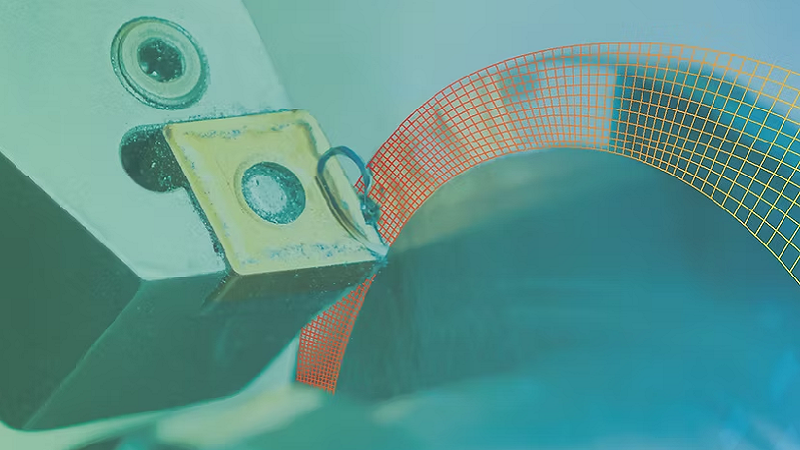
Bridging Machining Simulation and Fatigue Analysis
In today’s highly competitive manufacturing environment, companies face increasing pressure to improve machining productivity while ensuring the long-term reliability of critical mechanical components. Balancing faster production with durable performance remains a significant engineering challenge, particularly for sectors such as aerospace, automotive, and energy where component failure can have serious consequences.
French software developer MISUTECH has introduced a new approach that addresses this challenge by integrating advanced machining simulation with fatigue life assessment technology from Hottinger Brüel & Kjær (HBK). The combined capability enables engineers to make more informed design and process decisions while reducing reliance on costly and time-consuming physical testing.
Impact of Machining on Fatigue Life
Machining processes expose materials to extreme conditions. During cutting, materials undergo intense plastic deformation and rapid temperature increases within milliseconds. These conditions significantly influence the resulting surface integrity of the component.
The machining process can introduce a range of material state changes, including:
- Residual stress fields within the surface and subsurface layers
- Microstructural transformations
- Strain hardening of the material
These effects play a critical role in determining fatigue life. Compressive residual stresses, for example, can improve fatigue resistance, while tensile residual stresses may accelerate crack initiation and propagation.
Although the relationship between machining and fatigue performance has long been recognised, incorporating these manufacturing-induced material states directly into fatigue life calculations has historically been difficult. As a result, manufacturers have often had to rely on conservative machining strategies or extensive physical testing to verify component durability.
Linking Machining Simulation with Fatigue Analysis
To overcome these limitations, MISUTECH and HBK have developed an interface linking MISULAB, MISUTECH’s machining simulation platform, with nCode DesignLife, HBK’s fatigue analysis software.
MISULAB simulates machining operations and predicts the resulting surface integrity of components. Crucially, the software calculates three-dimensional residual stress fields generated during machining processes.
Through the new interface, these predicted residual stress fields can be seamlessly transferred into nCode DesignLife alongside operational loading conditions.m]
The result is a more comprehensive and realistic evaluation of component performance.
Reducing Testing and Accelerating Optimisation
The integrated workflow enables engineers to evaluate multiple machining strategies in a virtual environment before implementing them on the shop floor.
Using the combined simulation and fatigue analysis tools, engineers can:
- Assess the fatigue impact of different machining parameters
- Evaluate new cutting tools or process strategies
- Identify machining conditions that minimise harmful residual stresses
- Optimise machining productivity while maintaining structural integrity
By performing these evaluations virtually, manufacturers can significantly reduce the need for extensive machining trials and long-duration fatigue testing programmes. This approach supports faster development cycles while reducing development costs and risk.
Demonstrating Benefits
In one application involving an aerospace power transmission shaft, the combined MISULAB and nCode DesignLife solution was used to analyse the influence of machining parameters on fatigue performance.
Simulation results showed that certain conventional turning conditions introduced harmful tensile residual stresses in the component surface. By adjusting machining parameters to avoid these stress states, engineers were able to significantly improve predicted fatigue performance.
The optimised machining strategy delivered both improved component durability and greater confidence in production parameters without requiring extensive physical testing.
Bridging Manufacturing and Performance Engineering
The collaboration between MISUTECH and HBK represents a broader shift toward integrating manufacturing process simulation with product performance analysis. Traditionally, these domains have been treated separately, with machining optimisation focusing on productivity while fatigue analysis focuses on operational performance.
By linking the two, engineers gain a more complete view of how manufacturing decisions affect long-term component behaviour.
For industries where safety, reliability, and cost efficiency are all critical, this integrated approach offers a powerful tool for improving both productivity and product performance.
MISULAB software from MISUTECH has been developed in partnership with major aerospace contractors and the French technical centre CETIM, ensuring that the solution addresses the demanding requirements of high-performance engineering sectors.
For more information: www.hbkworld.com