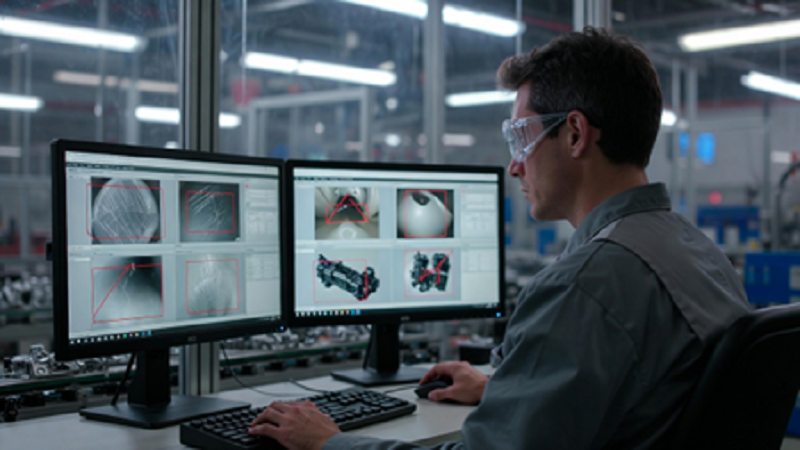
Breaking the Data Bottleneck: Synthetic Data Accelerates AI-Driven Quality Control
In the rapidly evolving world of manufacturing, AI powered automated inspection systems are emerging as a transformative force in quality control. They deliver exceptional accuracy, speed and consistency, enabling real time defect detection on complex surfaces in demanding sectors such as automotive, aerospace and electronics. This dramatically reduces human error, minimises production downtime and cuts material waste. As the industry shifts from Industry 4.0’s full automation to Industry 5.0’s human centric approach, which emphasises resilient, sustainable and flexible processes with safety and worker wellbeing at the core, AI is becoming a true collaborative partner.
It handles repetitive visual analysis while allowing people to apply critical judgement, creativity and contextual insight. Nevertheless, scaling this potential remains challenging, particularly in fast changing production environments that demand highly adaptable, easily trainable and continuously evolving AI models.
Scalability Challenges in AI Training and Onboarding
Training AI for tasks like spotting defects in manufacturing requires a massive amount of data because the system learns by example, much like teaching a child to recognize shapes through repetition. Without enough varied examples, the AI might miss patterns or make mistakes in real-world situations.
Traditionally, this data is labelled by humans: experts review thousands of images or samples, marking what’s “normal” versus “defective”—for instance, drawing boxes around cracks, scratches, or irregularities to show the AI exactly what to watch for. This approach works great for uniform products, like identical metal bolts on an assembly line, where everything looks the same and defects stand out clearly, so you don’t need as many examples to train a reliable model. But things get trickier with more organic or varied items, such as fruits with natural textures or custom car parts with slight design differences.
Here, the AI needs way more data to learn the full range of “normal” variations—otherwise, it might flag a harmless bump on an apple as a bruise or mistake a unique pattern on a fabric as a tear, confusing acceptable differences for flaws. Scaling up the data helps the AI build a broader understanding, reducing false alarms and making it smarter in diverse scenarios.
A sentence about how this consumes crazy amounts of data, time and manpower and thus leaves lingering in “research hell” – i.e. the project never leaves the “trying to get it to work” status.
Innovative Approaches to Synthetic Data Generation
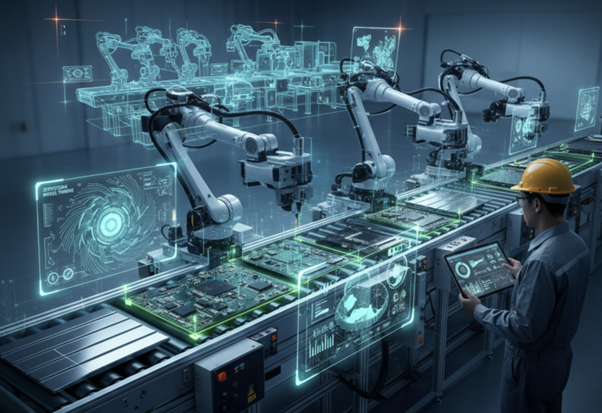 To tackle data scarcity in AI training for automated inspections, synthetic data generation has progressed from early methods to advanced techniques for more reliable outcomes.
The journey began with Basic Image Manipulation and 3D Simulations. Engineers relied on simple geometric transformations—such as cropping, rotating, or adding noise—and uniform virtual models to expand datasets (data augmentation).
Advanced synthetic data techniques now combine procedural generation with realistic 3D rendering and controlled material attributes—such as surface texture, gloss, reflectance, metalness, and color—to produce highly customizable datasets. By blending real-world examples with synthetically generated elements at varying levels of integration, these composite approaches achieve superior photorealism and precise defect simulation, enabling accurate replication of subtle anomalies under matched lighting and camera conditions.
This method proves especially effective for overcoming persistent challenges in industrial inspection, including scarce or rare defect samples, inherent product non-uniformity and noise, extensive design variations that demand flexibility without full model retraining, and constraints from limited production runs or saturated lines, ultimately facilitating high-accuracy, scalable quality control with dramatically reduced data collection efforts.
While these methods were computationally cheap and fully explainable, they were limited to repositioning existing patterns and failed to replicate complex defects or organic textures, often resulting in models that misflagged natural variations as flaws.
The field subsequently shifted to The Deep Learning Revolution: VAEs and GANs. This era introduced competing neural networks where a generator crafted samples and a discriminator verified realism. This allowed for the simulation of detailed defects on varied materials across different industries. However, while capable of generating diverse data for rare scenarios, this approach suffered from notorious training instability (mode collapse) and high computational costs.
Currently, the industry is leveraging The Modern Era: Transformers and Diffusion Models. Unlike previous hybrids, these Generative AI approaches use iterative noise-removal processes to “in-paint” hyper-realistic anomalies onto clean surfaces with pixel-perfect blending. These models offer unmatched photorealism and controllability, though they require substantial computing power and careful calibration to avoid “hallucinating” non-existent features.
Precise Digital Twins That Mirror Actual Production
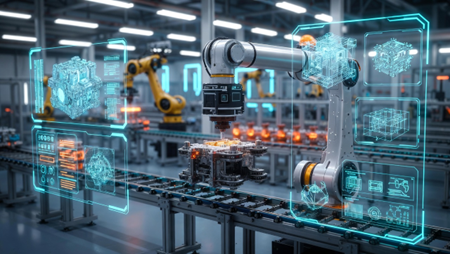 Looking forward, the frontier lies in creating highly accurate virtual replicas of manufacturing environments. Here, real-world samples, physics-based rendering, and generative AI come together to build precise digital twins that mirror actual production settings with exceptional fidelity.
This approach enables better simulation of complex industrial scenarios, improved training for inspection AI, and more reliable testing of quality control processes, all without needing to perfectly synthesize every individual object from scratch.
Leading solutions are already capitalising on these advancements. For instance programs like Zetamotion’s ZELIA integrate a cutting-edge “grounded synthetic data” pipeline to generate reliable, context-aware datasets. Tools like ZELIA aim to democratise Machine Vision for Inspection and can lend a helping hand out of the aforementioned “research hell” towards solutions which truly elevate production lines.
For more information: www.zetamotion.com
Author: Dr. Wilhelm Klein, Zetamotion CEO