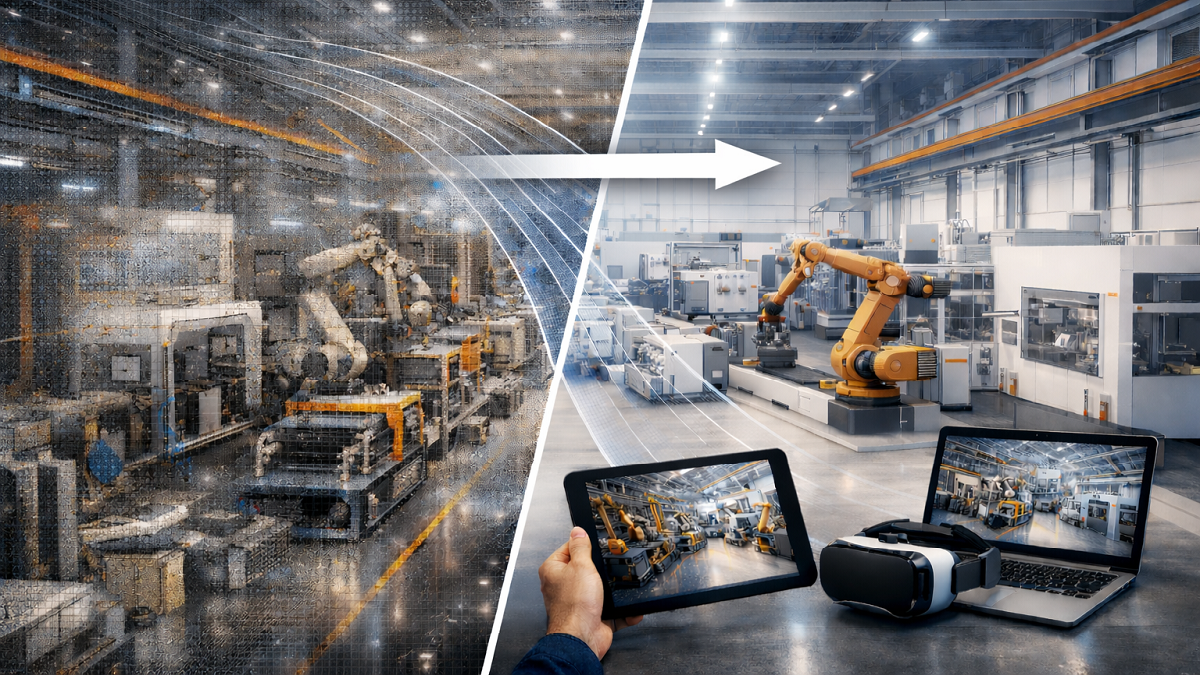
Breaking the 3D Data Bottleneck for Digital Twins and Physical AI
As industries accelerate toward spatial computing, digital twins, and Physical AI, a fundamental infrastructure challenge continues to limit scale and adoption: high-fidelity 3D data can be too large to move efficiently. From factory-wide digital twins to LiDAR-based inspection environments, the sheer weight of 3D assets can become a bottleneck for real-time visualization, simulation, and collaboration.
At the recent CES 2026, deep-tech startup Greneta announced the global launch of Greneta Optimizer 2.0, a 3D data optimization solution designed to dramatically reduce data size while preserving the geometric precision demanded by many industrial applications. According to the company, Optimizer 2.0 can reduce 3D data size by up to 99.6%, transforming gigabyte-scale CAD models and scan data into lightweight assets suitable for real-time streaming.
Moving Beyond ‘MP3-Style’ 3D Compression
Traditional 3D compression approaches often sacrifice fidelity for size, degrading geometry in ways that are unacceptable for engineering, inspection, and medical workflows. Greneta positions its technology as a departure from what many engineers describe as the ‘MP3 of 3D’—solutions that reduce file size but compromise accuracy.
Greneta Optimizer 2.0 is designed to maintain professional-grade geometric integrity, enabling optimized assets to be used not only for visualization but also for simulation, training, and AI-driven physical environments.
“The era of waiting for 3D files to load is over,” said Tae Woong Kim, CEO of Greneta. “Whether it is a digital twin of a factory or a training simulation for robotics, data weight is the enemy of scale. Optimizer 2.0 removes that friction instantly.”
Bridging Infrastructure Gaps for the Industrial Metaverse
As manufacturers and solution providers explore the industrial metaverse, real-time access to accurate 3D data becomes essential. Optimizer 2.0 is positioned as a foundational infrastructure layer for these environments, enabling large-scale, high-resolution assets to be streamed across devices—from high-end workstations to mobile XR headsets.
Key capabilities of Greneta Optimizer 2.0 include:
Extreme Optimization: Compression of gigabyte-scale CAD models and LiDAR scan data into megabytes within seconds, enabling real-time streaming and interaction on mobile and XR platforms.
AI-Driven Restoration: Automatic repair of mesh defects, holes, and inconsistencies commonly found in 3D scan data—an essential step for establishing reliable Physical AI and simulation environments.
Enterprise Compatibility: Seamless integration with leading 3D and simulation platforms, including Unreal Engine, Unity, and NVIDIA Omniverse, delivered through a flexible plugin architecture.
These capabilities align closely with emerging requirements in metrology, where high-resolution scan data must be shared across inspection, analysis, and visualization workflows without sacrificing accuracy.
Industry Validation and Ecosystem Alignment
Greneta is also a member of NVIDIA Inception, NVIDIA’s global program supporting startups that are transforming industries through advanced computing and AI technologies. This affiliation underscores Greneta’s focus on scalable, GPU-accelerated workflows for next-generation industrial applications.
By addressing both data size and data quality, Greneta’s approach supports the increasing use of 3D data not just for visualization, but as a core asset for AI training, robotics simulation, and digital thread continuity.
For more information: www.greneta.ai