Beyond the Factory Floor – Metrology’s Expanding Role in Cultural Heritage
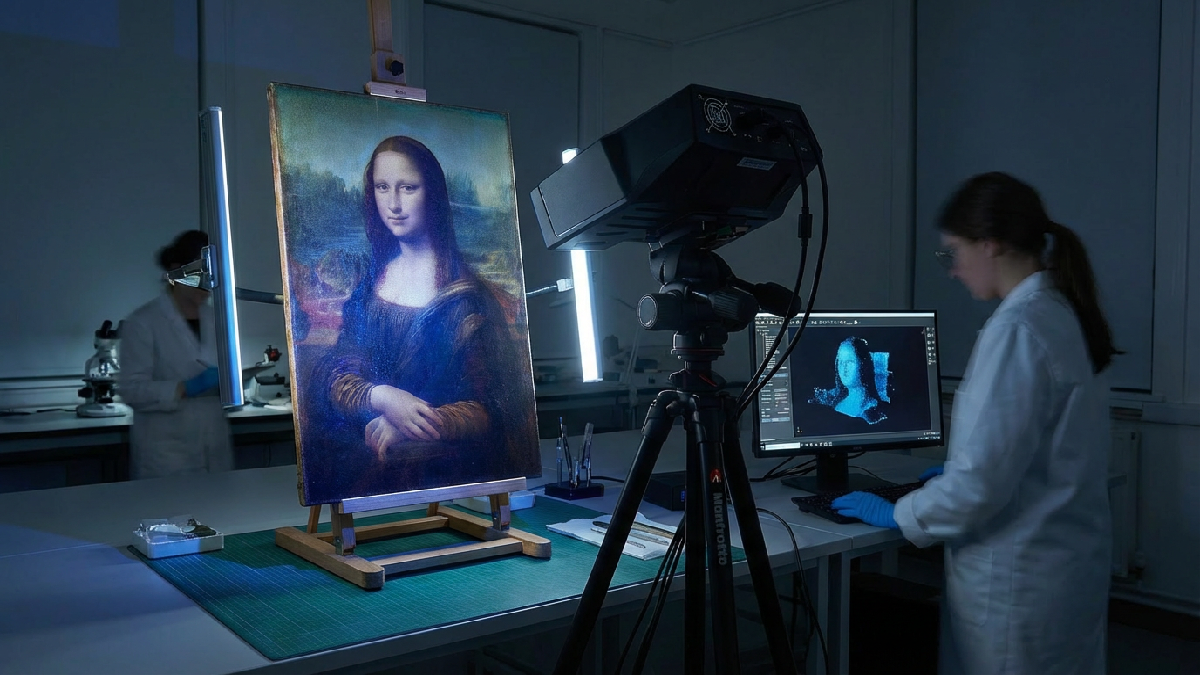
In industrial metrology, accuracy is routinely measured in microns. Increasingly, however, these same precision technologies are finding applications far beyond the factory floor. One of the most compelling examples is their growing role in the scientific analysis and conservation of cultural heritage. A recent study of a 17th-century copy of Leonardo da Vinci’s Mona Lisa, owned by Taiwanese collector Mr. Pan Chong-Jen Huang, demonstrates how advanced measurement systems are becoming indispensable tools for art historians, conservators, and researchers alike.
The Metrological Challenge: Fusing Heterogeneous Data in Artwork Analysis
 The objective of the project was twofold: to support authentication efforts and to conduct a detailed structural examination of the painting. To achieve this, Italian specialists from EDItech applied a suite of advanced 2D imaging techniques, including multispectral imaging in visible, infrared, and ultraviolet light, alongside X-ray radiography. Each modality revealed critical but isolated information, such as pigment composition, underdrawings, restoration traces, and internal damage.
From a metrological standpoint, this created a fundamental challenge: how to integrate multiple, heterogeneous 2D datasets into a unified analytical framework. Understanding the spatial relationship between a hidden infrared underdrawing and the surface relief of brushstrokes requires a precise three-dimensional reference. This, in turn, demands a high-resolution, non-contact measurement technique capable of capturing the painting’s micro-topography — from canvas texture and paint layer thickness to the fine network of craquelure.
The Solution: High-Resolution Structured Light 3D Scanning
To generate an accurate digital twin of the artwork, the team selected a high-precision eviXscan 3D scanner based on structured light technology. The choice was driven by several key parameters essential when working with fragile, high-value cultural assets:
Non-Contact Measurement: Ensuring complete structural safety of the historic painting
High Point Density: The ability to capture millions of measurement points, enabling micron-level resolution of surface details
Rapid Data Acquisition: Minimising exposure time and environmental impact during scanning
Together, these characteristics made structured light scanning particularly well suited to the demands of heritage metrology.
From Point Cloud to Integrated Analytical Model
The metrological workflow comprised several critical stages:
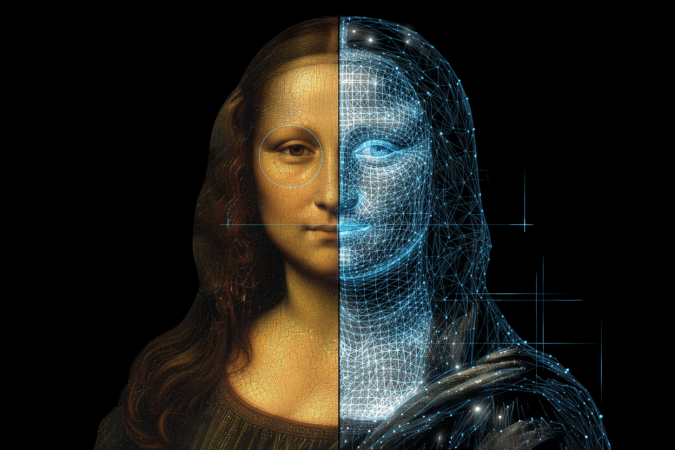
3D Data Acquisition: The eviXscan system projected structured light patterns onto the painting’s surface, while integrated cameras recorded their deformation. From this data, the software calculated XYZ coordinates for millions of points, generating a dense point cloud that accurately represented the surface topography.
Polygon Mesh Generation: The point cloud was processed into a high-fidelity polygon mesh (STL), producing a metrologically accurate 3D surface model. A visible-light texture was mapped onto the mesh, resulting in a photorealistic digital replica of the artwork.
Multisource Data Fusion: This stage proved pivotal. The 3D model served as a geometric reference framework onto which the 2D datasets from multispectral imaging and X-ray radiography were precisely aligned using common reference features. For the first time, chemical and subsurface information could be directly correlated with the physical morphology of the painted surface.
Results: Quantifying Art and Expanding Research Capabilities
The application of high-resolution 3D scanning delivered results that extend well beyond traditional art historical analysis:
Quantitative Surface Analysis: Precise measurements of brushstroke height and profile provided objective data for studying artistic technique and attribution.
Conservation State Documentation: A detailed 3D map of the craquelure network enabled measurement of crack depth and width, creating a robust baseline for long-term condition monitoring.
Advanced Visualisation Tools: False-colour height maps — commonly used in industrial quality control — revealed subtle surface variations invisible to the naked eye, offering new interpretive insights.
Expanding Horizons for Precision Metrology
The analysis of this 17th-century Mona Lisa copy highlights how the scope of industrial metrology continues to expand. Measurement technologies developed for aerospace, automotive, and advanced manufacturing applications are now playing a vital role in scientific research, digital archiving, and the preservation of cultural heritage. The ability to create accurate digital twins and to integrate multisource data is transforming how conservators and researchers study historic artworks — enabling levels of insight that would have seemed unimaginable just a decade ago. This convergence of engineering precision and art scholarship stands as a powerful example of metrology’s evolving impact far beyond industry.
For more information: www.evixscan3d.com