Automated Inspection and Packaging of 36,000 Syringes per Hour
In pharmaceutical manufacturing, the integrity of the final product depends not only on how it is produced but also on how it is inspected, labelled and packaged. At high production volumes, these end-of-line processes must deliver both speed and absolute reliability while meeting stringent regulatory standards.
When a multinational pharmaceutical manufacturer required a solution capable of inspecting, labelling and palletizing 36,000 syringes per hour, the company turned to Ward Automation, an automation specialist based in Sligo. The challenge was to create a system that could guarantee product integrity and traceability while operating under hygienic pharmaceutical production conditions.
The resulting solution is a compact robotic cell built around three robots from Stäubli Robotics, integrating machine vision inspection, automated labelling and palletizing in a single streamlined system.
Managing High Throughput with Full Traceability
 The production requirements were demanding. Syringes arrive at the end-of-line packaging stage in trays containing 100 units, with six trays entering the system every minute. Each tray must undergo inspection to verify the presence and condition of the syringes, confirm the integrity of tamper-evident caps, and ensure the correct number of units before it can proceed to labelling and packaging.
The system also had to meet the requirements of 21 CFR Part 11, which governs electronic records and traceability in pharmaceutical and medical device manufacturing. Ensuring that defective syringes, missing components or incorrectly applied labels could not enter the distribution chain was therefore a critical objective.
To address these requirements, Ward Automation designed a fully integrated robotic cell capable of performing inspection, labelling and palletizing operations continuously while maintaining a detailed digital record of every tray processed.
Robotic Handling and Vision Inspection
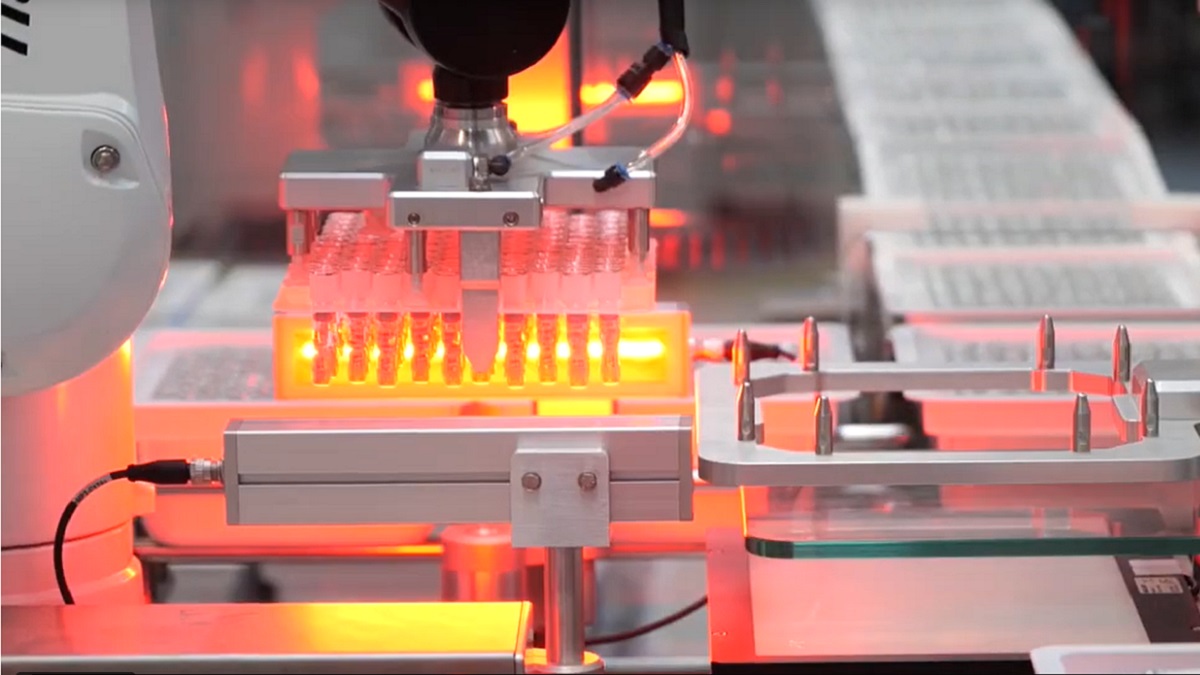
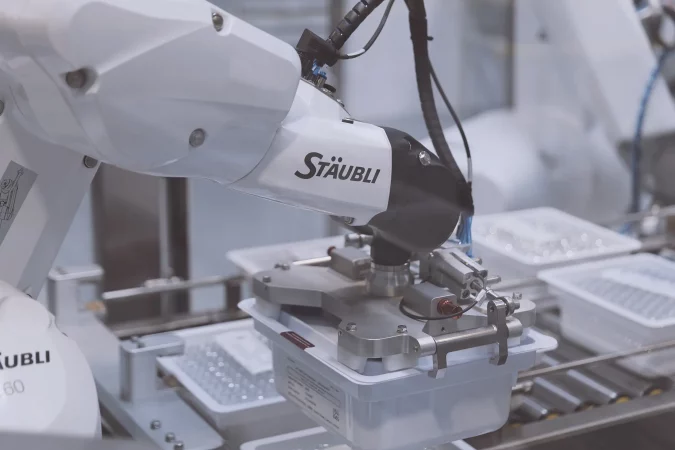
The process begins with a Stäubli TX2-60 robot that retrieves each tray and transfers it to a machine vision inspection station. Two vision systems analyse the tray contents, verifying that the correct number of syringes is present and checking for defects or missing PRTC caps.
Any tray that fails inspection is automatically diverted to a reject station where an operator replaces defective syringes before returning the tray to the inspection line. Trays that meet the quality requirements proceed directly to the next stage of the process.
Automated Labelling and Verification
Once a tray has been verified as compliant, it enters a labelling station where inner and outer labels are printed and immediately checked for accuracy. The TX2-60 robot applies the inner label before additional inspection confirms both its presence and correct positioning.
This verification step ensures that the labelling information associated with each tray remains accurate and traceable. Such traceability is essential in pharmaceutical production, where individual batches must be tracked throughout the manufacturing and distribution chain.
Sealing and Tamper Protection
Before the trays can be prepared for shipping, they must be securely sealed. To accomplish this, Ward Automation developed a dedicated lid-separating station that feeds individual lids to a second Stäubli TX2-60 robot.
A vision system first verifies the orientation of the lid. The robot then grips it and places it onto the tray with high positional accuracy. A custom end-of-arm tool applies a tamper-proof seal and wraps a security label around the outside of the lid, creating an additional barrier against interference.
The tray is subsequently rotated by 180 degrees so that a second label can be applied. Once sealed and labelled, the tray is transferred to a buffer conveyor ready for palletizing.
Robotic Palletizing
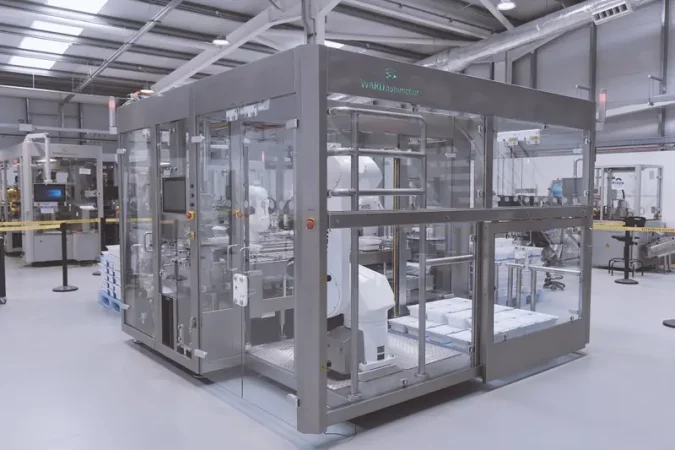
The final stage of the process is handled by a larger Stäubli RX160L robot, which stacks the completed trays onto pallets in preparation for shipping. This automated palletizing operation ensures consistent stacking patterns while maintaining the high throughput required by the production line.
By integrating palletizing directly within the robotic cell, the system eliminates manual handling at the end of the line and maintains the integrity of the packaged product.
Hygienic Design for Pharmaceutical Production
One of the key reasons the pharmaceutical manufacturer selected Stäubli robots was their suitability for hygienic production environments. The robots used in the system are the Humid Environment (HE) versions, which are specifically designed to withstand frequent wash-downs with aggressive cleaning agents.
Their sealed construction protects internal components while preventing contamination, making them well suited for pharmaceutical and medical device production facilities where cleanliness and reliability are paramount.
Flexible and Adaptable Operation
The robotic cell was also designed with flexibility in mind. Pharmaceutical production lines often need to accommodate different packaging formats, and the system can be quickly configured for different tray sizes and product quantities.
The machine is capable of handling both three-inch trays containing 100 syringes and four-inch trays holding 160 syringes, all within the same compact footprint. This adaptability allows manufacturers to respond to changing production requirements without major equipment modifications.
Advanced control systems and virtual programming techniques also contributed to the system’s development. By simulating robotic movements and workflows during the design phase, engineers were able to optimise cycle times and ensure the system would meet the required throughput before installation.
Reliable High-Speed Inspection
Since its implementation, the automated cell has enabled the manufacturer to perform fully automated inspection of syringes, labels and tamper-evident seals at high speed. Defective syringes can be identified immediately, replaced, and reintegrated into the production process without disrupting the overall workflow.
The combination of machine vision, robotic precision and automated traceability has significantly improved productivity while ensuring compliance with strict pharmaceutical quality standards.
Automation Supporting Pharmaceutical Quality
As pharmaceutical manufacturers continue to increase production volumes, automation is playing an increasingly important role in maintaining quality and compliance. The robotic cell developed by Ward Automation demonstrates how high-speed robotics and intelligent inspection systems can work together to deliver both efficiency and reliability.
By integrating inspection, labelling and palletizing within a single automated system, the manufacturer can now process 36,000 syringes per hour while maintaining full traceability and quality control—an example of how advanced automation is transforming end-of-line operations in pharmaceutical manufacturing.
For more information: www.staubli.com