Apera Evolves 4D Vision Robotics
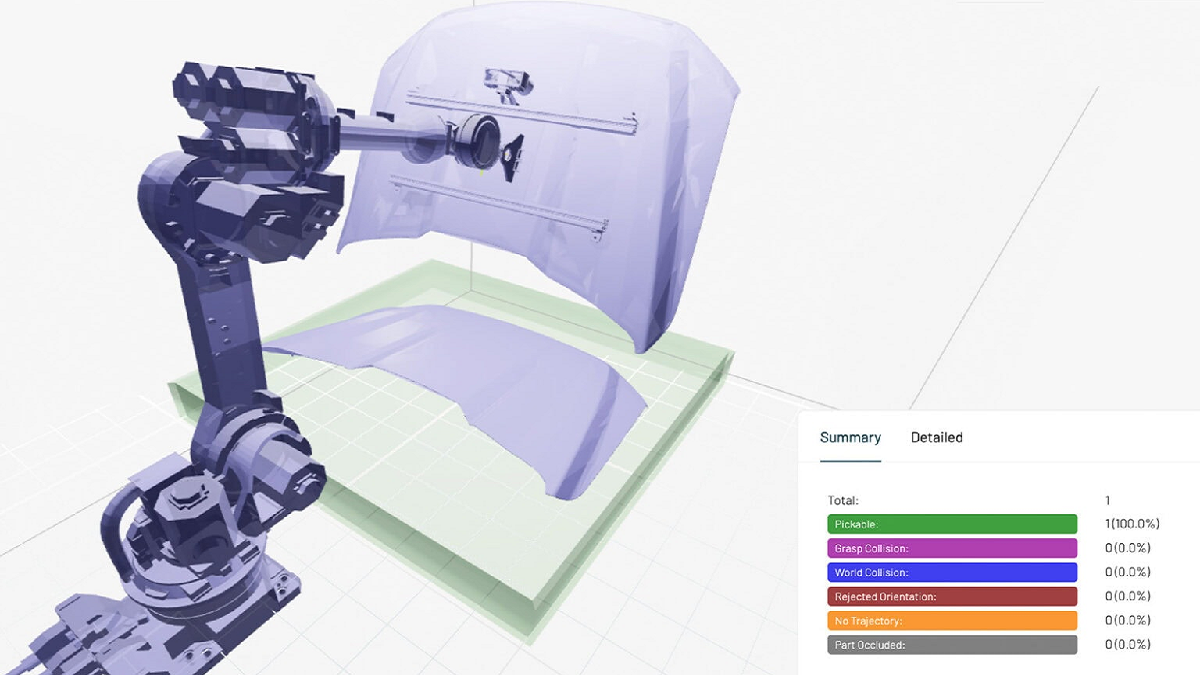
Apera AI has introduced a major update to its 4D Vision-guided robotics platform, releasing Apera Vue 9.52 alongside significant performance upgrades to its Apera Forge simulation and AI training environment. The new release focuses on three areas that remain persistent bottlenecks in robotic automation: motion control precision, deployment speed, and diagnostic visibility into robot performance.
As manufacturers continue pushing toward higher uptime and more autonomous production, vision-guided robots are increasingly expected to operate not just accurately, but predictably and at high speed in dynamic environments. Apera’s latest release positions 4D Vision as a core enabler of that shift from ‘working automation’ to ‘optimized automation’.
According to Apera AI, its 4D Vision system enables robots to achieve up to 10× faster vision processing and greater than 99.9% reliability in object recognition and task execution, supporting high-mix, high-variability applications where conventional 2D or 3D approaches struggle.
Greater Control Over Robotic Motion
One of the most notable additions in Vue 9.52 is Programmable Autopilot, an expansion of Apera’s robot guidance tool designed to reduce cycle time while increasing motion predictability and safety.
Rather than treating motion as a largely fixed outcome of vision guidance, engineers can now shape robot trajectories at a granular level. Users can:
- Select Joint (J) or Linear (L) moves for individual motion segments
- Add multiple approach, grasp, and retreat waypoints
- Define motion relative to bins or parts to clear walls and avoid obstacles
This level of control is particularly relevant in dense bin-picking or constrained cells where collision risk, cable management, and mechanical limits all influence real-world performance. By embedding motion strategy into the vision-guided workflow, Apera is effectively tightening the integration between perception and robot kinematics — a key step toward what is often described as ‘physical AI’.
Faster Installation Through Visualized TCP Accuracy
Accurate tool center point (TCP) calibration remains critical to reliable robotic picking, especially in high-precision or tightly packed applications. Vue 9.52 introduces 2D and 3D TCP visualization tools that display discrepancies between the ideal gripper TCP and the actual end-of-arm tooling.
 This visual feedback allows integrators to quickly validate:
- Overall calibration accuracy
- Correctness of gripper CAD models
- Mechanical or mounting inconsistencies
By shortening the iteration loop between calibration, validation, and adjustment, this feature directly targets one of the more time-consuming stages of system commissioning.
Range Finding for Dynamic De-Racking
For de-racking and similar applications where part position and rack conditions can vary, Apera has added Range Finding Pipelines. These allow the robot to autonomously determine the optimal distance and position before image capture.
Used in conjunction with de-racking pipelines, the system supports more consistent results even with unstructured or shifting racks. The feature is designed for Eye-in-Hand configurations using Apera’s EOAT-mounted VuePort XS cameras, reinforcing the trend toward more adaptive, in-motion sensing strategies.
Built-In Diagnostics for Robot Health
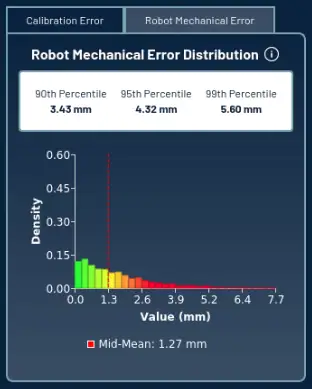
Vue 9.52 also strengthens diagnostic capabilities with a Robot Mechanical Error Histogram generated during hand–eye calibration. The histogram exposes intrinsic mechanical errors, giving operators immediate insight into whether a robot may require mastering or quick-mastering.
This shift toward embedded performance diagnostics aligns with broader smart manufacturing goals, where vision systems not only guide motion but also serve as sensors for robot condition and cell health.
Additional workflow improvements include:
- An Auto-Configure Cameras button to simplify network setup
- Automatic detection of the Apera pattern board during calibration
Simulation-to-Deployment: Apera Forge Accelerates AI Training
On the development side, updates to Apera Forge address another major constraint in advanced robotic vision: training time. Forge, Apera’s no-code simulation and AI training studio, now delivers up to 4× faster asset training, completing in as little as six hours.
Using synthetic data and digital cycles, Forge trains neural networks to achieve >99.9% reliability in recognition and task performance. A complete vision program can move from simulation to plant-floor readiness in six to 24 hours, significantly compressing the traditional timeline between cell design and production deployment.
More Realistic Structured Training
Forge also introduces a major upgrade to structured training setup, allowing simulation environments to more closely mirror real robotic cells. Users can now:
- Configure loosely or tightly structured bins
- Auto-fill bins or place parts individually
- Generate 2D or 3D grids and patterns
- Define multiple structures with different origins and part orientations
This added realism improves consistency between simulation results and real-world performance, reducing the gap that often appears when moving from digital validation to physical systems.
From Vision System to Production Enabler
Taken together, the Vue 9.52 and Forge upgrades show a clear strategic direction: reducing friction at every stage of the automation lifecycle — from design and training, to installation, to ongoing optimization and diagnostics.
By combining finer motion control, faster AI training, and deeper visibility into robot mechanics, Apera AI is positioning 4D Vision not as an add-on sensor layer, but as a central intelligence layer that helps transform underperforming robotic stations into high-speed, reliable production assets.
For manufacturers facing labor constraints, rising quality expectations, and pressure to increase line throughput, tools that shorten deployment time while improving predictability and uptime may prove as valuable as raw vision performance itself.
For more information: www.apera.ai