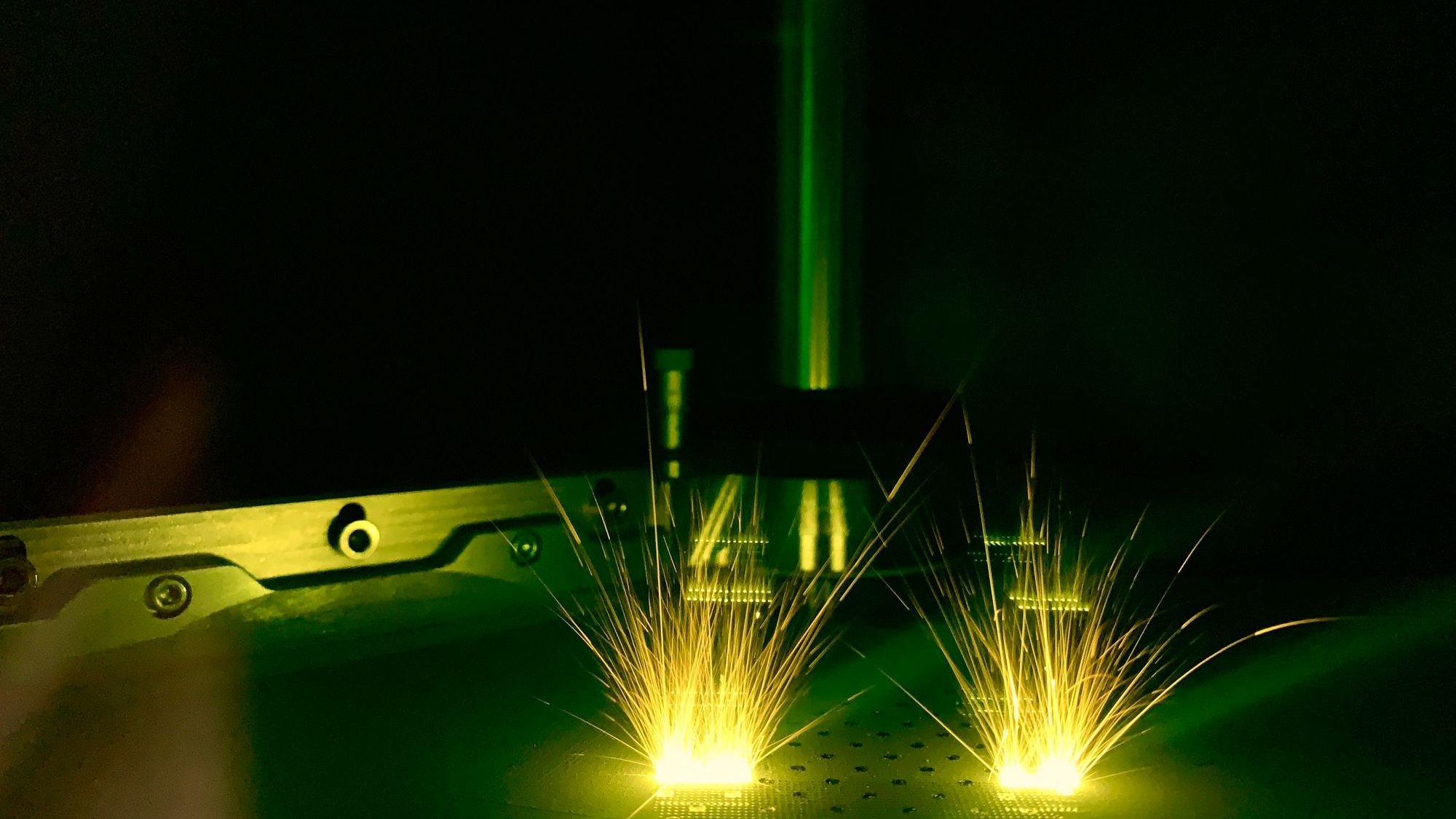
AI Brings Real-Time Intelligence to Metal Additive Manufacturing
Metal additive manufacturing has promised design freedom and production agility for more than a decade. Yet for all its progress, one uncomfortable truth remains: metal AM still struggles to deliver the level of process predictability and quality assurance that high-value industries demand. Scrap rates remain high, qualification cycles are long, and confidence in repeatability is often hard won.
Against this backdrop, the recent work by researchers at University College London (UCL) feels less like another incremental research project and more like a signal of where metal AM is heading. By applying artificial intelligence to in-process monitoring data, the team is tackling one of the sector’s most persistent weaknesses – its inability to reliably see, understand, and react to what is happening during the build itself.
Seeing The Problem Too Late
In conventional metal AM workflows, quality is still largely judged after the fact. Parts are scanned, sectioned, or destructively tested once the build is complete. If a defect is found, the opportunity to correct it has long since passed. The result is wasted time, wasted material, and limited learning that can be applied to the next build.
Process monitoring systems have existed for years, producing high-speed images, thermal maps, and sensor signals from the melt pool. But data alone does not equal insight. Without intelligent interpretation, manufacturers are left with terabytes of information and very few actionable decisions.
This is the gap UCL’s work seeks to address.
From Data Overload to Decision-Making
At the heart of the UCL approach is an inspection process built around in-situ X-ray imaging, shifting quality assessment from surface observation and post-build verification to direct visualization of subsurface phenomena during the build itself. Using high-speed X-ray radiography, researchers capture images of the melt pool and surrounding material as metal is deposited, revealing internal dynamics that are invisible to conventional optical or thermal sensors. These X-ray images provide real-time insight into keyhole behaviour, pore formation, and lack-of-fusion events as they develop.
The captured X-ray data is analysed using the neural network AM-SegNet, which has been trained to rapidly segment and classify features within each frame. Rather than treating inspection as a binary pass–fail exercise, the system interprets complex internal process signatures and links them to known defect mechanisms. From a metrology perspective, this represents a shift toward physics-informed, in-process inspection—where internal quality is assessed as it is being created, using reference-grade X-ray measurements to inform future process control strategies, rather than being inferred after the part is complete.
What makes this approach compelling is not simply its technical sophistication, but its practicality. The model is designed to operate at production-relevant speeds, meaning it can realistically be deployed on industrial machines rather than confined to laboratory demonstrations.
For metrology professionals, this represents a shift in mindset. Measurement is no longer just about verifying a finished part—it becomes an active participant in the manufacturing process itself.
Redefining Quality Assurance in AM
If metal AM is to mature into a true production technology, quality assurance must move upstream. AI-driven, in-process monitoring offers exactly that: the ability to generate quality-relevant data as the part is being built.
This does not replace traditional metrology techniques such as coordinate measurement, surface inspection, or X-ray CT. Instead, it complements them. By reducing uncertainty earlier in the process, manufacturers can focus downstream inspection where it adds the most value, rather than using it as a safety net for an unstable process.
More importantly, in-process intelligence lays the foundation for a continuous digital thread – linking design intent, process parameters, in-situ measurements, and final part verification. For sectors facing stringent regulatory requirements, this traceability could be just as important as dimensional accuracy itself.
Road to Closed-Loop Control
Perhaps the most transformative implication of UCL’s work lies in what comes next. Once a system can reliably detect instability, the logical next step is to respond to it automatically. Closed-loop control, where laser power, scan speed, or material feed are adjusted in real time, has long been discussed as the holy grail of additive manufacturing.
AI-based monitoring brings that vision closer to reality. Instead of relying on static parameter sets, machines could adapt dynamically to changing conditions, improving consistency from layer to layer and build to build.
For metrology, this evolution challenges traditional boundaries. Measurement, control, and manufacturing begin to converge into a single, data-driven ecosystem.
Challenges That Cannot Be Ignored
Despite its promise, AI-driven monitoring is not a silver bullet. Machine-learning models are only as good as the data used to train them. Achieving robustness across different machines, materials, and geometries remains a significant challenge.
There are also open questions around validation and standards. How should in-process AI measurements be calibrated? How are decisions made by algorithms audited and certified? These are issues the metrology community will need to address as such systems move from research to routine use.
Sign of Things to Come
The work emerging from UCL underscores a broader trend: quality in additive manufacturing is shifting from inspection-led assurance to intelligence-led control. AI is becoming a critical enabler in that transition, turning raw sensor data into meaningful, actionable knowledge.
For an industry still seeking industrial-scale confidence, that shift may prove decisive. Metal additive manufacturing will not earn its place in production by geometry alone – it will do so by demonstrating control, repeatability, and trust. AI-driven in-process metrology may be one of the most important tools in making that happen.
For more information: www.ucl.ac.uk