Advanced Vibrometry Sets New Benchmarks for Acoustic Analysis of Electric Drives
As electric motion increasingly become the primary drive technology in passenger vehicles, the expectations placed on their performance extend well beyond efficiency and power density. Acoustic behavior has emerged as a decisive factor in the perceived quality of electric vehicles (EVs). Unlike internal combustion engines, whose noise signatures are familiar and often masked, electric drives operate more quietly making previously negligible sounds and vibrations far more noticeable to occupants.
To address this challenge, numerical simulation methods for predicting and optimizing acoustic behavior are now used very early in the development of electric drives. However, while simulation tools have advanced significantly, their predictive capability remains limited in one critical area: damping. In particular, accurately modeling the structural-dynamic response of electric machines across a wide frequency range remains difficult. As a result, efficient and precise measurement methods are essential – not only to understand real vibration behavior, but also to validate and improve numerical models.
A Wideband Acoustic Challenge
Electric drives generate acoustic excitations across the entire audible frequency spectrum. Beyond the low- and mid-frequency vibrations associated with mechanical rotation, modern power electronics introduce high-frequency forces and noise components in the kilohertz range. These higher-frequency effects are often perceived as especially unpleasant – manifesting as whining, tonal noise, or high-pitched buzzing.
From an experimental perspective, this creates a complex measurement challenge. High-frequency vibrations require a dense spatial resolution to accurately reconstruct deflection shapes and mode patterns. At the same time, the mechanical structures of electric machines can exhibit non-linear behavior, further complicating interpretation. Traditional contact-based sensors can struggle under these conditions, as they may influence the dynamics of lightweight structures or simply lack the spatial coverage needed.
Optical Vibrometry as a Solution
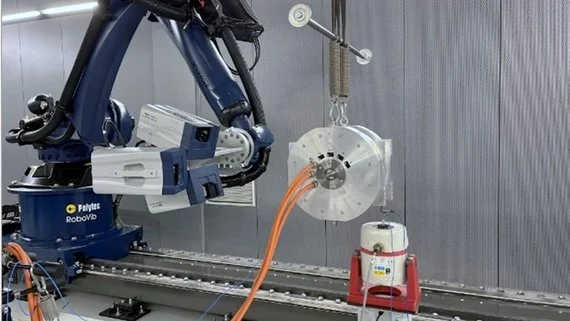 Polytec’s robot-assisted 3D laser Doppler vibrometers offer a compelling answer to these challenges. By relying on an entirely optical measurement principle, laser Doppler vibrometry eliminates mass loading and minimizes the influence of the test setup on the measurement results. Crucially, it enables the acquisition of vibration data at an almost unlimited number of measurement points – a prerequisite for analyzing complex mode shapes at higher frequencies.
The latest generation of laser Doppler vibrometers equipped with QTec technology further enhances performance by delivering a significantly increased signal-to-noise ratio. This improvement reduces measurement time, extends the evaluable frequency range into the higher kilohertz domain, and enables more reliable damping estimation—an area where both simulations and conventional measurements often fall short.
Experimental Modal Analysis in Practice
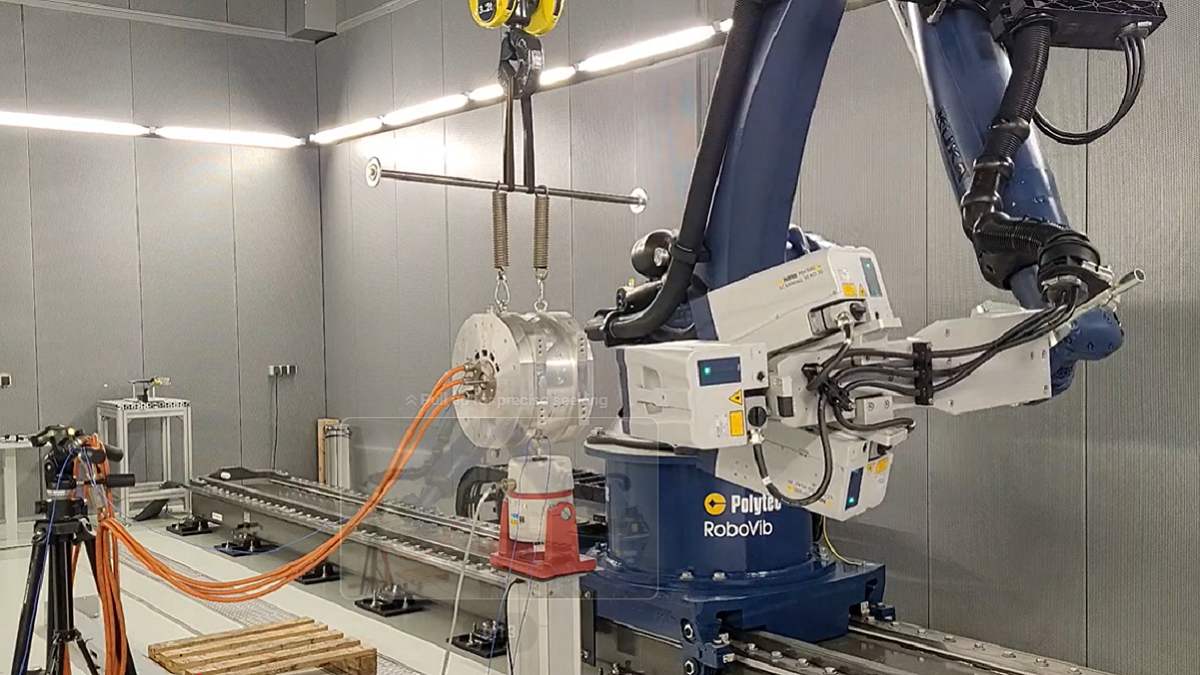
These capabilities are demonstrated through the experimental modal analysis of an electric drive carried out at Polytec’s fully automated RoboVib test center. The goal of the investigation is to characterize the structural-dynamic transmission behavior of the drive – describing its natural frequencies, mode shapes (eigenvectors), and damping—and to compare the results with numerical simulation models.
To ensure realistic and repeatable boundary conditions, the electric drive is elastically suspended using springs. This suspension minimizes external influences while allowing the structure to vibrate freely. The stiffness of the springs is carefully selected so that the suspension’s natural frequency is well separated from the first expected natural frequency of the machine itself. This approach ensures that the suspension has minimal impact on the measured damping behavior of the drive.
Controlled Excitation Strategies
A key aspect of experimental modal analysis is the controlled excitation of the structure. In the RoboVib test center, several excitation methods and signal types are available to suit different investigation needs. The study explores excitation using an LDS shaker driven by pseudo-noise and white noise signals, as well as excitation using an automatic modal hammer from NV-Tech.
When employing the automatic modal hammer, thin hardened steel plates are attached at the excitation points to prevent plastic deformation of the machine housing. These excitation points are not chosen arbitrarily; instead, they are determined in advance using specially developed methods that take into account the test boundary conditions within the numerical model. This ensures optimal energy input into the structure and improves the quality of the measured frequency response functions.
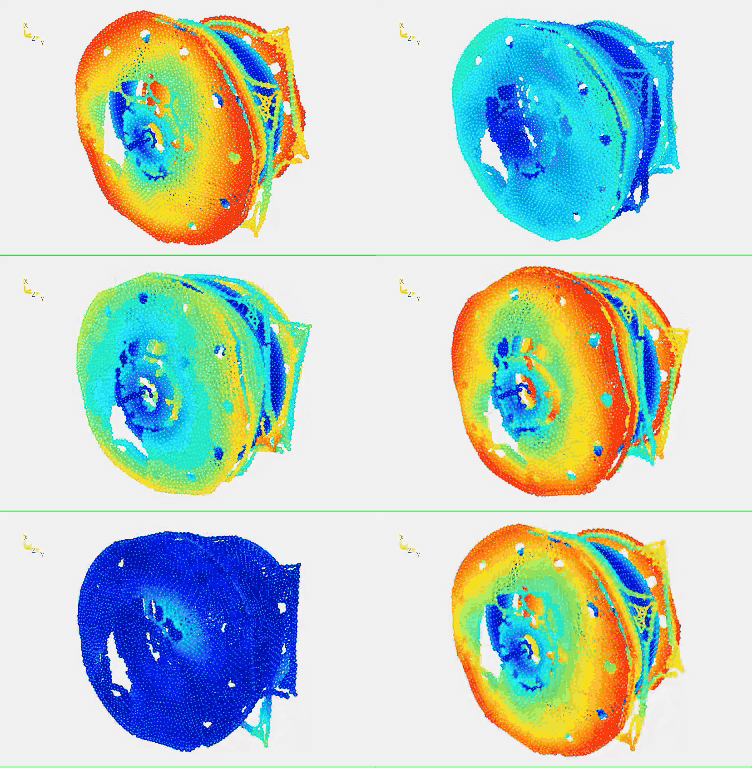
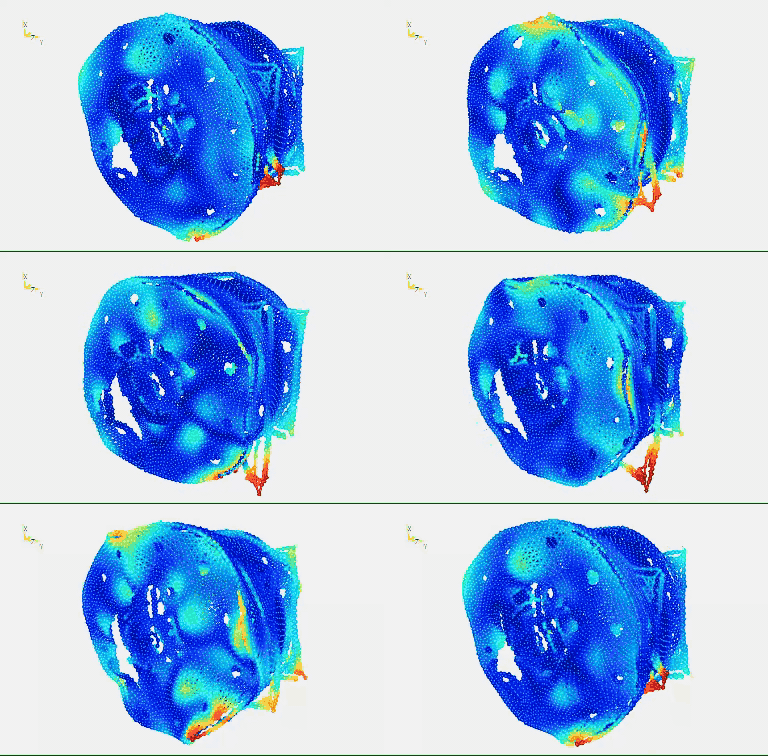
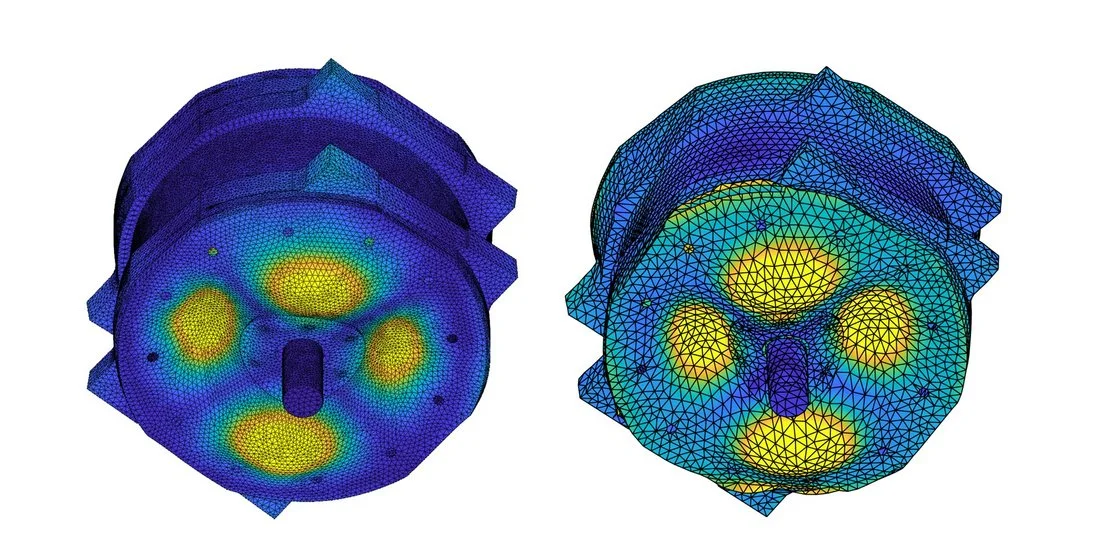
The test setup makes it possible to carry out an experimental modal analysis of the electrical drive up to 12 kHz. The illustrations show deflection shapes at selected resonance frequencies..
High-Density Automated Measurement
Measuring the vibration response of an electric drive presents additional complexity due to its curved and geometrically intricate surface. To maintain optimal laser incidence and signal quality, multiple positions of the vibrometer are required. In this case, two different laser Doppler vibrometers, the PSV Xtra and the PSV QTec, are used.
The RoboVib measurement system handles this complexity through full automation. The robot repositions the vibrometer with high repeat accuracy, performing measurements from a total of 17 different positions to capture the complete vibration behavior of the machine. This automated approach not only ensures consistent data quality, but also makes it practical to acquire the large number of measurement points required for high-frequency analysis.
Beyond Simulation: Measurement Still Matters
One of the most important outcomes of the study is the correlation between experimental results and numerical models. While simulations can capture general trends in vibration behavior, the comparison clearly shows that current calculation methods are unable to describe the vibration response of electrical machines with high accuracy across the entire frequency range—particularly when it comes to damping.
This finding underscores a critical reality for electric drive development: numerical methods, while indispensable, cannot yet fully replace physical measurement. High-fidelity experimental data remains essential, both to validate models and to guide improvements in simulation methodologies.
Setting New Standards for Acoustic Analysis
Robot-assisted 3D laser Doppler vibrometry represents a significant step forward in the acoustic analysis of electric drives. Complete automation enables the dense spatial measurements required for high-frequency investigations, while the optical, non-contact approach minimizes test setup influence. The enhanced signal-to-noise ratio provided by QTec technology reduces measurement time, extends usable frequency ranges, and delivers more reliable damping estimates.
As electric mobility continues to evolve, so too must the tools used to ensure quality, comfort, and customer satisfaction. By making vibrations visible with unprecedented clarity, advanced vibrometry systems are helping engineers meet the acoustic challenges of next-generation electric drives—and setting new standards for precision in the process.
For more information: www.polytec.com