Active Balancing and Acoustic Monitoring Advance High-Speed Grinding Performance
Recent developments in the grinding machine industry are pushing spindle rotation speeds higher while demanding ever-improving surface finish and geometric accuracy. As these performance thresholds rise, the continuous monitoring and control of vibration has become a critical factor in maintaining process stability, part quality and machine reliability.
In high-precision grinding applications, vibrations generated by mechanical components and the grinding wheel can have a direct impact on surface integrity. Active wheel balancing systems play a central role in mitigating these effects by automatically compensating for wheel unbalance. By reducing vibration intensity at the source, these systems improve surface finish and dimensional accuracy across a wide range of components, including ring gears, input and intermediate shafts, pinions and planetary gear elements. In advanced gear grinding, where the control of tooth twist and surface texture is essential, active balancing ensures consistent process conditions throughout the grinding cycle.
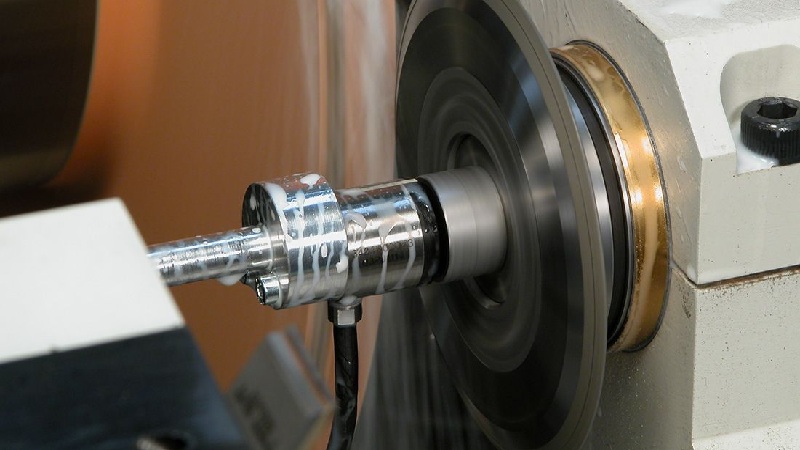
Marposs Dittel wheel balancer systems provide continuous vibration monitoring and real-time compensation, effectively eliminating grinding wheel vibration. This active control capability supports higher spindle speeds while safeguarding surface quality and tool life.
Acoustic Emission Monitoring for Optimised Dressing
As surface quality requirements become more stringent, grinding operations increasingly require more frequent dressing cycles. Managing these cycles efficiently is essential to maintaining wheel integrity and minimising abrasive consumption. Acoustic Emission (AE) monitoring has emerged as one of the most effective technologies for this task.
Marposs Dittel AE ultrasound acoustic sensors monitor and control the dressing process by detecting the acoustic signals generated when the grinding wheel contacts the dresser or the workpiece. By analysing these signals, the system can precisely control material removal during each dressing pass, limiting unnecessary wheel wear and ensuring a consistent wheel surface. Acoustic monitoring also enables the early detection of process anomalies, allowing corrective actions to be taken directly at the machine.
For maximum effectiveness, AE sensors must be positioned as close as possible to the machining area. To achieve this, the sensors can be integrated directly into the wheel balancing head, placing them near the contact point between the grinding wheel and the workpiece or dresser.
OTX: Contactless Transmission for Integrated Control
Because the balancing head is installed inside the spindle, a contactless transmission system is required to supply power and exchange data. The new OTX transmission system has been developed to meet this requirement, combining wheel balancing and acoustic monitoring in a single, high-performance solution.
The OTX system performs two core functions: it drives the balancing masses to correct wheel unbalance based on commands from a Marposs control system, and it detects, processes and transmits the acoustic signals generated by an AE transducer housed in the rotating body.
In OTX-based configurations, BLÚ—the latest modular and distributed monitoring system from Marposs—acts as the supervising controller. BLÚ includes a dedicated node specifically designed for managing OTX transmission. The solution is the result of combined expertise from Marposs and Dittel in wheel balancing and acoustic emission monitoring.
The balancing process begins with an analysis of wheel unbalance, detected via an accelerometer and an integrated RPM sensor. The control system then applies different balancing strategies, with the algorithms hosted in the supervising electronics. Commands to drive the balancing masses are transmitted contactlessly to the rotating head through the OTX system.
Marposs Dittel balancing systems support both heuristic strategies, used with balancing heads without encoder position feedback, and deterministic strategies, which rely on encoder-equipped heads. The systems are also configurable for single-plane and double-plane spindle layouts.
Simplified Architecture and Enhanced Performance
OTX significantly enhances the capabilities of the conventional MiniCT transmission system by simplifying system architecture and improving performance. In a typical MiniCT single-plane application, three separate nodes are required: an ACC node for accelerometer detection, a WBTX node to drive the transmission, and an AE node for acoustic sensing. With OTX, these functions are consolidated into a single node, as wheel balancing and AE signals are digitalised and transmitted through one cable.
Performance improvements are also achieved through acoustic signal processing directly within the rotor. By sampling and processing AE signals close to the sensor, OTX enables reliable, fully digital transmission to the stator and the BLÚ system, reducing noise and improving signal quality.
Flexibility for Modern Machine Designs
The OTX transmission system is designed to support a wide range of machine configurations. New hardware components are mechanically compatible with existing MiniCT rotor and stator designs (axial diameters of 42 mm and 38 mm), protecting prior investments. Additional configurations are also available, including an axial transmission with a diameter of 32 mm, capable of driving balancing heads down to 24 mm, as well as ring transmission solutions.
The transmission and associated balancing heads are suitable for high-speed grinding applications of up to 30,000 rpm, depending on the specific design. All components incorporate an enhanced embedded diagnostic system that monitors both system health and machining process conditions.
Key Features of the OTX Transmission System
- Optimised system layout
- Single node for wheel balancing transmission (WBTX), acoustic emission (AE) and accelerometer (ACC) channels
- Embedded AE signal processing near the sensor inside the spindle
- FFT analysis with fully digital signal transmission
- Support for heuristic and deterministic balancing strategies
- Single-plane and double-plane spindle management
- Super-compact configurations (down to Ø32 mm transmission and Ø24 mm balancing head)
- Suitable for high-speed applications up to 30,000 rpm
- Compatibility with ring transmission layouts
- Mechanical compatibility with existing MiniCT solutions
- Enhanced diagnostic capabilities
- Availability for both BLÚ and BLÚ LT monitoring systems
By integrating active balancing and advanced acoustic monitoring into a compact, high-speed capable transmission system, OTX addresses the increasing demands of modern grinding applications, supporting higher productivity while maintaining the highest standards of surface quality and process control.
For more information: https://www.marposs.com/eng/application/grinding-machine-monitoring