3D-Printed Tooling Reduces Injection Moulding Costs and Lead Times
The drive to reduce tooling costs and accelerate development cycles has led engineers at AMRC Cymru, UK to explore whether 3D-printed moulds can offer a practical alternative for prototype and low-volume injection moulding. Their latest initiative, the MiniMould project, set out to investigate the challenges surrounding polymer-based additive tooling and build the in-house expertise required to make it a viable manufacturing option.
Supported by nearly £30k of funding from the Internal Capability Project (ICP) 2025 programme, the two-month study grew out of earlier collaborations with Wrexham-based component manufacturer Fibrax. Those previous efforts had revealed a serious barrier: significant geometric deformation, or warping, in a 3D-printed polymer mould. The distortion – introduced during printing, cleaning, and UV curing—was severe enough to render the tool unusable for injection moulding. Understanding the source of these deviations, and how to eliminate them, became the starting point for the MiniMould team.
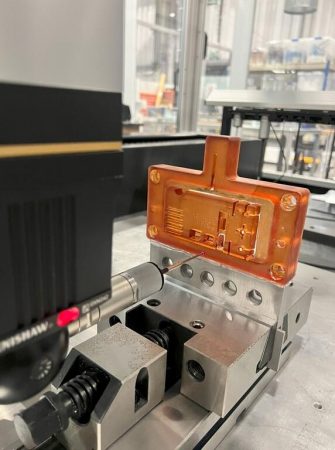 Engineers began with an iterative investigation, researching best practices for minimising distortion in resin 3D printing and measuring the initial reference mould to quantify baseline warping. Process refinements, including a more rigorous cleaning protocol prior to curing, produced immediate improvements in flatness. However, the inherent brittleness of photopolymer resins prompted a strategic shift in direction. The team moved to Selective Laser Sintering (SLS) and selected Nylon 11—a material with much higher elongation—to allow stresses to distribute more uniformly throughout the mould during clamping.
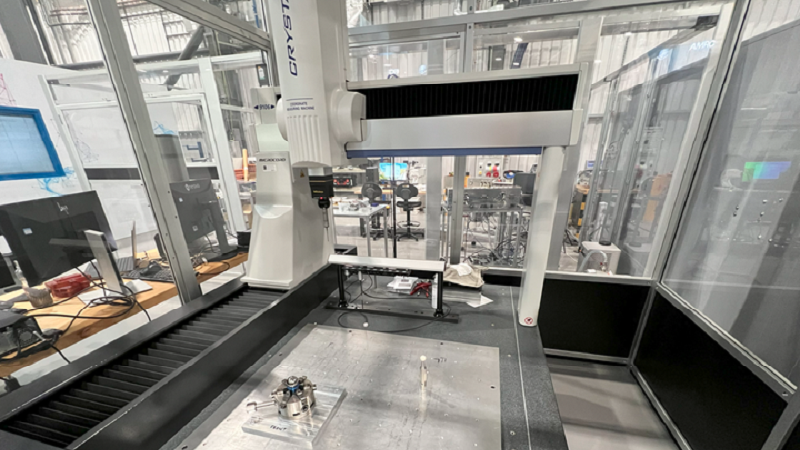
Successive iterations focused on optimising geometry and structural performance. Simplified features, thinner walls, and adjusted flow channels aimed to limit warping while maintaining mechanical resilience. Throughout the development loop, metrology played a crucial role: a Renishaw touch-trigger probe was used to capture detailed coordinate data from internal mould surfaces, verifying alignment to CAD geometry and tracking improvements across iterations.
This structured process ultimately paid off. AMRC Cymru successfully produced a moulded polypropylene part using an SLS-printed mould, demonstrating meaningful progress toward reliable additively manufactured tooling. The findings, however, highlighted the trade-offs inherent in the approach. While the first SLS mould exhibited greater flatness change – around 120% more variation than the resin version—its superior toughness allowed it to better withstand injection moulding clamping forces. Attempts to reduce wall thickness from 7.5 mm to 3 mm helped with warping but introduced structural weakness, leading to mould failure under load. The team also discovered that polypropylene adhered to the SLS mould surface, underlining the need for appropriate release agents, and that simplifying part geometry was essential for consistent results.
The project has demonstrated that 3D-printed tooling can serve as a realistic route for rapid injection moulding, particularly for prototypes and small production batches. More importantly, it has given engineers a deeper understanding of material behaviour, thermal response, and design-for-additive principles that govern performance. These insights outline a clear pathway for industry to reduce both tooling costs and lead times, while pointing to future areas of exploration—including hybrid or metal-plated tooling solutions, improved cooling approaches, and enhanced surface treatments to further bridge the gap between rapid additive tooling and traditional production moulds.
For more information: www.amrc.co.uk