Laser Projection System Redefines Workforce Guidance in Modern Warehousing
Businesses are faced with an increasing shortage of skilled workers. In some industries, like the logistics sector, specialists are so scarce that many companies have to rely on career changers and unskilled workers. What’s more, the sector is characterized by high staff turnover and the need to hire additional temporary staff to be able to handle seasonal peaks. Training new inexperienced staff members in complex work processes can be time-consuming.
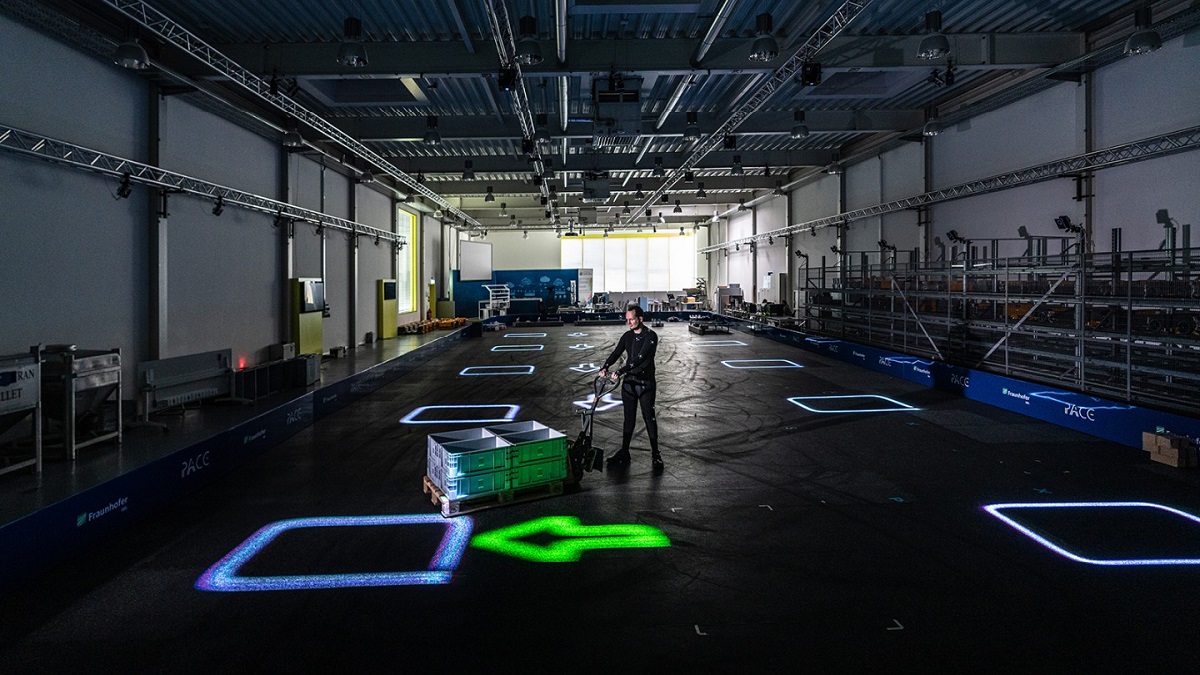
This is where LARS (Laser-AR-Safe) comes in. The laser-based projection system was developed by researchers from the Fraunhofer Institute for Material Flow and Logistics IML to assist staff in intralogistics warehouses with their daily tasks. LARS dynamically and flexibly projects personalized information such as routes, storage locations, signs and order numbers onto the warehouse floor to precisely guide staff members through the warehouse and their work processes in a playful manner.
The required knowledge can be easily shared via the projections themselves, both in initial training and whenever there are any changes to processes. Staff members no longer need to search for goods or remember storage locations. All necessary information is shown in the laser projections.
“In many warehouses, there are now workers who do not speak a lot of German or who have hardly received any training. Our system uses symbols, numbers and colors to visualize the tasks,” says Rico Ahlbäumer, a research scientist at Fraunhofer IML. “Long texts and cryptic pick tickets are replaced with clear, immediately comprehensible information on the floor.” A blue arrow, for example, might point the way to the correct platform, while a green square indicates the place where a pallet should be set down. “Communication of information using light could replace floor markings in warehouses in the future,” the researcher explains.
Human-Centered Approach
The modular and scalable guidance system combines hardware and software: The laser projectors are mounted to the ceiling or attached to high racks. The system is compatible with up to 200 projectors per warehouse. However, only five lasers are needed for projecting information in an area that is around 30 meters wide and can feature up to twelve lanes. The size of the area covered by the projectors depends on the ceiling height of the warehouse. An integrated beam expander lens ensures that the projected light is safe for the eyes, and the brightness and diffusion of the light can be adjusted. There are no limits when it comes to the projected colors and shapes. A software is used to control the projectors, while another application, developed by Ahlbäumer and his team, enables projection of the images onto the floor. LARS can be integrated into a wide range of different logistics systems and is usually monitored by the warehouse manager.
In their work on LARS, the researchers have been following a human-centered approach to addressing specific problems that is based on requirements of staff members. Operational scenarios include picking and consolidation of orders, as well as palletizing and sorting. It is also feasible that LARS could be used as a shop floor navigation system.
The Fraunhofer IML researchers have carried out a successful field test at the Rhenus Logistics premises in which LARS demonstrated its effectiveness and operational efficiency. LARS is able to support multiple staff members simultaneously, making the system an ergonomic, scalable solution for modern working environments. “The area of intralogistics is becoming ever more complex, due to various factors such as shorter delivery times, smaller batch sizes, growing product ranges and the shortage of skilled workers. LARS is a flexible tool that logistics and production companies can use to respond to these challenges,” Ahlbäumer says.
For more information: www.iml.fraunhofer.de